

Screenrec
About Screenrec
ScreenRec is a screen recorder built around one idea. The moment you stop recording, a private link to the video is already on your clipboard, because the file was uploading while you were still talking. Everything else in the application, the region selector, the microphone and system sound toggles, the webcam overlay, the screenshot annotator, exists to feed that link.
That puts it in a different corner of the market from the recorders people usually compare it with. OBS and Bandicam are about the file on your disk and how much control you get over it. ScreenRec is closer to Loom or Gyazo, where the recording is a message you send rather than a project you edit.
If that distinction sounds trivial, try emailing a 400MB MP4 to a client and then try pasting a URL.
Alt+S, draw a box, pick video or picture
Capturing starts with Alt+S from anywhere. The screen dims, you drag a rectangle over the part you want, and a small toolbar appears at the bottom left of the selection with two choices, take a picture or record a video. There is no project window to open first, no preset to pick, no encoder to configure.
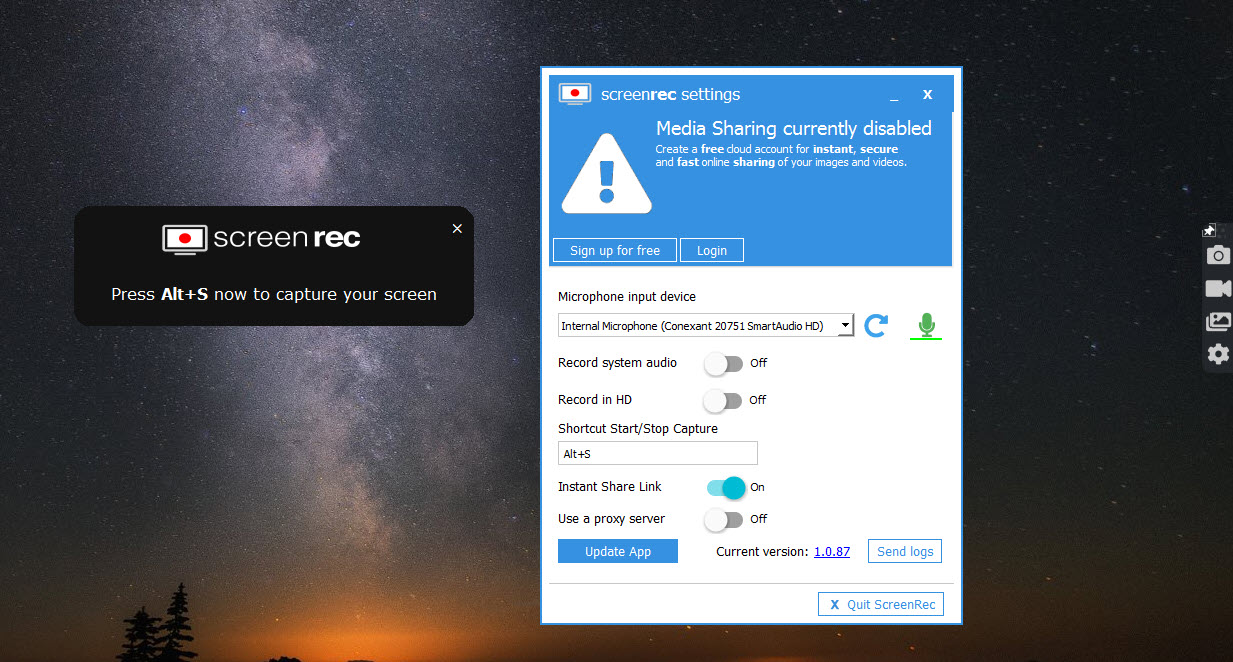
The selection can be any region on any monitor, and the floating quick menu can be parked on whichever screen you like, which matters more than it sounds on a three-monitor desk. A mouse cursor highlight can be switched on in Settings so viewers can follow your pointer.
That is the full extent of the on-screen effects, so if you wanted click ripples, zoom-and-pan or keystroke overlays, ShareX does all of it and ScreenRec does none.
Recording quality, frame rate and the five-minute wall
Quality comes in SD, HD and 4K, and the encoder will run at up to 120 frames per second on hardware that can keep up. In practice HD at the default frame rate is what nearly everyone uses, and it is smooth on ordinary laptops without a fan spinning up.
Two limits define the experience. Without signing in, every recording stops dead at five minutes. Create an account and that cap disappears entirely. The second limit never goes away, which is that a recording is a single unbroken take. There is no pause, so a phone call mid-tutorial means starting over, and there is no built-in trim afterwards to lose the awkward first three seconds. You download the MP4 and cut it elsewhere.
For a two-minute bug report that is irrelevant. For a twenty-minute lecture it is the reason to look at something else.
Microphone, system sound and webcam in the same take
ScreenRec records the microphone, the computer’s own audio output, or both, and the toggles on the docking menu can be flipped while the recording is running. System sound capture works without the loopback device juggling that makes a recorder built around grabbing computer audio a common recommendation, and a fix for crackling on that channel landed a while back, so it is clean now.
The webcam records on its own or as a facecam overlay pinned to one corner, with no way to move or resize it mid-take, so it suits a talking-head walkthrough and little else.
The link is ready before you stop recording
Video is uploaded to your hosted space as it is captured, so pressing stop hands you a finished URL rather than a progress bar. The link is private by default, meaning only people who have it can watch, and the recording is stored with 128-bit AES encryption.
From the web side you can add a password, restrict playback to specific viewers, and see who opened the video and how far they got. That last part is the feature support teams end up living on, because it answers whether the customer watched the fix before they replied.
If the connection drops mid-recording, the upload queues and resumes when you are back online, and a local copy is written to disk regardless. Long recordings are where this gets fragile. Reports of uploads that sit at a spinning icon for an hour, or a video that blacks out partway through a long session, are consistent enough to take seriously. Gyazo has the same instant-link model and fewer of those complaints, but it also caps clips far shorter.
Screenshots and the annotation tools
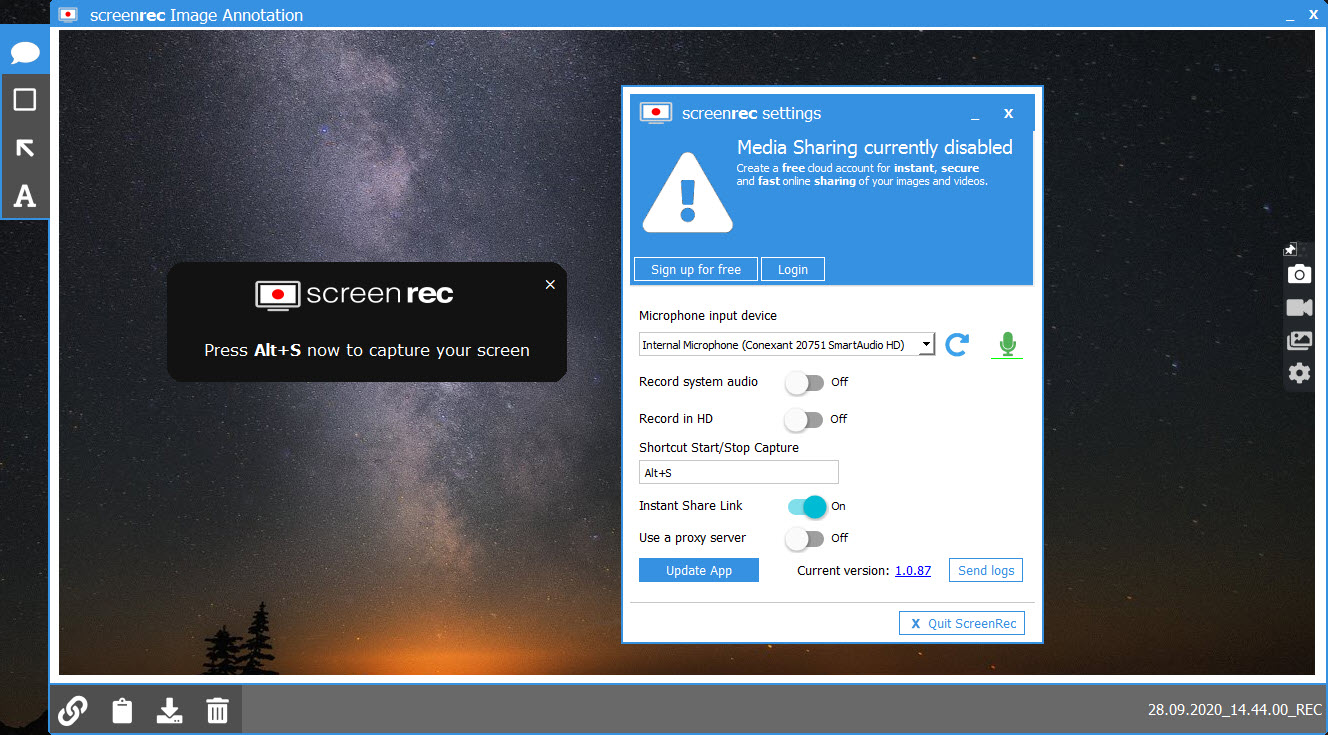
Picking picture instead of video drops the capture into an editor with text, arrows, rectangles, ellipses and a point-and-comment tool that attaches a numbered marker to a note. The tools are enough for “click here, then here” instructions and the result uploads to the same private link system as video. What you do not get is a blur tool for hiding sensitive details, a scrolling capture for long pages, or any way to annotate a video after the fact.
Anyone who spends their day producing documentation screenshots will hit those gaps fast and will be happier pairing this with a screenshot tool with a full annotation editor and keeping ScreenRec for the videos.
Recording History and living inside 2GB
Recording History lists every capture you have made, with search by title, sorting by date, name or size, and a filter for videos or images. Each entry offers the sharing link, a Save button that writes the MP4 or PNG to a folder of your choosing, and a delete that asks for confirmation. Local copies stay on disk even after you delete the hosted one, which matters because a ten-minute HD recording runs to a few hundred megabytes and the account holds perhaps an hour of video before uploads stop.
There is no automatic expiry and no warning before you hit the wall, so treat the hosted space as an outbox, not an archive.
Conclusion
ScreenRec is for people whose recordings are messages. Support staff explaining a fix, a team lead reviewing a design, a teacher answering one student’s question, anyone who would otherwise type four paragraphs and hopes the other person actually watches. For that job the instant link, the viewer analytics and the on-the-fly audio toggles make it faster than anything with a proper editor attached.
It is a poor fit for anyone making content meant to last. The missing pause and trim, the single output format and the storage ceiling all point the same direction, which is that the application wants your video watched this week and forgotten next month. Know that going in and it delivers exactly what it promises.
Pros & Cons
- Sharing link is on the clipboard the instant a recording stops
- Microphone and system sound can be muted or unmuted mid-recording
- Password protection and viewer analytics on every hosted video
- Records any region on any monitor with the quick menu docked wherever you want
- Recording History keeps local copies even after hosted files are deleted
- No pause during recording and no trimming afterwards
- Five-minute cap on every recording until you sign in
- 2GB of hosted storage with no expiry policy and no warning before it fills
- Long recordings can stall in the upload queue or drop frames
- Annotation lacks a blur tool and scrolling capture
Frequently asked questions
Because you are not signed in. Recordings made without an account are capped at five minutes. Sign in from Settings and the limit is removed.
Yes. Both sources can be enabled together, and either one can be muted or unmuted from the docking menu while the recording is in progress.
Yes. Every video and screenshot is written to disk as well as uploaded, and the Save button in Recording History exports it as an MP4 or PNG wherever you choose.
No. The application has no trimmer or editor. Download the MP4 and cut it in a separate video editor, then share that file instead of the hosted link.
New captures still record and save locally, but they will not upload or generate a sharing link until you delete older hosted items from Recording History.


I mostly use it for office communication. Despite drafting long emails, record your message and send the link to your colleague. Super easy!
If we compare it with other free screen recorders, ScreenRec stands out because it is light, its user interface is very simple, and above all, it gives free cloud storage of 2 GB absolutely free.
ScreenRec also works with Linux really well. I have tried using it on Windows 10 and Linux worked really well on both OS.
I have used OBS and Bandicam extensively but I have found ScreenRec to be the most convenient. It’s lighter than them of them and does not lag in any situation. Also it’s free and doesn’t leave any watermarks on your recordings.
For my professional use, I have always used ScreenRec, a lightweight screen recorder perfect for low-end PCs. It’s compatible with Windows and Linux, and I don’t have to pay a dime to use any of its premium features, including cloud storage.