

Auslogics Disk Defrag


About Auslogics Disk Defrag
Auslogics Disk Defrag is a defragmenter for mechanical hard drives that does more than glue scattered files back together. It also moves system files toward the fastest part of the disk and packs the unused space into one block, so new files have less reason to fragment in the first place. A coloured cluster map shows the whole operation live, block by block.
It sits in a small field of dedicated defraggers that people install instead of the built-in tool, mostly for control. You choose what gets defragmented and how deeply, you can run it when the PC is idle, and you can target a single folder instead of a whole drive. That control is the reason to pick it.
Three modes, three very different run times
The main buttons in Auslogics Disk Defrag hide three jobs that are easy to confuse. Defrag analyses the drive first, then reassembles fragmented files. Quick Defrag skips the analysis and gets straight to work, which suits a drive you already know is lightly fragmented. Defrag & Optimize is the heavy option.
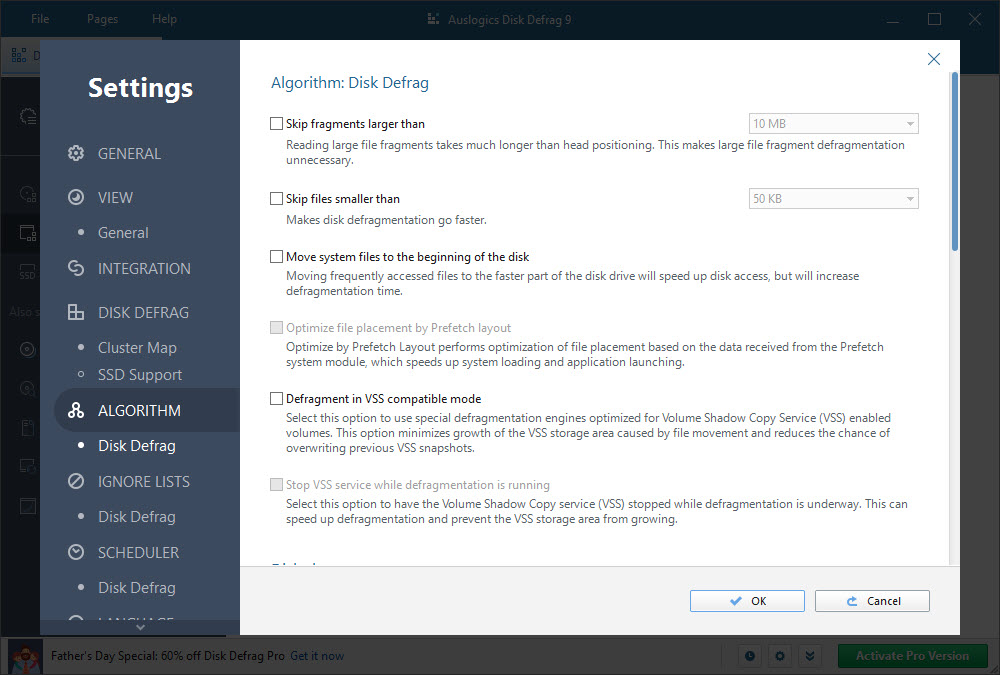
That last mode reorganises the disk instead of just repairing it. Frequently used system files are moved to the outer zone of the platter, where reads are fastest, and unused space is consolidated so it sits in one block. On a large, cluttered drive it can run for hours, which is exactly what users complain about on forums.
Run it overnight, or once after a big cleanup, and use plain Defrag the rest of the time. If you prefer a lighter tool that does one job, Defraggler keeps things simpler.
A cluster map and a list of the worst offenders
The cluster map is not just decoration. Each square stands for a group of disk clusters, and its colour tells you whether those clusters hold fragmented files, contiguous files, system files or nothing. Watching it during a run, you see red blocks turn blue as files are rewritten in one piece.
After analysis, Auslogics Disk Defrag also lists the most fragmented files, with their fragment counts and sizes. That list is often more useful than the overall percentage.
A drive at five percent fragmentation can still hide a database or a game archive split into thousands of pieces, and that one file is what makes loading slow.
Defrag one folder instead of the whole drive
You do not have to defragment everything. Right-click any file or folder in the file manager, or pick one inside the program, and only that item gets rewritten. On a two-terabyte media drive, defragmenting only the folder with your photo catalogue takes minutes instead of an afternoon.
The same precision works in the other direction. Exclusion lists keep specific files and folders out of every run, which is useful for huge virtual machine images or backup archives that would take ages to move and gain nothing from it.
If you are not sure what fills the drive in the first place, a visual disk space analyzer answers that question in seconds, before you decide what deserves defragmenting.
Scheduling and idle-time defragmentation
Auslogics Disk Defrag can run on a schedule (daily, weekly, monthly) or start automatically when the computer has been idle for a set time. Idle mode is the practical choice for most people, because it works in short bursts while you are away and stops when you return.
Resource limits keep it polite. You can cap how much processor time it uses, so a scheduled run on a laptop does not spin the fans up during a video call. There is also an option to shut down the computer when a long run finishes, which pairs well with an overnight Defrag & Optimize pass.
A temporary-file cleanup can run before each defrag as well, so the program is not wasting time moving files you are about to delete.
What it does with solid-state drives
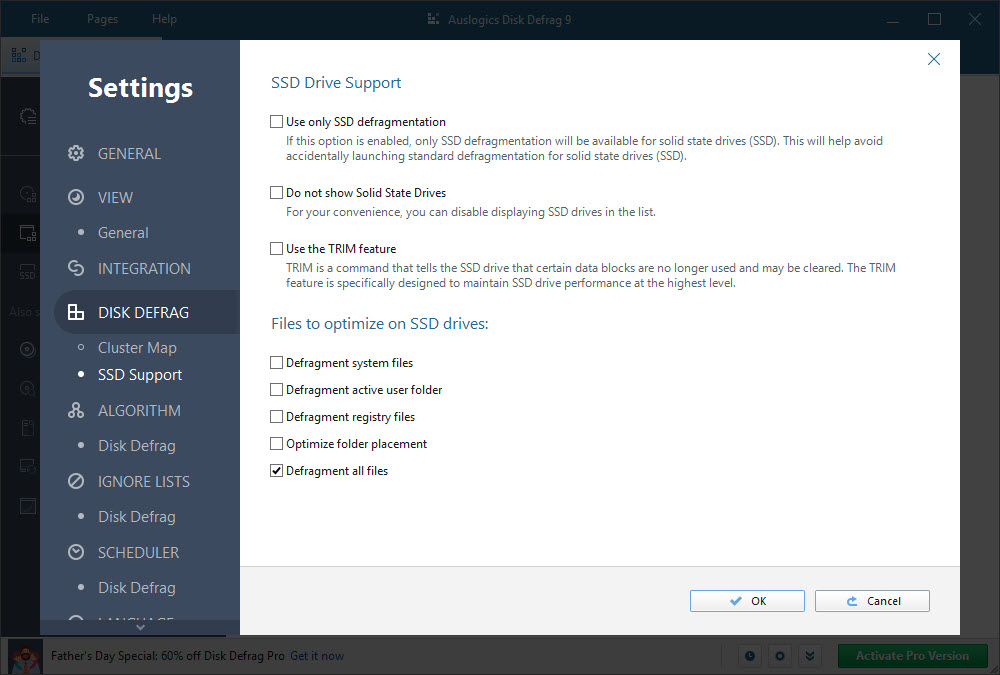
Auslogics Disk Defrag detects SSDs and switches to a different algorithm for them instead of a classic defrag. That matters, because rewriting files on a solid-state drive brings no speed benefit and only adds wear. Forum advice is consistent on this point. Leave SSDs to the system’s own optimisation, and point this tool at mechanical drives.
So treat the SSD handling as a safety net rather than a feature to use. If your system drive is an SSD and your data drive is a hard disk, exclude the SSD and schedule the hard disk alone. For keeping an eye on drive health and wear across both types, CrystalDiskInfo reads the SMART data this program does not show.
Watch the installer
The setup wizard offers extra third-party software on more than one screen, and the boxes are ticked by default. Users have been annoyed by this for a long time, and it is easy to click through without noticing. Read each screen and untick everything that is not the defragmenter itself.
One more surprise lives in the settings. The program can replace the system’s built-in defragmenter, and some installs switch the built-in one off. That is fine if you plan to rely on this tool, but check the scheduled optimisation for SSDs afterwards so it is still running.
For future installations of any software, a tool that unticks bundled offers automatically saves you the vigilance.
Conclusion
Auslogics Disk Defrag suits anyone still running mechanical hard drives, whether as the main disk in an older PC or as a big data drive next to an SSD. Its strengths are control and visibility, from folder-level runs and idle scheduling to a cluster map that shows what actually changed.
Watch the installer, keep it away from SSDs, and save the long optimisation mode for overnight. Used that way, it keeps a busy hard drive noticeably quicker than the built-in tool would on its default schedule.
Pros & Cons
- Defrag & Optimize places system files in the fastest disk zone and consolidates unused space
- Single files and folders can be defragmented on their own
- The cluster map and fragmented-file list show exactly where the problem sits
- Idle-time and scheduled runs with processor limits stay out of your way
- Detects SSDs and avoids a classic defrag on them
- The installer bundles third-party offers that are ticked by default
- Defrag & Optimize can run for hours on large drives
- It may disable the built-in defragmenter, so SSD optimisation needs checking
Frequently asked questions
No. The program detects SSDs and avoids a normal defrag, but solid-state drives gain nothing from it. Let the system handle SSD optimisation and use this tool on mechanical drives.
Because it moves system files to the fastest zone and rearranges the remaining data, not just fragmented files. On a large drive that can mean hours, so run it overnight and use plain Defrag for routine maintenance.
Yes. Right-click the folder in the file manager or select it inside the program, and only that folder is processed.
For most mechanical drives, a weekly plain Defrag or the idle-time mode is enough. Save the full optimisation for after large installs, uninstalls or cleanups.


