

CheckDiskGUI
About CheckDiskGUI
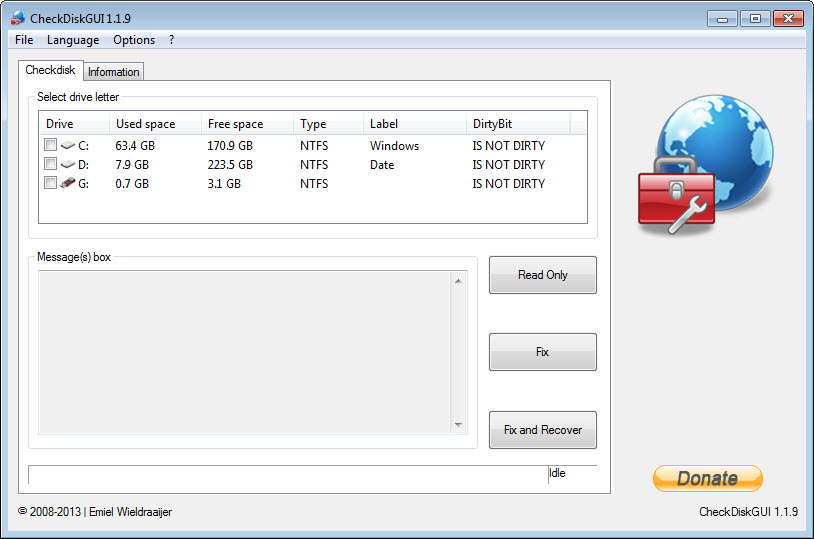
The system’s disk checking tool has always been a command with a handful of switches, and the switches have names that explain nothing to anybody who has not read the documentation. CheckDiskGUI puts them in a window with labels a person can understand, and shows you what came back.
CheckDiskGUI asks you to pick a drive, tick the options you want, and run it. The output appears in the window rather than in a console that closes before you have read it.
That is the entire product, and its value is that it stops people either guessing at switches or avoiding the tool altogether.
What the options actually do
Two CheckDiskGUI settings matter, because one is quick and the other can take all night.
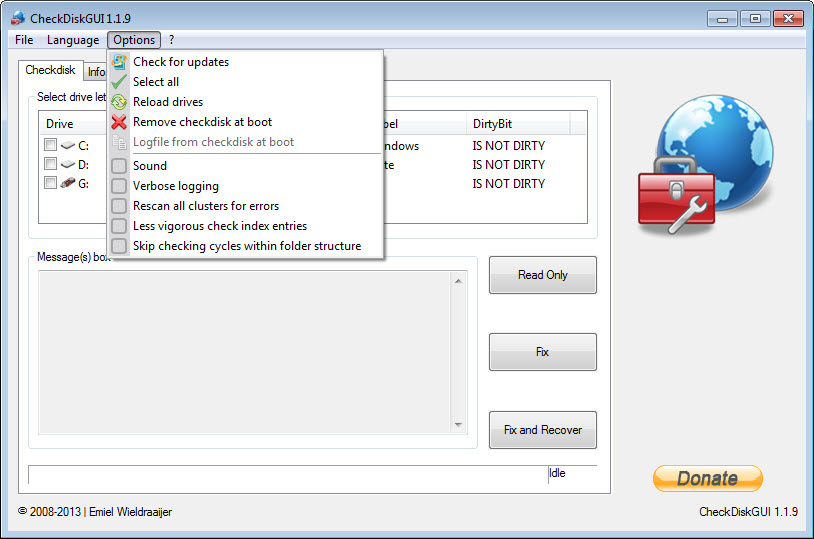
Fixing errors examines the file system’s structure, meaning the records describing where files are and which parts of the drive belong to them, and corrects inconsistencies it finds. On a modern drive that takes minutes.
Locating bad sectors is the other one. It reads every sector on the drive, which on a large disk runs for hours, and moves readable data away from sectors that are failing.
The first is routine maintenance. The second is a serious operation you run for a reason, not because the checkbox was there.
The repair prioritises the file system, not your files
Here is the fact that changes how you should approach CheckDiskGUI, and almost nothing mentions it.
The tool’s job is producing a consistent file system. Where a file’s records are damaged beyond reconciling, the way to achieve consistency is to detach that file from the structure, and what happens to fragments it cannot place is that they end up as numbered files in a recovery folder with no names and no folder structure.
So a repair can leave you with a healthy drive and a missing document. That is not a fault, it is the tool doing what it was designed to do, and the design goal is not the same as yours.
The consequence is an order of operations. If anything on the drive matters and is not backed up, copy it off before repairing rather than afterwards, and Recuva is the tool for what has already gone missing rather than what is about to.
A failing drive is the worst case for a surface scan
The second CheckDiskGUI caution follows from the first and matters more.
A full sector scan puts a drive under continuous read load for hours. On a healthy drive that is unremarkable. On a drive that is physically failing, it is sustained stress at the exact moment you least want it, and drives do die during that process.
So establish which situation you are in before starting. A drive reporting reallocated or pending sectors is telling you it has hardware trouble, and the correct response is copying the data off, not scanning it.
Reading those figures takes seconds, and CrystalDiskInfo shows every health attribute with its trend so the answer is a fact rather than a feeling.
The system drive needs a restart
Something CheckDiskGUI users meet immediately and do not expect.
A drive cannot be checked properly while it is in use, so requesting a check on the drive the system is running from schedules it for the next start rather than doing it now.
That is a limitation of the operation rather than of this front end, and it means a check on the main drive requires a restart and an unpredictable wait while it runs before anything else loads.
Conclusion
CheckDiskGUI makes a properly useful built-in tool approachable, which matters because plenty of people never touch it purely because it lives behind a command and cryptic switches.
Use it in the right order though. A repair aims at a consistent file system rather than at preserving your documents, and a full sector scan is hours of load on hardware that may already be struggling. Check the drive’s health first, copy anything irreplaceable off second, and repair third.
Pros & Cons
- Puts the command's switches in a window with labels that explain them
- Output stays visible instead of vanishing with a console window
- Drive selection from a list rather than typed letters
- Portable and tiny, with nothing installed
- Makes a useful built-in tool reachable for people who avoid command lines
- Repairs the file system's consistency, which can detach files it cannot reconcile
- A full sector scan runs for hours and stresses a drive that may be failing
- Checking the system drive requires a restart
- Reports nothing about hardware health, which is a separate question
- Only exposes what the underlying command already offers
Frequently asked questions
Labels and visible output. The underlying check is the system's own, and this presents its switches in plain language and keeps the results on screen instead of in a console that closes.
It can. The goal is a consistent file system, so a file whose records cannot be reconciled gets detached, with unplaceable fragments left as numbered files carrying no names. Copy anything that matters off first.
No. It reads every sector, takes hours on a large drive, and puts sustained load on hardware. Use it when you have reason to, and check the drive's health figures before starting.
Because the drive the system runs from cannot be checked while in use, so the check is scheduled for the next start. That applies to the underlying tool rather than to this interface.


