

TweakPower
About TweakPower
Suites promising to speed up a computer arrive with a reputation problem earned by the category rather than by any one product. TweakPower belongs to it and does two things its neighbours generally do not, which are worth the review on their own.
It records every change it makes and lets you undo them individually. And its cleaner accepts ignore lists and inclusion lists with wildcards, so what gets removed is something you decide rather than something you discover afterwards.
Those two facts change how much trust the program deserves, because the usual objection to this category is not that the tools are bad but that they act broadly and irreversibly on a system you depend on.
The backup centre is the reason to take it seriously
TweakPower records changes per module. The registry cleaner, the junk file removal, the autostart manager, the registry scan, the plugin cleaner and the privacy settings each keep their own record of what they altered, and each can be rolled back separately.
That matters more than any cleaning capability. A tool that removes four thousand items and offers a single undo is asking you to accept all of it or none, and a tool that lets you reverse only the module that broke something is offering a different proposition entirely.
The dashboard puts a restore point button prominently in view alongside drive health, boot and shutdown timing, system information, which is the correct order of priorities for software that modifies a working machine.
Cleaning you actually control
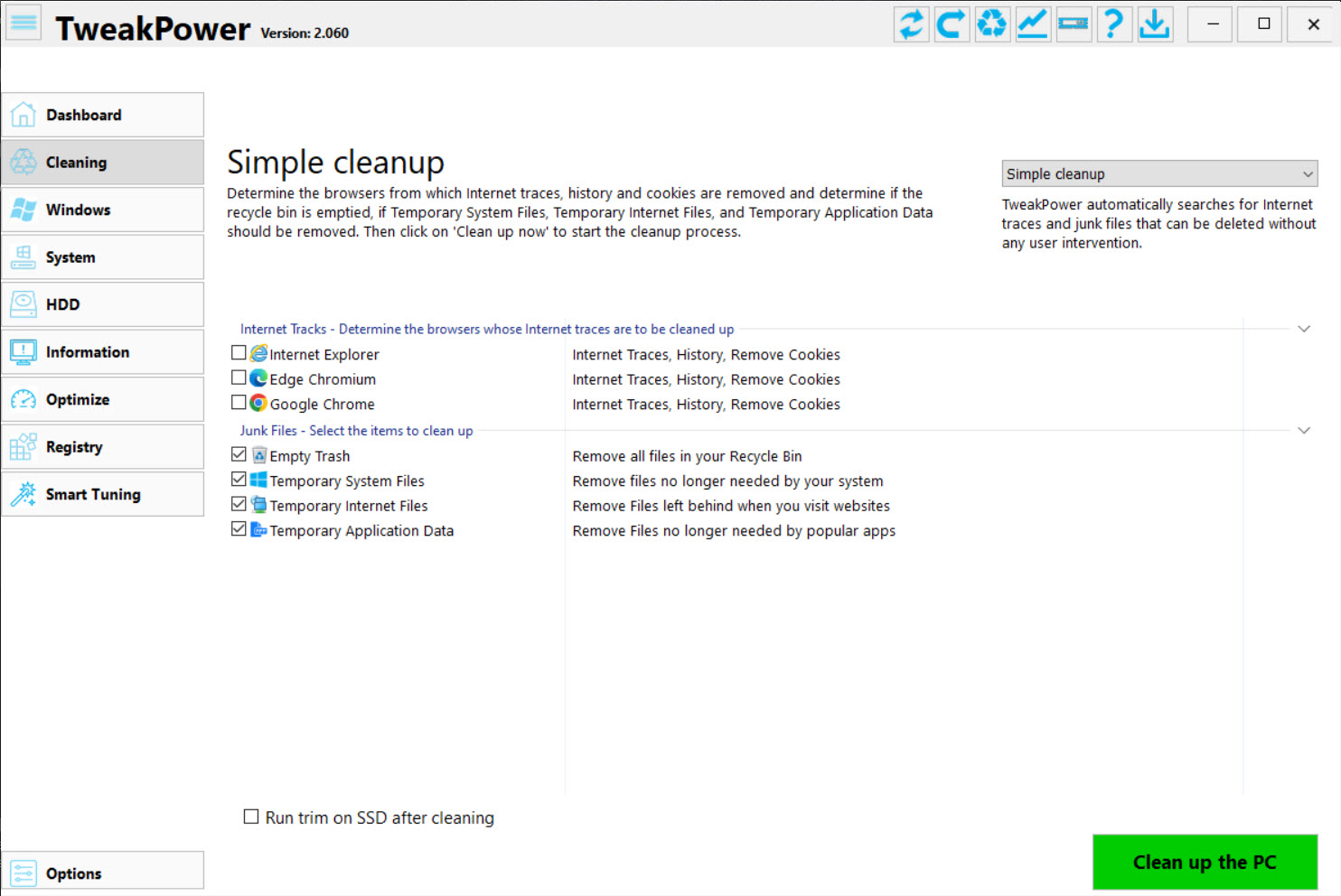
The TweakPower junk cleaner accepts two lists. An ignore list of files, folders, registry values that must never be touched, and an inclusion list of additional locations that should be. Both accept wildcards.
That is the feature that turns a cleaner from something you run nervously into something you configure once. An application whose cache you want preserved goes on one list, a folder some program fills with debris goes on the other, and the behaviour stays correct from then on.
How deletion happens is configurable too, sending files to the recycle bin, deleting them outright, or shredding them so they cannot be recovered. For a focused cleaner with an open definition set and nothing else attached, BleachBit does that single job and stops there.
The registry modules, and the honest verdict
TweakPower cleans the registry, defragments it, searches it and backs it up, and the first two of those achieve nothing measurable.
Removing invalid registry entries does not make a machine faster. The registry is not a bottleneck on any current system, and the orphaned entries being deleted were not being read by anything. The impressive count of items removed is the whole reward. Defragmenting it is the same story, since the database is memory-mapped and the fragmentation being repaired has no observable effect.
None of this is specific to this product. It is true of every suite in the category, and the reason the belief persists is that the operation produces a satisfying number and no visible harm. Here the harm risk is low because of the per-module backup, which makes it pointless rather than dangerous.
The registry search is a different matter and is separately useful for anybody who actually needs to find a value.
The modules that do concrete work
Several TweakPower modules earn their place, and they are the ones performing measurable tasks rather than abstract optimisation.
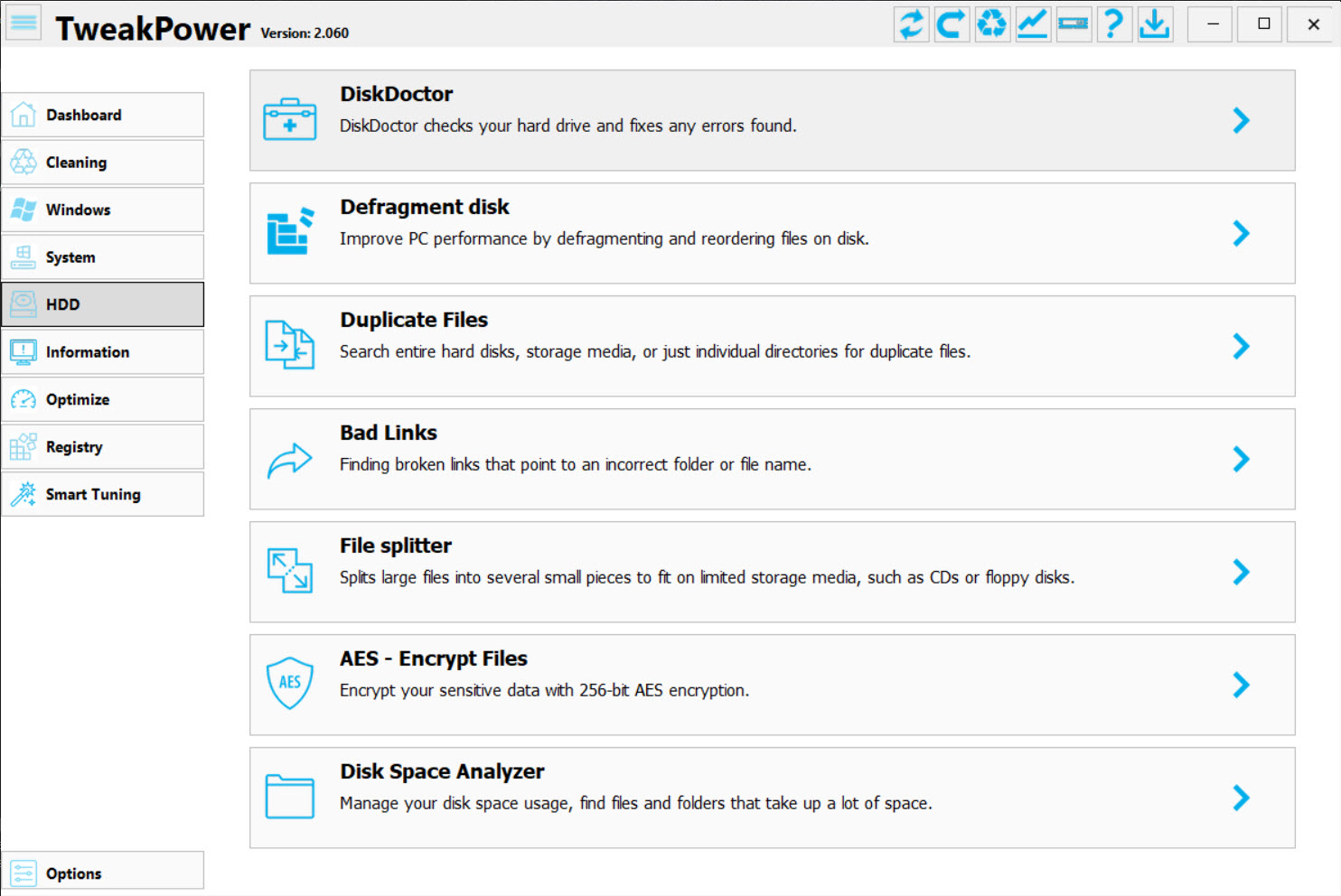
Duplicate file removal reclaims real space, disk error checking finds actual faults, the shredder overwrites files properly, and encryption using a standard cipher covers material that should not be readable. A file splitter, a process viewer and system information round out the set.
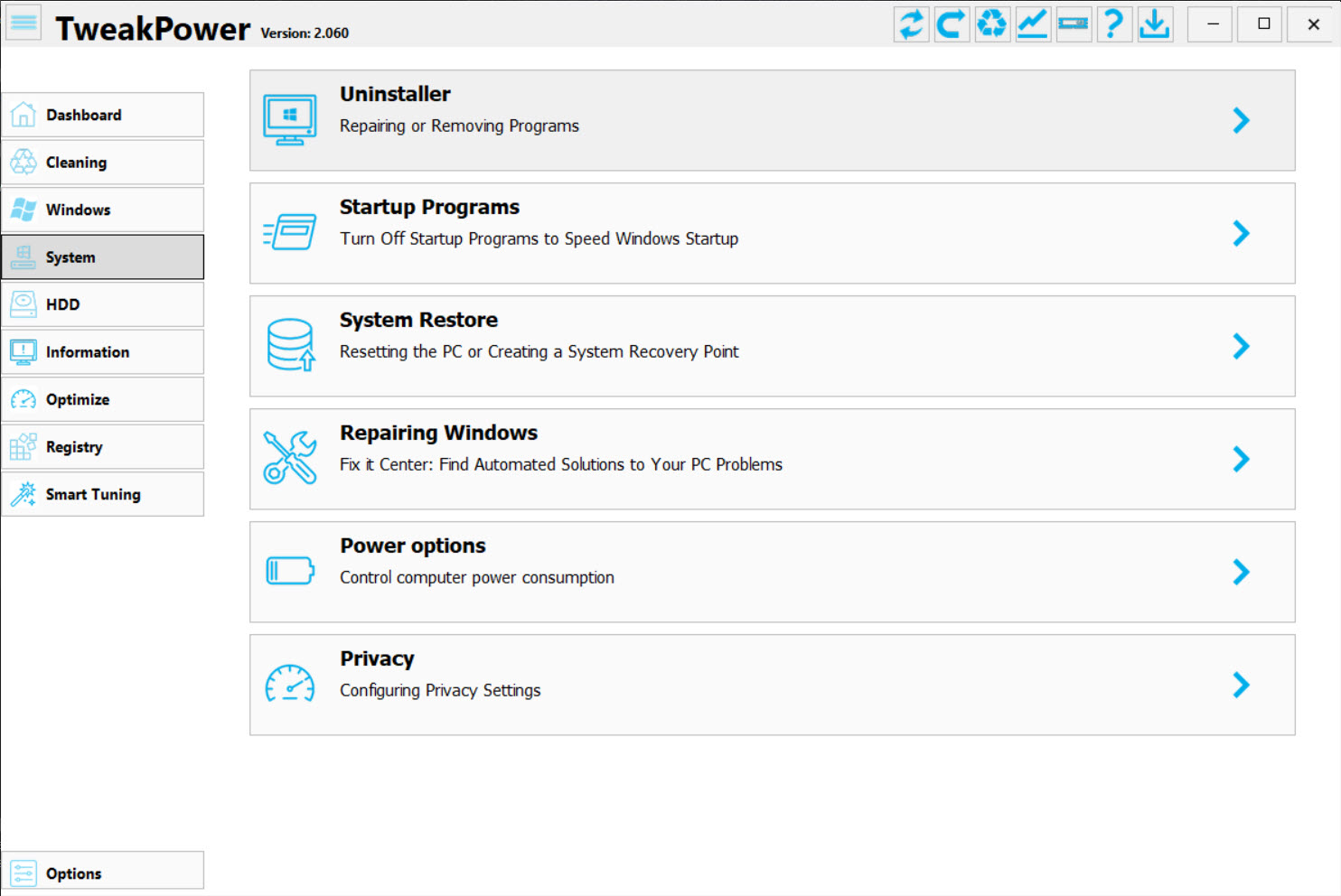
The startup manager is the one that measurably affects how a machine feels, since programs loading at boot are among the few things that measurably slow a computer down. For the complete picture across every location where something can be set to load, Autoruns shows entries no suite of this kind enumerates.
Duplicate hunting by name and size is a starting point rather than a conclusion, and dupeGuru compares contents including near-identical images, which is what a photo collection actually needs.
The tweaks, and the caution they deserve
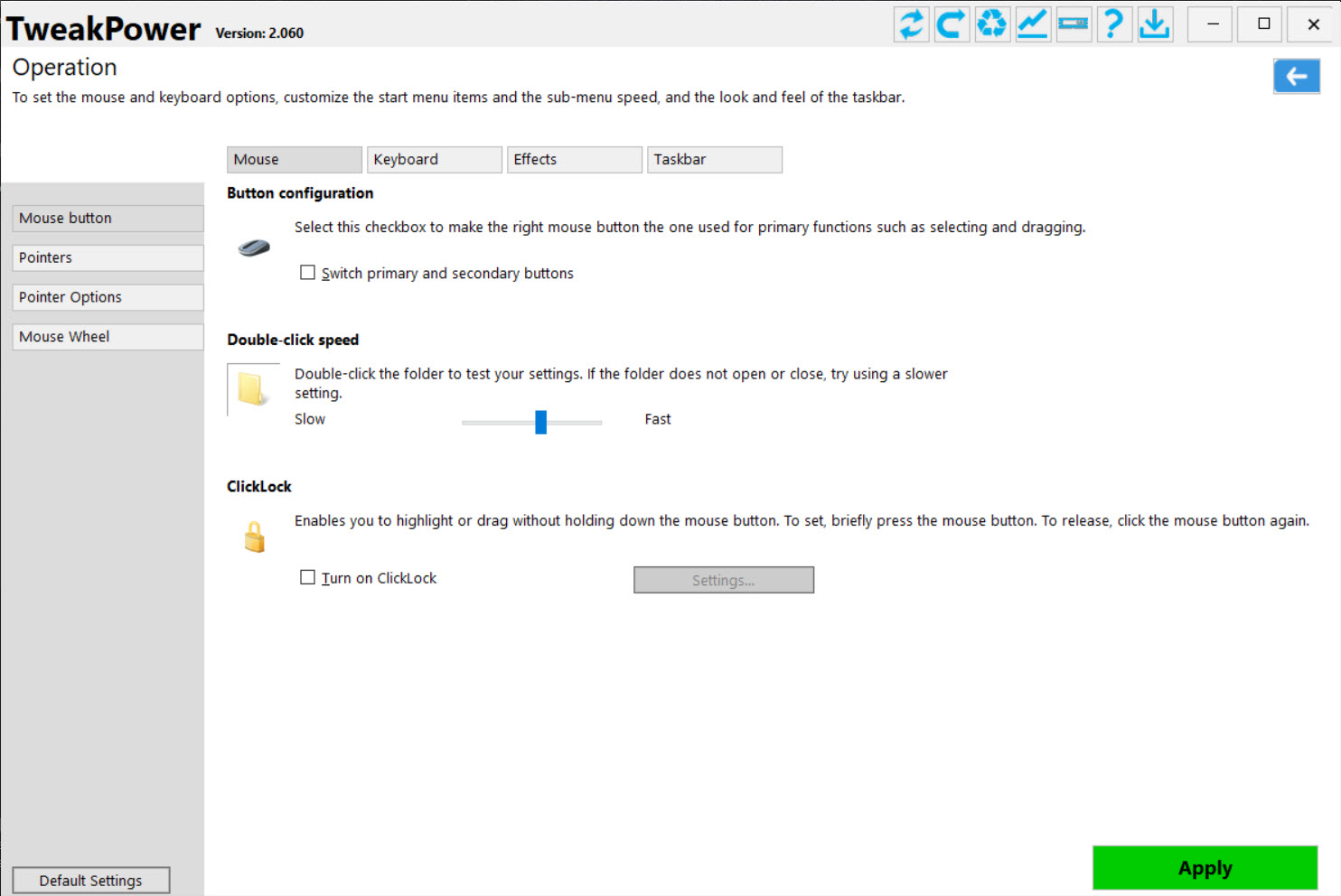
The TweakPower customisation side covers appearance, behaviour, mouse and keyboard settings, plus the start menu, power management and internet connection parameters.
Most are harmless preferences. Some are not, and the internet connection adjustments in particular belong to a time when default network settings were poor and now mostly are not, so changing them is as likely to hurt as help.
The saving grace remains the same. Everything is recorded and reversible, so an experiment that makes things worse is undone rather than lived with. That is the right design for software whose entire purpose is modifying a system, and it is what separates this from tools that change things and shrug.
One thing to check before installing
TweakPower has a sibling from the same source with substantially overlapping functions, and installing both achieves nothing except two programs competing to clean the same files.
HDCleaner covers much of the same territory with a different emphasis, weighted towards cleaning where this one leans towards customisation and reversibility. Pick whichever emphasis matches what you actually want and install only that one.
Conclusion
TweakPower is a better-behaved member of a category that has earned its poor reputation. Recording changes per module, allowing each to be reversed independently, and letting you define exactly what the cleaner may and may not touch are the three things that make a tool like this trustworthy rather than merely capable.
Use the parts that do concrete work and ignore the parts that do not. The startup manager, the duplicate finder and the disk checks all change something you can measure. The registry cleaner produces a number and no difference, and the connection tweaks apply guidance that stopped being correct several hardware generations ago. Approached selectively it is a decent toolkit.
Approached by pressing the one-click button it will report a great deal of activity and leave the machine exactly as fast as it was.
Pros & Cons
- Every change is recorded per module and can be undone independently
- Ignore and inclusion lists with wildcards give real control over what gets cleaned
- Deletion method is configurable, from recycle bin through to shredding
- Restore point creation is prominent on the dashboard rather than buried
- Duplicate removal, disk checking, shredding, encryption all do concrete work
- Startup manager addresses one of the few things that measurably slows a machine
- Available as a portable build as well as an installed one
- Registry cleaning and defragmenting produce no measurable performance improvement
- Internet connection tweaks apply advice that has largely stopped being correct
- One-click maintenance bundles the worthwhile modules with the pointless ones
- Heavy overlap with another suite from the same source
- The sheer number of options invites changes nobody needed to make
Frequently asked questions
No. The registry is not a performance bottleneck and the invalid entries removed were not being read by anything. The per-module backup means the operation is harmless rather than useful, and the item count it reports is the only reward.
Yes, and this is its best feature. Each module records its own changes separately, so the registry cleaner, the junk removal, the autostart manager and the privacy settings can each be rolled back without touching the others.
Telling the cleaner which files, folders, registry values must never be removed, with wildcards supported. An inclusion list does the opposite, adding locations that should be cleaned. Together they mean the behaviour is configured once rather than trusted every run.
The startup manager, the duplicate finder, the disk error check and the shredder, all of which do measurable work. The registry modules are the ones to skip, and the connection tweaks deserve scepticism.
No. The functions overlap heavily and two programs cleaning the same files gains nothing. Choose the one whose emphasis matches what you want and install only that.


