

Logitech Gaming Software


About Logitech Gaming Software
Logitech Gaming Software is the configuration program for the older generation of G-series mice, keyboards and headsets. It assigns commands and macros to buttons and G-keys, sets mouse sensitivity levels, controls lighting, drives the small LCD screens on classic keyboards, and switches all of that automatically when a game starts. Its successor, Logitech G HUB, covers newer hardware, but many older devices are either missing from the new program or work better in this one.
That is the reason it is still downloaded. Compatibility is decided per model, not per age, so the first step is to check which program lists your device. If yours appears here, the feature set below is complete and mature, without the growing pains the newer program went through.
Owners of plain office mice and keyboards from the same brand are in the wrong place entirely and should use the configuration tool for non-gaming devices.
Profiles that follow your games
The profile system is the backbone. Each profile ties a set of button assignments, macros, sensitivity settings and lighting to one or more programs, and automatic game detection switches to the right profile the moment that game has focus. A default profile covers everything else, so the desktop and a shooter can use the same mouse in entirely different ways.
There is one rule worth understanding. Logitech Gaming Software offers two modes, automatic game detection and onboard memory, and they are exclusive. In onboard memory mode, the settings live on the device itself and travel with it to another computer or a machine where the software is not installed, but application-specific switching stops working.
For tournaments or shared PCs, onboard memory wins. For a single gaming desktop, automatic detection is the richer option.
Macros and G-key assignments
The macro editor records sequences of keystrokes and mouse clicks, including the delays between them, and lets you edit every step afterwards. Macros can run once, repeat while a key is held or toggle on and off, and text blocks can be typed out with a single press. Assignments go beyond macros too, with media controls and shortcuts available for any programmable button.
The keyboards with dedicated G-keys gain the most, since several banks of G-keys multiply the available slots per profile. One caveat comes from the official documentation. Some anti-cheat systems, GameGuard among them, can block macro and binding output from reaching a game, so a macro that works on the desktop may fall silent inside certain titles.
Sensitivity, surface tuning and lighting
Mouse users of Logitech Gaming Software get up to five DPI levels per profile, cycled with a button, plus a separate shift level that drops sensitivity while a button is held for precise aiming. Polling rate and acceleration settings sit alongside. On supported mice, surface tuning calibrates the sensor to your specific mouse pad for more consistent tracking. Wireless mice that have lost their link to the receiver must be re-paired with a small pairing utility before any of these settings reach them.
Lighting runs from simple brightness and colour on single-zone devices to per-key colours on RGB keyboards, with effects such as breathing, colour cycling and lighting that reacts to key presses.
Profiles can carry their own lighting, which gives a visual cue that the game profile has loaded. The effects library is smaller than in the successor, but what it offers is reliable.
LCD applets and input analysis
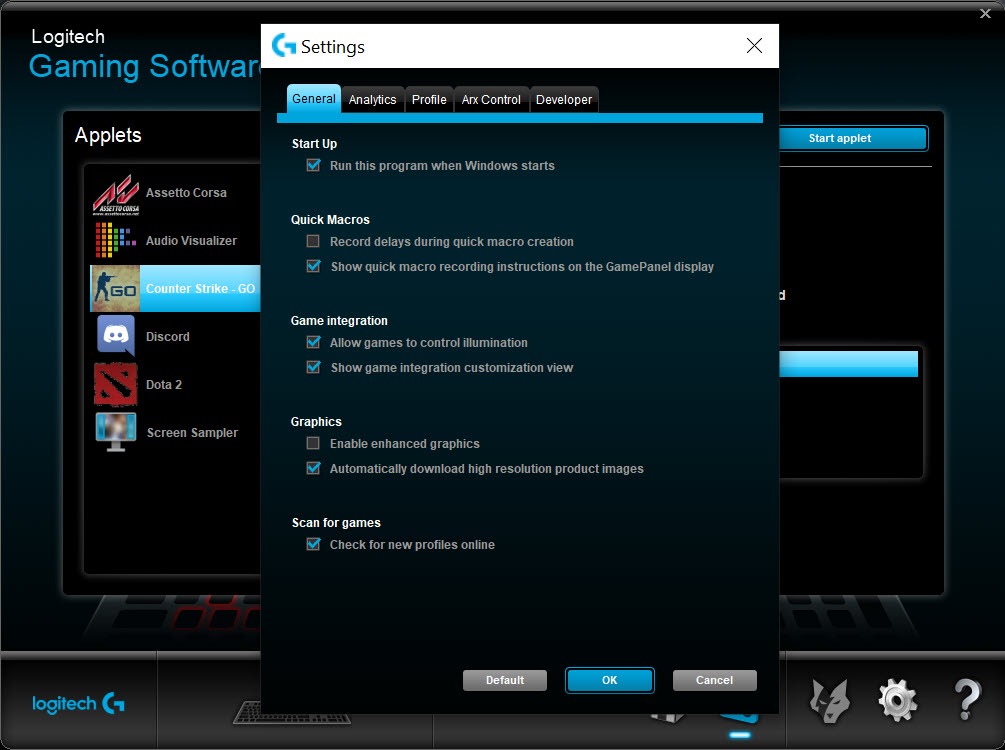
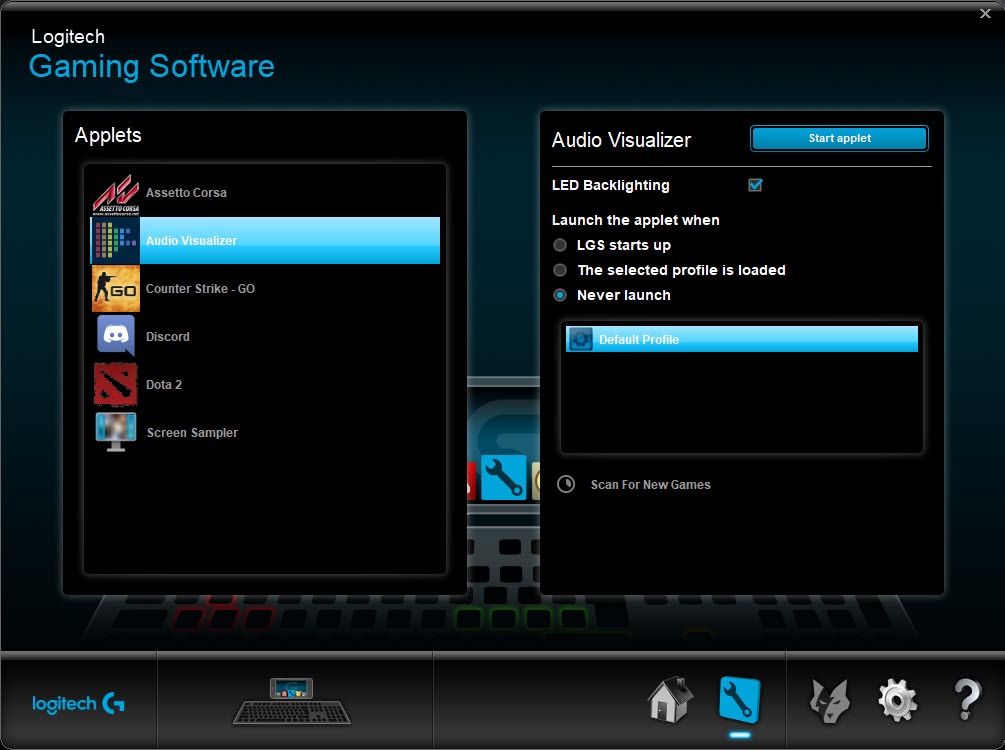
Classic keyboards with built-in screens, the G13, G15 and G19 among them, depend entirely on Logitech Gaming Software for their displays. Applets show a clock, media information, system performance, or game statistics for titles that support the interface, and the screen cycles between them with the keyboard’s own buttons. Nothing newer drives these screens, which makes the software irreplaceable for their owners.
A heat map tool records which keys and buttons you press most during a session and paints the results onto an image of the device. It sounds like a gimmick until you use it to decide which rarely touched key deserves a macro, or to discover that a game’s default layout sends your fingers across the keyboard more than it should.
Living alongside the newer program
Having both programs installed causes trouble. The newer one takes over devices it recognises and the two fight over the hardware, so the sensible setup is one or the other, with older devices on this one and newer devices on Logitech G HUB. Profiles can be exported and imported here, which makes rebuilding a setup on another PC quick.
The program has not received a new release in years. Everything it supported still works, but no new devices will be added and no new effects will appear.
Conclusion
Logitech Gaming Software suits owners of older G-series mice, keyboards and headsets, and anyone with a keyboard whose LCD screen nothing else can drive. Its profiles and macros are complete and dependable, and onboard memory makes settings portable.
It will not gain new devices or features, and it must not share a PC with the newer program. For the hardware it supports, though, it remains the right tool rather than a reluctant compromise.
Pros & Cons
- Automatic game detection switches profiles the moment a game gains focus
- Full macro editor with recorded delays, repeat modes and text blocks
- Up to five DPI levels plus a shift level, with surface tuning on supported mice
- Per-key RGB lighting tied to profiles
- The only software that still drives G13, G15 and G19 LCD screens
- Onboard memory mode carries settings to any computer
- Onboard memory and automatic game detection cannot be used together
- Conflicts with the newer program if both are installed
- Some anti-cheat systems block macros inside games
- No new releases, so newer devices are not supported
Frequently asked questions
Check which one lists your device. Older G-series hardware, and anything with an LCD screen, belongs here. Newer devices belong in the newer program, and installing both causes conflicts.
Some anti-cheat systems block macro and binding output from reaching the game, while normal typing keeps working. Nothing in the software can bypass that.
The device is probably in onboard memory mode, which disables automatic game detection. Switch it back to automatic game detection in the device settings.
Yes, either by exporting profiles and importing them on the other machine, or by storing settings in the device's onboard memory so they travel with the hardware.


