

Kindle for PC
About Kindle for PC
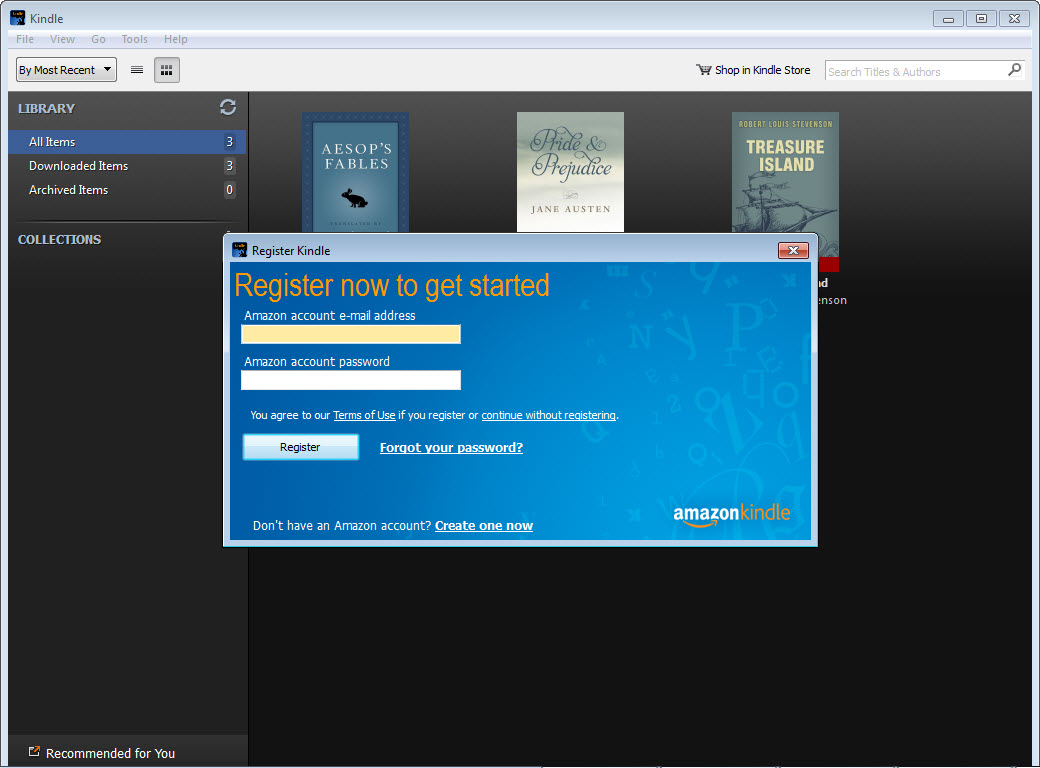
Kindle for PC puts a reading library on the computer. Sign in with the account your ebooks were bought on, and the whole collection appears as covers in a grid, every title you own ready to open. Pick one and it opens at the page you last reached on any other device, a phone, a tablet or a dedicated e-reader, because your place travels with the account. Highlights and notes made elsewhere are already there, and the ones you add at the desk show up on the e-reader later. It is the same library, read on a bigger screen.
A change at the core of the product needs saying first. The classic desktop app that carried this name has been retired, and the version that opens protected books today is a newer Kindle app built to replace it. The older program no longer signs in to open purchased titles, so anyone with it installed is reading from a client that has stopped working. Kindle for PC in its current form keeps the familiar reading features and adds comics and manga, personal documents and a closer match to the e-reader experience.
The sections below take each part in turn and end with what the switch to the new app changes.
The library
The Kindle for PC library opens to your collection, as a grid of covers or a list with titles and reading progress. Filters narrow it to downloaded titles, unread ones, comics or a collection, and sorting runs by title, author, date added or publication date in either direction. Collections you created on another device appear here, so a shelf organised on the e-reader is already organised on the desktop.
Books live in the cloud until you open them. Opening one downloads it for reading offline, and downloaded titles stay available with no connection until you remove them. That suits a laptop on a flight or a train. Downloading only what you are reading keeps a library of thousands of books off the disk.
Reading
The Kindle for PC reading view is built around comfort over long sessions. Font and text size are adjustable along with spacing and margins, the page colour switches to sepia or dark for night reading, and the layout runs as one column or several on a wide screen. A full-screen mode removes everything but the text. Real page numbers from the printed edition appear for many popular titles, useful when a class or a book club refers to a page.
Select any word and its definition appears without leaving the page. A search finds every place a name or a phrase occurs in the book. X-Ray, on titles that support it, gathers the characters and places that recur, which is how a reader returning to a long novel after a break remembers who someone was.
Progress shows as a percentage and the time left in the chapter.
Notes and sync
Highlight a passage in Kindle for PC in one of several colours and it is saved to the book. Attach a note to it and the note is saved too. A notebook view gathers every highlight and note in the book in one list, which is the part students and researchers use most, since a semester’s reading becomes a page of quotations to review. Bookmarks mark places to return to.
Everything syncs. The furthest page reached, the bookmarks, the highlights and the notes follow the account, so a passage marked on the phone during a commute is waiting on the desktop at home. That sync is the core reason to read on the computer at all, since the book on the big screen is always the same book as the one in your pocket.
For organising a collection of ebooks you own as plain files rather than as an account library, Calibre manages and converts them.
Comics and manga
The current Kindle for PC app handles illustrated books properly, which the older one did poorly. Comics and manga open with their images in high resolution, with zoom for detail. Guided View steps through a comic panel by panel, enlarging each one in turn, so a page designed for print reads comfortably on a laptop screen. Manga reads in its right-to-left direction.
Illustrated non-fiction and magazines benefit from the same high-resolution handling, with images that zoom rather than blur. For reading comic archives and image folders you already own as files, Sumatra PDF opens the common comic formats along with PDFs and ebooks.
Your own documents
Personal documents drag into Kindle for PC and become part of the library, readable on the desktop and, once sent to the account, on the other devices too. That turns a long report or a saved article into something you can read on the e-reader in the evening, with the same highlights and notes as a bought book. The supported formats cover the common document and ebook types the account accepts.
For files the app does not open, or for formatting a document before sending it to the e-reader, a preview tool for Kindle formatting shows how a file will look on the device.
What the switch to the new app changes
The move from the classic Kindle for PC app to the current one changed a few things readers notice. Books are downloaded again after signing in, since the old app’s downloads do not carry over. Notes and highlights follow the account, as do reading positions, so they reappear, but it is worth confirming that important annotations are there before removing the old program. Downloaded books now sit in a fixed, protected location that cannot be moved to another folder, and the old way of downloading a book to the computer for transfer to a device has gone.
Some computers have no straightforward path to the new app, including machines built on the low-power processor family that the app does not support. On those, the web reader in a browser remains the fallback, with reading in the browser and limited offline use.
Conclusion
Kindle for PC suits anyone with an ebook library on the account who wants to read it on a large screen. That covers a student gathering highlights for an essay and a reader who wants to finish on the laptop the chapter started on the phone. The sync, the notebook of highlights and the reading controls are the reasons to keep it, and the current app adds comics and personal documents to the mix.
The classic program is gone, the new one downloads books afresh and stores them where you cannot move them, and a few computers are left on the web reader. Sign in to the current app, let the account bring back your notes, and download only the books you are reading.
Pros & Cons
- Whole account library on the desktop, with filters and collections
- Syncs the furthest page and every highlight and note across devices
- Adjustable fonts and page colours, with dark mode and full screen
- Dictionary lookup, search, X-Ray and real page numbers on supported titles
- Comics and manga in high resolution with Guided View, plus right-to-left manga
- Personal documents dragged in and read across devices
- The classic app has been retired, so older installs no longer open purchased books
- Books must be downloaded again after moving to the new app
- Downloaded books sit in a fixed location that cannot be changed
- Some low-power computers have no direct path to the new app
Frequently asked questions
No. The classic desktop app has been retired and can no longer sign in to open purchased books. The current Kindle app replaces it.
Yes. They are stored with the account, so they reappear in the current app after you sign in. Check that important annotations are there before removing the old program.
Yes. Open a book once to download it, and it stays readable offline until you remove it.
Yes. Drag them into the app to read them on the desktop, and send them to the account to read them on other devices.


