

Kindle Previewer
About Kindle Previewer
The most painful review a self-published author can get has nothing to do with the story. “Formatting is broken on my device” arrives after launch, from a paying reader, about a problem that was invisible in the manuscript.
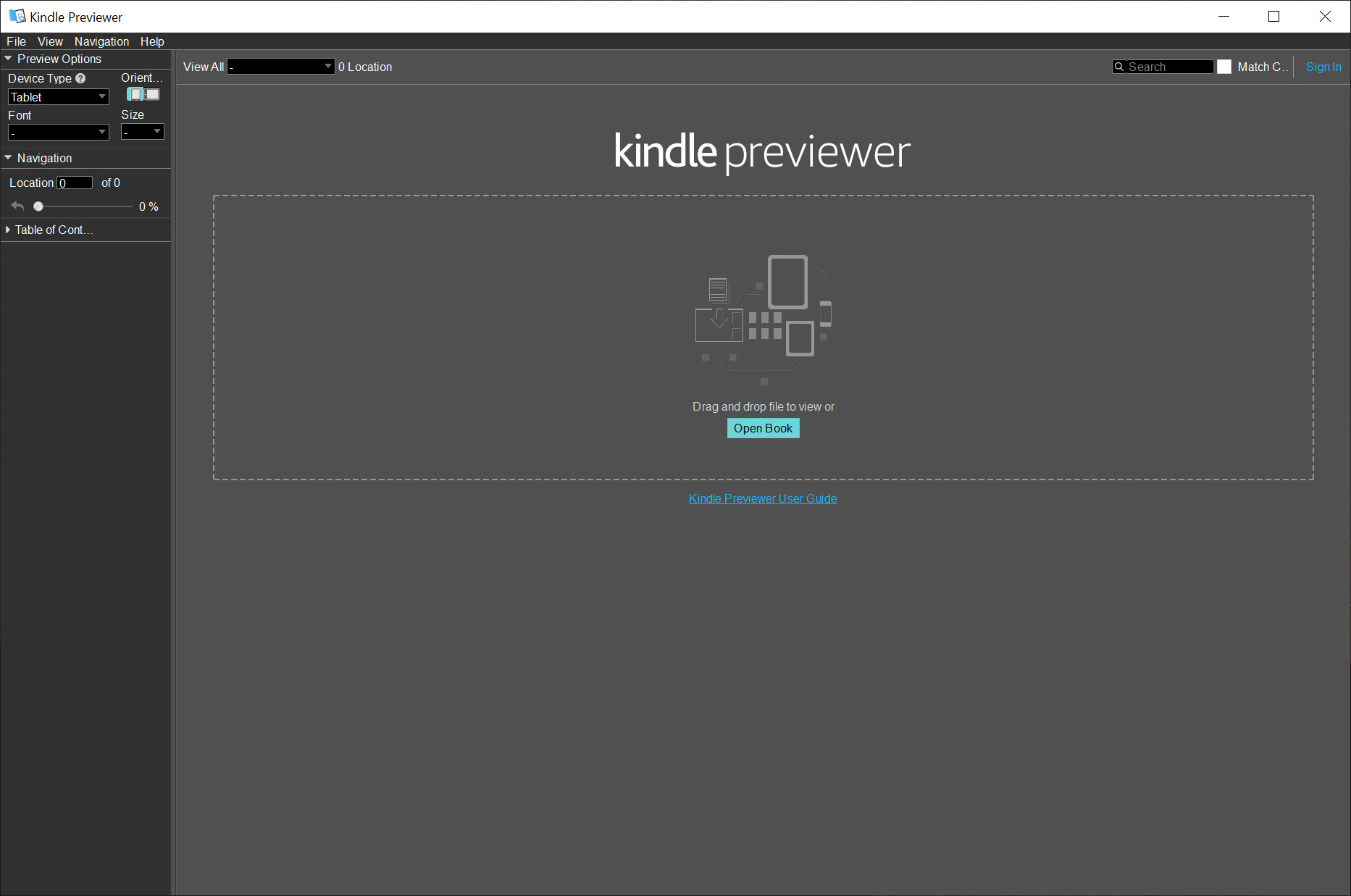
Kindle Previewer exists to catch that problem while it can still be fixed quietly. Feed it your book file and it converts the manuscript with the same engine the Kindle publishing pipeline uses, then shows the result exactly as e-readers, tablets, and phones will render it.
That “same engine” detail is the whole value. An EPUB that looks flawless in your editing software gets reflowed, retypeset, and occasionally mangled on its way into the Kindle format. Previewing in anything else is an educated guess. Previewing here is the actual output.
From EPUB or DOCX straight to Kindle pages
The tool accepts the files authors actually have. Drop in an EPUB from your formatting workflow, a DOCX straight from your word processor, or an existing Kindle-format file, and conversion runs automatically on open. A progress log lists what happened during conversion, and any structural complaints (broken links, missing images, table trouble) surface as warnings you can chase down one by one.
For an author finishing a book in Sigil or exporting from Calibre, this becomes the final checkpoint in the pipeline. Build the EPUB there, open it here, and see what the store will actually sell.
One book, every screen
The preview isn’t a single rendering but a simulator. Switch between e-ink reader, tablet, and phone profiles, flip orientation, and walk through the font sizes and typefaces a reader can choose, because every one of those choices reflows your book differently. The chapter that looks elegant at medium type on a tablet may orphan its headings at large type on a phone, and this is the only practical way to see it before a reader does.
Enhanced Typesetting behavior, the modern layout system with improved hyphenation, spacing, and image handling, is part of the simulation, so drop caps, tables, and image placement show their real behavior. Books in right-to-left languages and vertical text render properly too, which matters to anyone publishing beyond Western markets.
A thumbnail view lays out the whole book as a grid of miniature pages, and it’s the fastest error-hunting tool in the box.
Broken image, collapsed table, or a chapter that lost its page break, all of it jumps out visually when you’re skimming two hundred tiny pages instead of paging through them one by one.
What it deliberately won’t do
Kindle Previewer is a viewer and a validator, not an editor. When it reveals a broken layout, the fixing happens back in your source file, in Sigil or your word processor, followed by another round trip through the preview. That loop is the workflow, and pretending otherwise leads to frustration. It’s also not a general reading app.
For actually reading purchased books at your desk there’s Kindle for PC, and for managing a personal ebook library across formats, Calibre remains the standard.
Two honest gripes from real use. Image-heavy books, children’s titles and comics especially, convert and page noticeably slower than plain novels. And while the simulation is very close, it is still a simulation. The rare stubborn layout issue only reveals itself on physical hardware, so a final skim on an actual device remains good practice for anything visually complex.
Conclusion
Kindle Previewer is essential for exactly one audience, anyone publishing a book into the Kindle store. Self-published novelists, small presses, and formatters doing client work all get the same payoff, seeing the real converted book on every simulated screen before a reader ever can. The cost of skipping it is learning about your formatting bugs from one-star reviews.
Outside that pipeline it has no role, and even inside it, it’s one leg of a workflow that still needs a proper editor beside it. As the final quality gate before hitting publish, though, nothing else is looking at your book through the store’s own eyes.
Features & benefits
Pros & Cons
- Converts with the same engine the Kindle publishing pipeline uses, so the preview matches the product
- Accepts EPUB and DOCX directly, no manual conversion step
- Simulates e-readers, tablets, and phones with every font size, typeface, and orientation
- Thumbnail grid exposes broken layouts across the whole book in seconds
- Conversion log flags structural problems with links, images, and tables
- Handles right-to-left scripts and vertical text correctly
- Strictly a previewer, with every fix requiring a round trip to your editor
- Sluggish with image-heavy books like comics and children's titles
- Occasional edge-case differences from rendering on physical devices
- Useless for non-Kindle publishing targets
Frequently asked questions
Yes. EPUB and DOCX files convert automatically on open, using the same conversion engine the publishing pipeline runs, and the converted result is what you preview.
Very nearly. It simulates e-reader, tablet, and phone rendering across font sizes and orientations with the real typesetting engine. Only rare edge cases differ on physical hardware, which is why a final check on a real device is still sensible for complex layouts.
No. It identifies problems but changes nothing. Corrections happen in your source file with an editor, and then you re-open the file to verify the fix.
Because the Kindle conversion reflows and retypesets your file with its own engine, including Enhanced Typesetting behavior. The editor shows your source. This tool shows the product.
Two ways. The conversion log lists structural warnings as the file opens, and the thumbnail view displays every page as a miniature, making broken images, tables, and page breaks visible at a glance.


