

WinDiff


 (23 votes, average: 3.26 out of 5)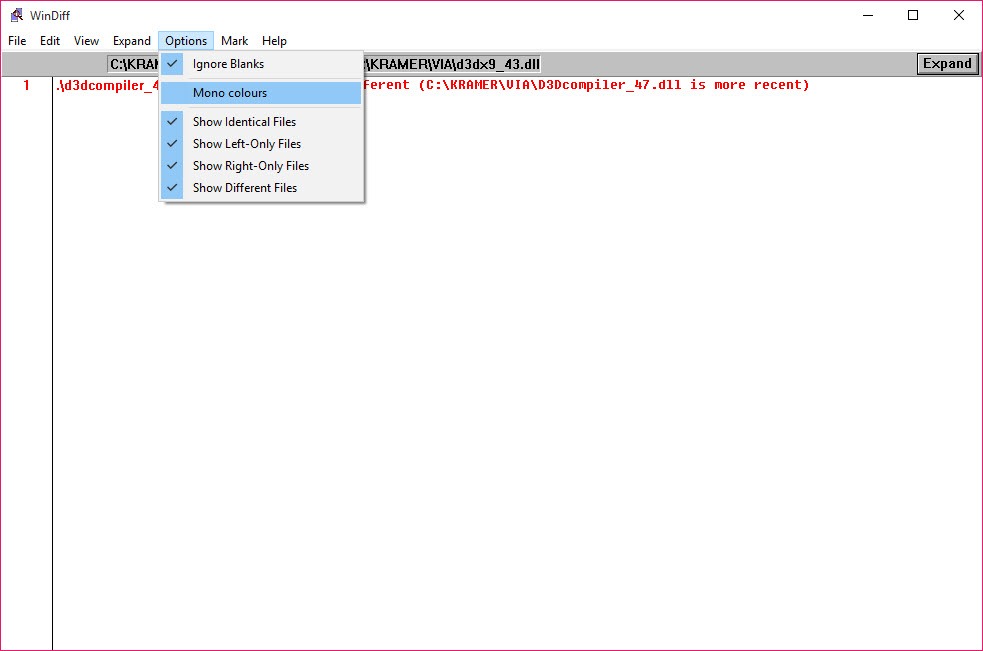
About WinDiff
Two versions of the same configuration file, and one of them works. That is the problem WinDiff was built for. Point it at two files and it shows you every line that differs, colour-coded and numbered. Point it at two folders and it walks the whole tree, telling you which files match, which differ, and which exist on only one side.
The trick that made it a technician’s staple goes further than source code. Export the registry before a change and again afterwards, then compare the two exports, and the setting you just altered is sitting there in the differences. No guesswork, no hunting through keys, just the delta between two states of a machine.
The interface makes no attempt to charm anyone. Two panes, a handful of menus, and colours that were chosen when screen real estate was scarce.
What it does have is a comparison engine that handles moved lines properly and a command-line surface far broader than the window suggests.
Outline mode and reading a folder tree at a glance
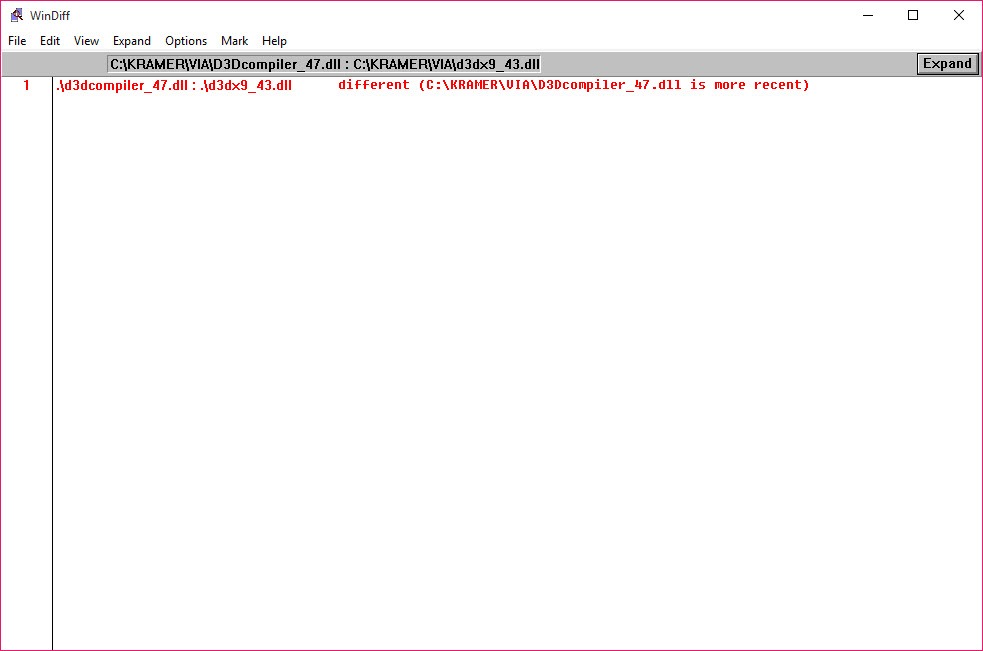
Comparing directories starts with a dialog asking for two paths and offering an include-subdirectories checkbox. From there WinDiff produces a list where every file carries its status, and on a tree of a few thousand files that list appears in seconds.
Four filters control what you actually see. Show Identical Files, Show Left-Only Files, Show Right-Only Files and Show Different Files can each be switched off, which is how a comparison of two build outputs stops being nine hundred identical entries with the four interesting ones buried among them.
The list itself is plain. No tree structure, no sorting by column, no grouping by folder, so on a deep hierarchy you read paths rather than move through them. If browsing and syncing matter more than inspecting, a dual-pane file manager with folder comparison built in is the more comfortable place to work.
Expand mode and the colour scheme
Double-click an entry in WinDiff and you drop into the line-by-line view. Lines present in only the left file take one colour, lines only in the right take another, and identical lines appear once in plain text. The colour continues into the margin, which is the detail that makes the display readable, because you can tell at a glance which side a highlighted line belongs to without counting panes.
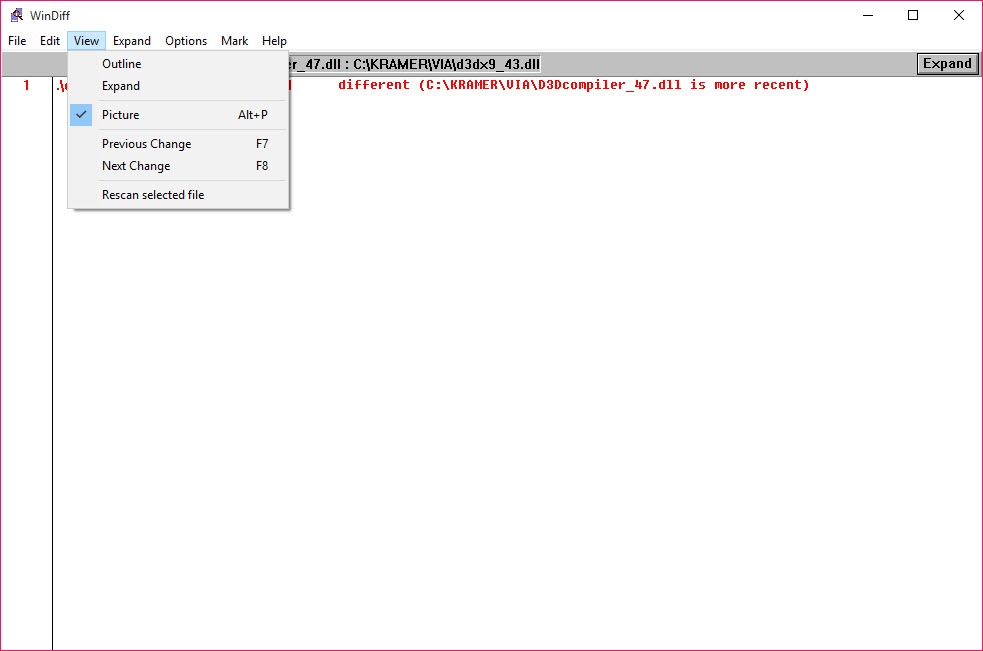
The Expand menu switches between showing the left file only, the right file only, or both interleaved. Interleaved is the default and usually what you want, but the single-side views are useful when one file has grown enormously and you only care about what it gained.
There is also a picture pane down the side, a compressed map of the whole comparison showing where the differences cluster. It answers the question of whether you are dealing with three scattered edits or a rewrite, and it can be switched off when the window is tight.
Moved lines and near matches
This is where WinDiff earns more respect than its age suggests. A naive comparison treats a block of lines that moved as a deletion plus an unrelated insertion. Here, arrow markers indicate that a line has moved and point to its position in the other file, and lines the engine believes correspond to each other are rendered in green even when their content is not identical.
Reordering a function or shuffling a block of settings therefore reads as a move rather than a hundred changes, which is exactly what you want when reviewing someone else’s edit.
The limit is granularity. Comparison happens at line level, so a single changed character marks the entire line as different with no indication of which character it was. On dense lines you end up reading both versions carefully, which WinMerge spares you by highlighting inside the line itself.
Editing from inside the comparison
The Set Editor command takes a command line of your choosing, with the default pointing at a plain text editor as “notepad %p”. Change it to whatever you actually use and the editor opens on the file you were looking at. Point it at Notepad++ and you get line numbers and syntax colouring for the editing half of the job.
The part that makes this a workflow rather than a detour is what happens next. Save the file, return, and the comparison re-runs automatically against the updated content. Edit, glance, edit again, without reloading anything by hand.
Do not mistake that for merging, though. WinDiff has no concept of taking a line from one side and applying it to the other. There is no merge pane, no accept-change button, nothing bidirectional. Every change is one you type yourself, and for reconciling two divergent files that is a real amount of manual work.
Command-line switches and saved reports
The command line is the part most people never discover. A -D switch restricts a directory comparison to one level, -T covers the whole subtree, and -O forces outline view without automatically expanding, which matters on very large files where expansion takes a long time and tells you little.
Reports come from two switches. -S writes out the file list with selectable flags for same, left-only, right-only and different entries, while -F saves a composite file of the lines themselves. Both accept an X flag that exits after writing, and that is the only way to run the comparison without a window appearing, which makes it semi-scriptable rather than properly headless.
For scheduled folder comparisons that need to run unattended and act on what they find, FreeFileSync is built for the job.
Conclusion
WinDiff suits the technician rather than the programmer. Comparing two configuration files, checking whether a deployment copied everything across, or hunting down which registry value a setting actually writes are all jobs it does quickly and without ceremony, and the recognition of moved blocks puts its engine ahead of what its interface implies.
Anyone reconciling code should use something with a merge pane instead, because typing every change by hand in an external editor stops being charming after the third file. Take it as a fast, precise inspection tool with a useful command line and no ambition beyond that, and it still earns a place in a support toolkit.
Pros & Cons
- Folder tree comparison across thousands of files completes in seconds
- Four status filters strip identical and single-sided files out of the results
- Moved blocks are recognised as moves rather than reported as deletions plus insertions
- Margin colouring makes it obvious which file each highlighted line came from
- Configurable external editor with automatic recomparison after saving
- Report switches export file lists or the differing lines themselves for further processing
- Line-level comparison only, with no highlighting inside a changed line
- No merge capability at all, so reconciling files means editing both by hand
- Line endings are not normalised, which can mark every line as different
- No case-insensitive mode, comment filtering or pattern-based exclusions
- The outline list is flat text with no tree view or column sorting
- The window always appears unless a save-and-exit flag is used, limiting true automation
Frequently asked questions
Yes. The directory comparison dialog has an include-subdirectories option, and the -T switch does the same from the command line. Status filters then hide the identical files so only the differences remain on screen.
No. It shows differences and hands editing to whatever external editor you configure, then recompares when you save. Nothing lets you copy a line from one side to the other inside the program.
Only with the X flag on a save switch, which writes the report and exits. Without it the interface opens regardless, so it suits assisted comparisons better than unattended ones.
Almost always line endings. A file edited on a system with different conventions differs invisibly on every line, and switching on Ignore Blanks in the options usually clears it up immediately.
Only at the level of same or different. It compares content to establish whether two binaries match but produces no meaningful line breakdown, so run those comparisons in outline view and skip the expansion.


