

Universal Password Manager
About Universal Password Manager
Universal Password Manager keeps every username, password, web address and note you own in one encrypted file, locked behind a single master password. Open the file, type the password once, and the accounts appear in a list that filters as you type, so finding a login is a matter of a few keystrokes.
Select an account and the username or the password copies to the clipboard, or the site opens in the browser, and that is the entire daily routine. The database is encrypted with AES, and nothing in the file is readable without the master password, including the account names.
The design is deliberately small. There is no browser extension, no form filling, no cloud account and no attempt to be a vault for documents and cards. What it adds instead is a way to keep that one encrypted file identical across several computers by publishing a copy to a web server you control and syncing against it. Universal Password Manager runs on the Java platform, so it needs the Java runtime installed and looks the same on every machine it runs on, and it is built for people who prefer the keyboard to the mouse.
It has not been updated in a long while, which matters for the sync options more than for the vault itself, and the sections below say where.
The vault, and working from the keyboard
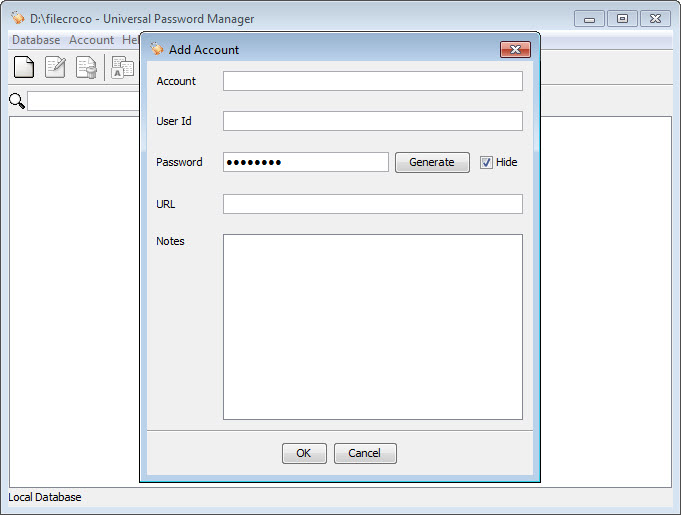
Each Universal Password Manager account holds a name, a username, a password, a web address and an open notes field, which covers security questions, licence keys and anything else that belongs with a login. The main window is the account list and a search box, and the list narrows with each character typed. Keyboard shortcuts copy the username, copy the password, open the address and edit the entry, so a complete login happens without touching the mouse, which is the habit the program is tuned for.
Adding an account is a small dialog, and a password generator fills the password field with a random string of the length you choose for anyone who has stopped inventing their own. The clipboard is not cleared automatically after a copy, so pasting the password and then copying something else is the sensible habit.
For a larger vault with attachments and groups, plus browser plugins, KeePass is the fuller tool in the same open-source tradition, and this one is the quieter cousin.
Syncing the database across machines
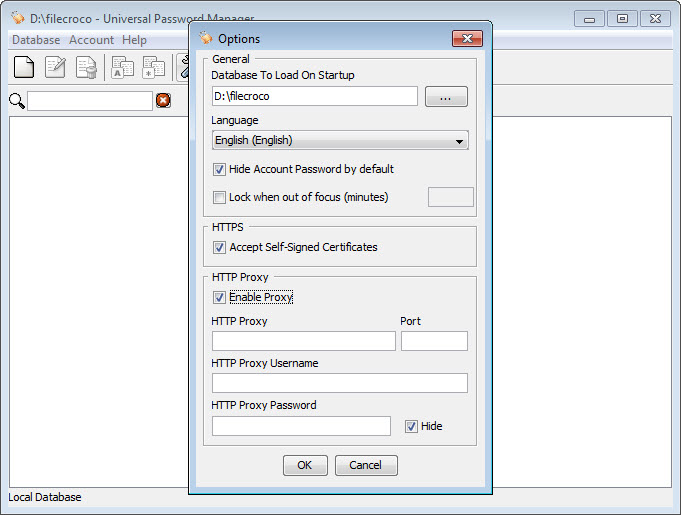
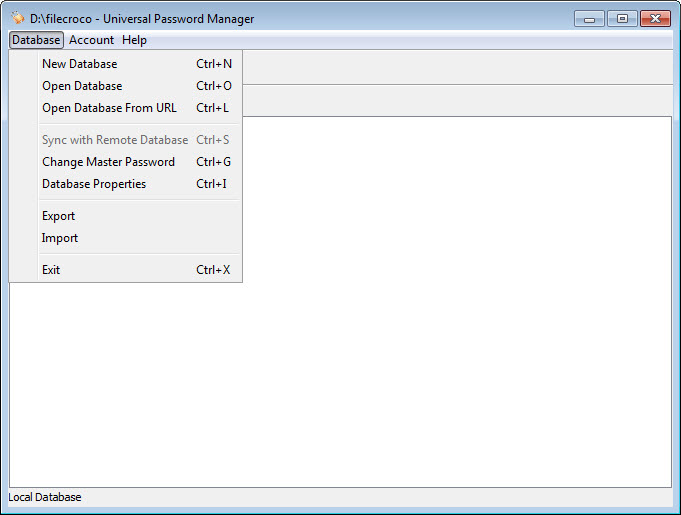
The feature that sets Universal Password Manager apart is database sync. Place a copy of the encrypted file on a web server, pointing the program at the address, and each computer synchronises its local copy against that remote one, uploading changes and pulling down others. A small server-side script ships with the program for anyone running their own web space, basic authentication protects the location, and the file stays encrypted end to end, so the server never holds anything readable.
The sync is manual rather than constant. You tell the program to sync, it compares the local and remote databases, and it warns when both have changed since the last sync so you can decide which wins. An option to sync through a popular cloud storage service also exists, but it depends on an interface that service has since changed, so the web server route is the one that still works reliably.
People who already keep a folder in sync with a cloud storage client can simply store the database file there and skip the built-in sync entirely.
Encryption and the master password
The database is encrypted with AES using a key derived from the master password, and the file format carries a version so the program knows how to open databases made by earlier releases. Lose the master password and the file is permanently unreadable, since there is no recovery route and no account to reset through.
That is the correct design for a password vault and the reason the master password deserves to be written down somewhere physical.
Backups, and the two habits that matter
Backups in Universal Password Manager are your job. The program keeps no history of the database, so a corrupted sync or a mistaken deletion is only reversible if a copy exists elsewhere.
Copying the file to a second location before each sync, or keeping it inside an encrypted container for a second layer, are the two habits long-term users recommend.
Where it shows its age
The Universal Password Manager interface is plain Java, functional but dated, and the program has not seen development in a long time, so there is no dark theme, no high-DPI polish and no support for the two-factor codes modern vaults generate. There is no browser integration, so every login is copy and paste. The cloud sync option is the clearest casualty of the long gap, and the Java dependency means installing a runtime that many machines no longer carry by default.
For a single person with one encrypted file and a web server or a synced folder, none of that stops it working, and the plainness is part of why it still runs on anything with a Java runtime. For a household sharing passwords, or anyone who wants autofill, a maintained vault is the right choice.
Password Safe offers a similarly minimal, local approach with current releases, and moving a vault across means exporting entries and importing them, since the two file formats differ.
Conclusion
Universal Password Manager suits someone who wants their passwords in one small encrypted file, driven from the keyboard, kept identical across a few computers through a server they run themselves. The vault does what a vault must, the sync is private by design, and nothing about it depends on someone else’s service staying alive. People who distrust cloud vaults on principle, and who already run a small web space, are the natural audience, and they tend to stay for years because nothing about the program changes under them.
It is the wrong choice for anyone who expects browser autofill, two-factor codes or a maintained program, and its cloud sync option has not aged well. Install the Java runtime, keep the master password on paper, back the file up before each sync, and it will hold a lifetime of logins without asking for anything else. Treat the web server sync as the only sync, and the cloud option as a relic, and the one real weakness stays out of the way.
Features & benefits
Pros & Cons
- One encrypted file holding logins and notes, with addresses, behind a master password
- Instant filtering and keyboard shortcuts for copying and opening
- Database sync against a web server you control, encrypted end to end
- Password generator built into the account dialog
- Same program and file format on every machine it runs on
- No browser integration, autofill or two-factor code support
- Cloud storage sync option relies on an interface that has changed
- Needs the Java runtime installed
- Not updated in a long time, with a dated interface
- No automatic clipboard clearing or database history
Frequently asked questions
No. There is no extension or autofill. You copy the username or password with a shortcut and paste it into the page.
A copy of the encrypted database sits on a web server you control, and each computer syncs its local copy against it on demand. The file stays encrypted on the server.
The database cannot be opened. There is no recovery option, so keep the master password somewhere safe outside the computer.
Yes. It runs on the Java platform, so the Java runtime must be installed on each machine.


