

VeraCrypt

About VeraCrypt
VeraCrypt encrypts storage rather than files. It creates an encrypted container that mounts as a drive letter, encrypts an entire partition or USB stick, or encrypts the whole system drive so that nothing starts until a password is typed before boot. Everything written to a mounted volume is encrypted on the fly, everything read is decrypted on the fly, and when the volume is dismounted nothing readable remains on the disk.
The program is open source, its format has been audited, and it has become the standard tool for encryption that must hold up against a determined attacker rather than a nosy colleague. That seriousness shows in the options.
Five ciphers, cascades of several ciphers in a row, keyfiles, a personal iterations multiplier, hidden volumes with plausible deniability and a rescue disk for system encryption all sit behind a plain, slightly old-fashioned interface.
From a single container to the whole system
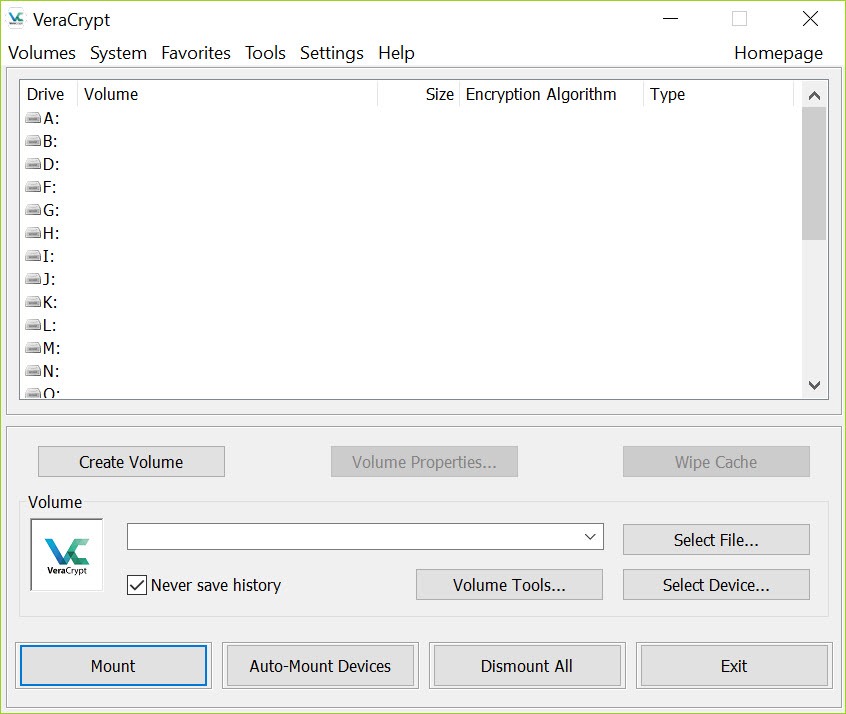
The simplest use is a file container. You pick a size, a password and a file system, and the result is a single file that mounts as a drive letter when you supply the password. Put documents on it, dismount it, and the file is an opaque blob that can be copied to a USB stick or a backup drive like any other. Containers are the right choice for a folder of sensitive work inside an otherwise normal machine. Sending a single encrypted document to someone else is simpler with an archiver that supports encrypted archives, since the recipient needs nothing installed beyond that.
Partition encryption applies the same idea to a whole partition or removable drive, with no container file to manage and no size to decide in advance. System encryption goes furthest. The boot drive is encrypted in place while you keep working, and from then on a password prompt appears before the operating system loads. Without it, the drive shows nothing but random data, which is what you want on a laptop that travels.
VeraCrypt supports system encryption on modern UEFI machines with secure boot, and the process creates a rescue disk image you must write to a USB stick before it proceeds.
Ciphers and the iterations multiplier
AES is the default cipher in VeraCrypt and the fastest, since current processors accelerate it in hardware. Serpent, Twofish, Camellia and Kuznyechik are available for people who distrust any single algorithm, and cascades run two or three of them in sequence, so breaking the data would require breaking every cipher in the chain. Cascades are slower, and on a machine with hardware AES the difference is noticeable, so plain AES is the sensible choice for most volumes.
The password is strengthened before it ever becomes a key. A hash function runs hundreds of thousands of iterations over it, and the personal iterations multiplier, or PIM, lets you raise or lower that count. A higher PIM makes each password guess slower for an attacker and each mount slower for you, which is the trade.
A lower PIM paired with a very long password keeps mounting quick. Forgetting the PIM you set is as fatal as forgetting the password, because the volume will not open without both.
Keyfiles and plausible deniability
Keyfiles add a second factor. Any file, an image, a document or a file generated by the program itself, can be required alongside the password, and a volume that needs a keyfile stored on a USB stick cannot be opened by someone who only learned the password. Smart cards and security tokens can hold keyfiles as well. Passwords and other small secrets, by contrast, belong in a password manager rather than a mounted volume, which is overkill for a few lines of text.
Hidden volumes are the feature that made this family of tools famous. A second encrypted volume lives inside the unused space of an outer one, and each opens with its own password. Reveal the outer password under pressure and the outer volume shows decoy files, while the hidden volume remains undetectable, because unused space in any encrypted volume looks like random data anyway. VeraCrypt can even run a hidden operating system alongside a decoy one.
The documentation is honest that deniability can be undermined by other software leaving traces, such as thumbnails or recent file lists, so it demands discipline to use properly.
The rescue disk and daily use
System encryption carries real risk, since a damaged boot loader means a machine that will not start, and the rescue disk exists for that. It restores the boot loader, repairs the volume header, and can decrypt the whole drive from outside if the system is beyond repair. The program refuses to encrypt the system until you have created it, which is one safeguard you should not resent.
Daily use of VeraCrypt is smoother than the feature list suggests. Favorite volumes mount with one click or automatically at logon, system favorites mount before the user logs in so services can reach them, and hot keys mount and dismount volumes from the keyboard.
A portable mode runs the program from a USB stick without installation, although mounting still needs administrator rights on the host machine. Volumes created by TrueCrypt, the predecessor this program grew from, can be opened and converted.
Keys in memory
An encrypted volume is only as private as the key that opens it, and that key sits in memory while the volume is mounted. VeraCrypt can encrypt the keys and passwords it holds in RAM, so that a memory dump or a cold boot attack on a running machine yields nothing usable. The option is off by default and disables hibernation while it is on, because a hibernation file would write the memory contents to disk.
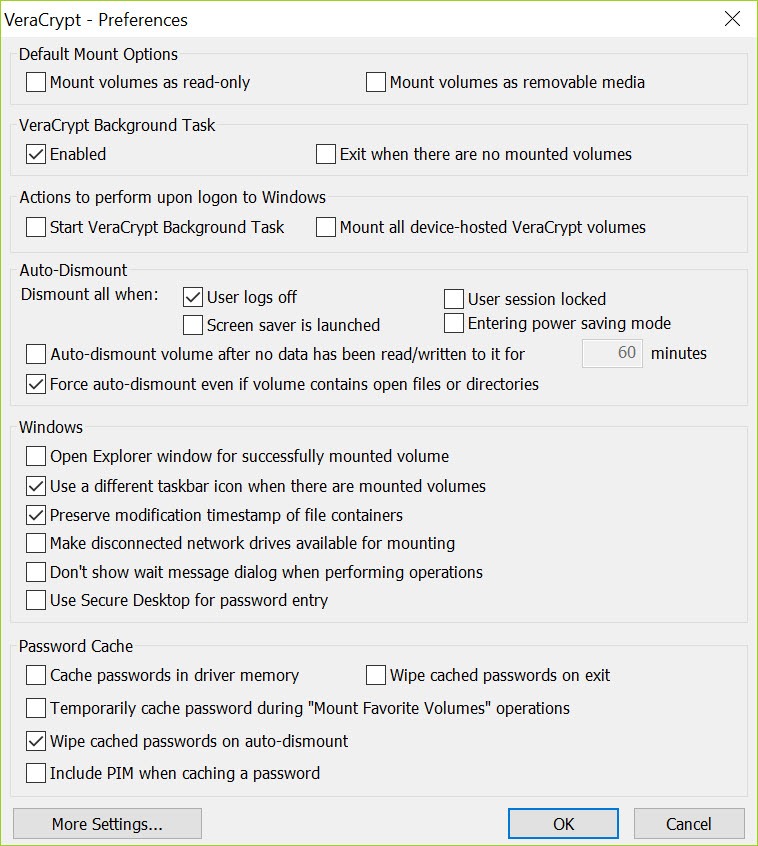
Keys are wiped when a volume is dismounted, and the program can dismount everything automatically after a period of inactivity, when the screen saver starts, when the user logs off or when power is lost on a laptop.
Those auto-dismount settings are the ones that matter most in practice, since a volume left mounted on an unattended machine defeats every other precaution.
SSDs, TRIM and performance
On a solid-state drive, the TRIM command lets the drive know which blocks are empty, and that information can reveal how much of an encrypted volume holds real data. VeraCrypt disables TRIM for non-system volumes by default and offers a choice for system encryption. Leaving it off protects deniability but can reduce the drive’s long-term write performance, and the documentation explains the trade so you can decide.
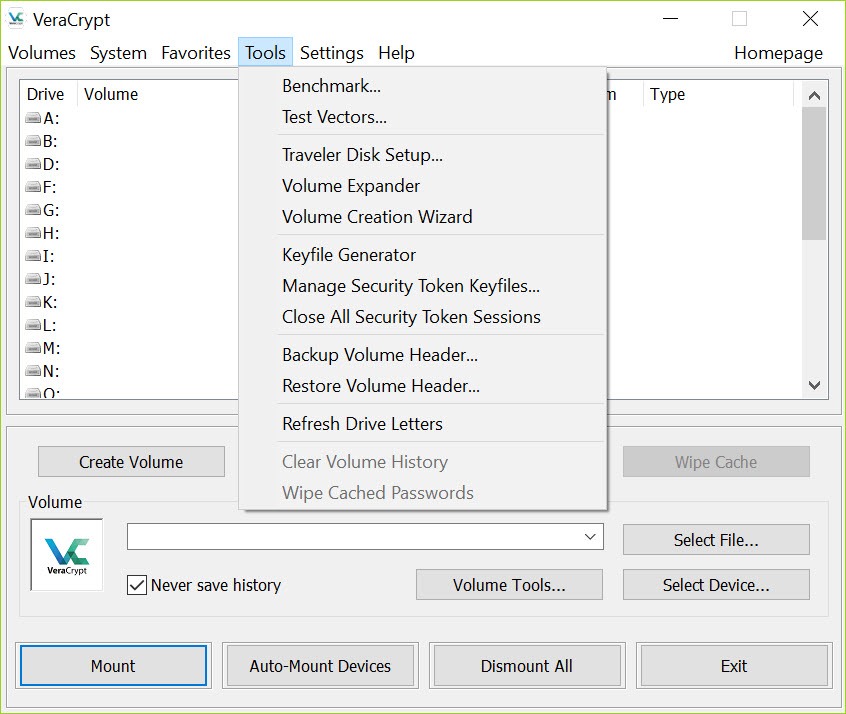
Performance otherwise is close to native for AES on hardware-accelerated processors, with encryption pipelined and spread across cores. A benchmark tool inside the program measures every cipher and cascade on your own machine, which settles the question of how much a cascade would slow you down before you commit to one.
Where other tools fit better
A container is a single large file, and cloud sync services handle it badly, re-uploading the whole file after any change. For encrypted folders that must sync through a cloud drive, Cryptomator encrypts file by file and uploads only what changed.
There is also no account, no recovery and no reset. A forgotten password or PIM, or a lost keyfile, means the data is gone for good, and no support channel can help.
That is the nature of encryption done properly, and it is the single most important thing to understand before encrypting anything you cannot afford to lose.
Conclusion
VeraCrypt suits anyone who needs storage encryption that holds up to serious scrutiny, from laptops that travel with client data to archives that must stay private for decades. Containers cover the everyday case, system encryption protects an entire machine, and the hidden volume option handles situations where even the existence of data must be deniable.
It demands care in return. Lose the password, the PIM or a keyfile and the data is gone, and the richer options take reading to use correctly. For storage encryption with no compromises and nobody else holding a spare key, it remains the reference tool.
Pros & Cons
- Encrypted containers and full system drives with pre-boot authentication
- Five ciphers plus cascades, with a built-in benchmark to compare them
- Keyfiles, security tokens and a personal iterations multiplier strengthen the password
- Hidden volumes and a hidden operating system provide plausible deniability
- Rescue disk restores the boot loader or decrypts the system from outside
- Open source with an audited format
- No recovery of any kind if the password, PIM or keyfile is lost
- Containers sync poorly through cloud services
- Cascades reduce speed noticeably on most hardware
- The interface and documentation assume a technical reader
Frequently asked questions
The personal iterations multiplier sets how many times the password is hashed before it becomes a key. A higher value slows attackers and slows mounting, and you must remember it along with the password.
No. There is no reset, no recovery and no back door. Keep the password, the PIM and any keyfiles somewhere safe and separate.
With AES on a processor that accelerates it, the effect is small. Cascades of several ciphers are noticeably slower, and the built-in benchmark shows the difference on your machine.
A second encrypted volume inside the unused space of an outer one, opened with a different password. The outer volume holds decoy files, and the hidden one cannot be proven to exist.
Because system encryption replaces the boot loader. The rescue disk repairs it, restores the volume header or decrypts the drive if the system stops booting.


