

Secret Disk
About Secret Disk
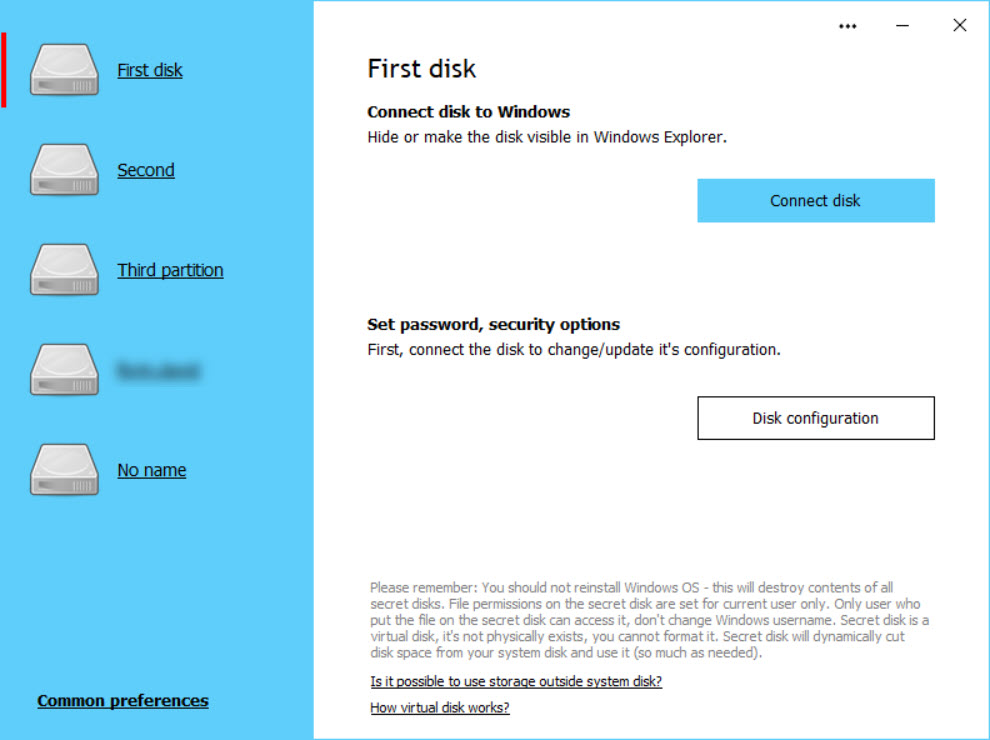
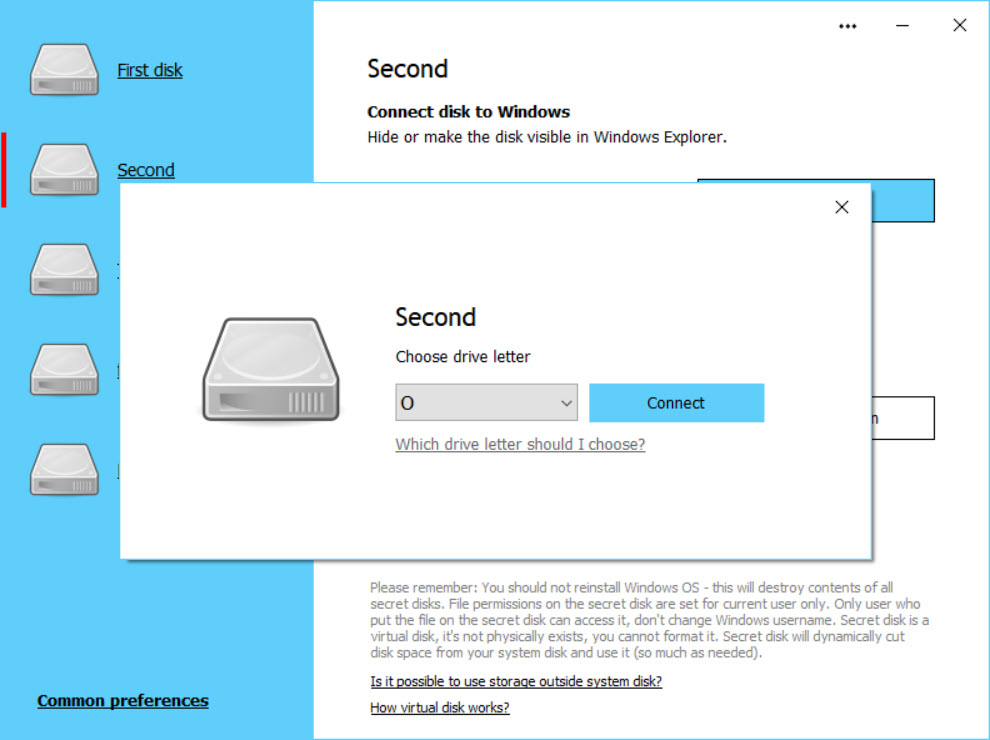
Secret Disk creates an extra drive on your computer that you can make invisible and lock behind a password whenever you want. Click a button and the drive vanishes from File Explorer, contents and all, as if it were never there. Click again, type your password, and it reappears with its own drive letter, ready to use like any normal disk. That’s the whole idea, and it’s refreshingly direct.
What makes it different from full-blown encryption tools is the approach. Instead of scrambling your files into unreadable ciphertext, the application ties a virtual disk to your data and simply controls access to it. When the disk is locked, it’s hidden and unreachable. When it’s open, your files behave exactly as they would on a regular drive. You don’t wait for anything to encrypt or decrypt, and every program you already have can read from the secret drive without special handling. The trade-off is worth understanding up front, and we’ll get to it.
For most people the appeal is obvious. You have a folder of tax documents, private photos, or work files you’d rather a housemate, a curious coworker, or a borrowed-laptop situation never stumbles onto.
Secret Disk gives you a place to put them that, by default, nobody else even knows exists.
How does the hiding actually work?
The drive you create looks and acts like a real hard disk. You assign it a free drive letter, drop files and folders onto it, and use it through File Explorer the same way you’d use your main drive. Nothing about the workflow feels unusual.
The difference shows up when you lock it. The drive disappears from the system entirely. It’s not greyed out or marked private. It’s gone from view, and so is any hint that it holds data. To bring it back you open the application and enter your password or PIN.
Someone poking around your machine sees no mysterious locked folder to get curious about, which is the quiet strength of the whole approach. What people can’t see, they don’t try to open.
Locking that doesn’t rely on you remembering
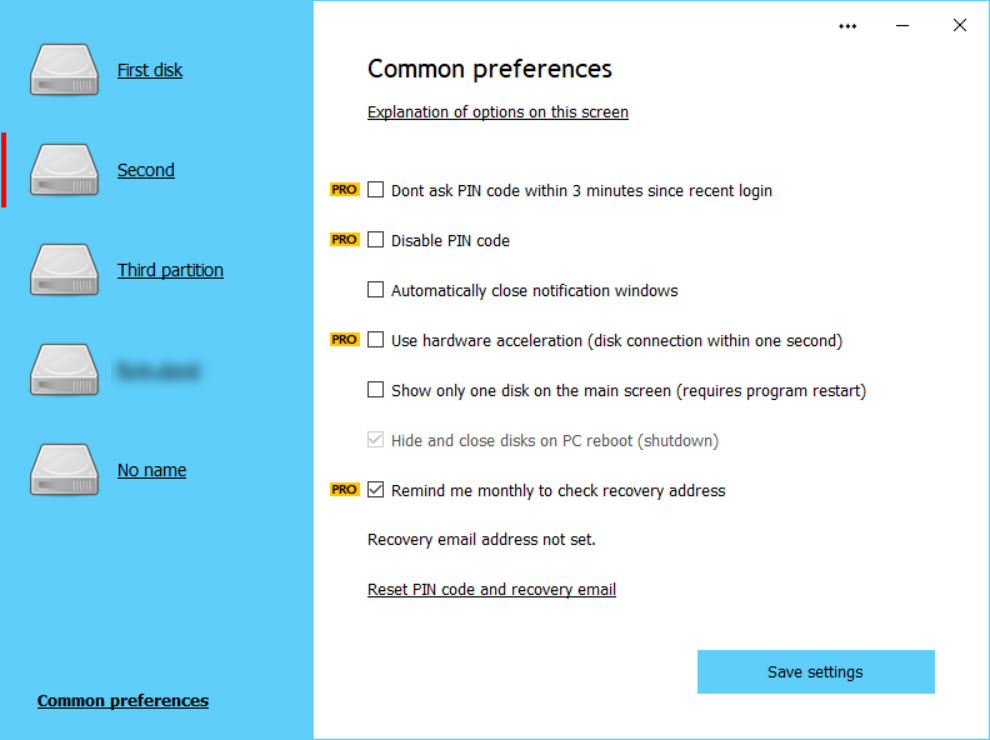
Here’s a feature that earns its place. The disk locks itself automatically in situations where you might otherwise leave it exposed. Walk away and a timer can close it after a set period. Lose power or hit a system crash, and because the disk’s state lives in volatile memory, it locks and hides on its own the moment things go wrong. You don’t have to manually secure it before every shutdown, which is exactly the kind of human error that sinks other privacy setups.
There’s also a small touch worth calling out. The application can tell you if someone tried to get into the disk while you were away, flagging the attempt the next time you sign in. It won’t stop a determined attacker, but knowing somebody went looking is information worth having.
Can you keep more than one secret drive?
Yes, and it’s handier than it sounds. You can spin up several separate disks, each with its own password, and use them to keep different categories of sensitive material apart. Financial records on one, personal documents on another, work-related files on a third. Each opens independently, so unlocking one doesn’t expose the rest.
This separation also limits your exposure if a password ever slips. One compromised disk doesn’t hand over everything else. For anyone juggling distinct kinds of private data, that compartmentalization is more practical than dumping it all behind a single lock.
The thing you need to know about encryption
Now the trade-off. Secret Disk is a hiding-and-locking tool, not an encryption suite. Its main job is to block access and conceal the drive, not to scramble the bytes on your physical disk. That means if someone with the right technical skills and direct access to your hardware goes digging at a low level, hiding alone may not stop them the way strong encryption would.
For everyday privacy against ordinary snooping, that’s usually plenty. A shared computer, a nosy guest, a work machine you don’t fully trust: the hide-and-lock model handles all of these comfortably. But if your threat model includes forensic recovery or a skilled adversary with physical access, you’ll want true volume encryption in the mix.
Tools like VeraCrypt or TrueCrypt encrypt entire volumes so the data is unreadable without the key, and they’re built for exactly that heavier scenario. There’s no shame in using both. Hiding for convenience, encryption for the files that really can’t fall into the wrong hands.
Where it fits among the alternatives
If your needs are simpler than even a virtual disk, a lighter approach might do. SecretFolder and Secure Folders hide and lock individual folders without creating a separate drive at all, which some people find tidier for a handful of items. And for protecting data you carry around, USB Flash Security extends password protection to removable drives.
What Secret Disk does better than most folder-hiders is the clean separation of a dedicated drive. Everything sensitive lives in one mountable, dismountable place rather than scattered across hidden folders you have to remember individually.
For people who think in terms of “my private drive” rather than “my private folders,” that mental model just fits.
Conclusion
Secret Disk is a clean, approachable way to keep a private drive out of sight on a shared or vulnerable computer. The one-click hiding, automatic locking, and support for multiple password-protected disks make it easy to live with, and the alert when someone goes snooping is a thoughtful extra. For everyday privacy against the people who might wander past your screen, it does the job with very little fuss.
Just go in clear-eyed about what it is. This is a tool for hiding and locking, not a fortress of encryption, and the two solve different problems. If your secrets are the ordinary kind you simply don’t want others seeing, it’s an excellent fit.
If they’re the kind that would cause real damage in the wrong hands, pair it with proper encryption and you get the best of both, convenience for the everyday and hard protection for what matters most.
Pros & Cons
- Creates a virtual drive you can hide from File Explorer with one click
- Files on an open disk behave exactly like those on a normal drive, with no decryption wait
- Locks automatically on a timer, or on power loss and system crashes
- Alerts you when someone tried to access the disk while you were away
- Supports multiple separate disks, each with its own password
- Works alongside every program you already have without special configuration
- Simple enough for non-technical users to set up in minutes
- Primarily hides and locks rather than encrypting, so it's weaker against forensic-level access
- A determined attacker with hardware access may bypass hiding alone
- Protection is only as strong as the password you choose
- Less suited to high-stakes threat models than full volume-encryption tools
- A virtual disk is more setup than some people need for just one or two folders
Frequently asked questions
It creates a virtual drive and, when you lock it, removes that drive from File Explorer entirely. The drive and everything on it become invisible until you reopen the application and enter your password.
Its core function is hiding and access control rather than encryption. It blocks access to the drive and conceals it, which covers everyday privacy, but for forensic-grade protection you'd want a dedicated volume-encryption tool as well.
Yes. The application lets you create multiple disks, each protected by its own password, so you can keep different categories of files separated and unlock them independently.
The disk locks and hides itself automatically. Because its state is held in volatile memory, a power loss or system error causes it to close on its own, so your files aren't left exposed.
Yes. While the drive is open it behaves like a standard hard disk, so any software you have installed can open, edit, and save files on it normally.
It can flag access attempts that happened while you were away, letting you know the next time you sign in that someone went looking. It's an alert, not a barrier, but a helpful one.


