Secure Folders
About Secure Folders
Most folder protection tools offer one switch. A folder is visible or hidden, open or locked, and that is the whole vocabulary. Secure Folders gives you four settings instead, applied to individual files as readily as to folders, and the extra granularity is what makes it useful rather than merely obstructive.
Four levels rather than one switch
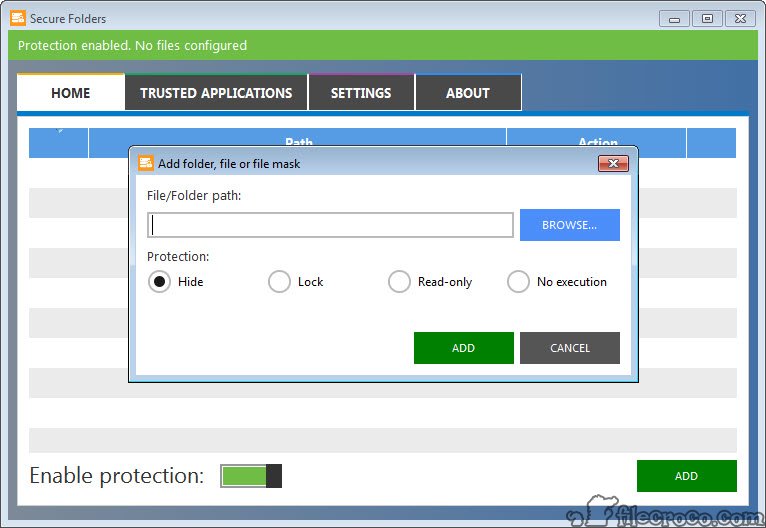
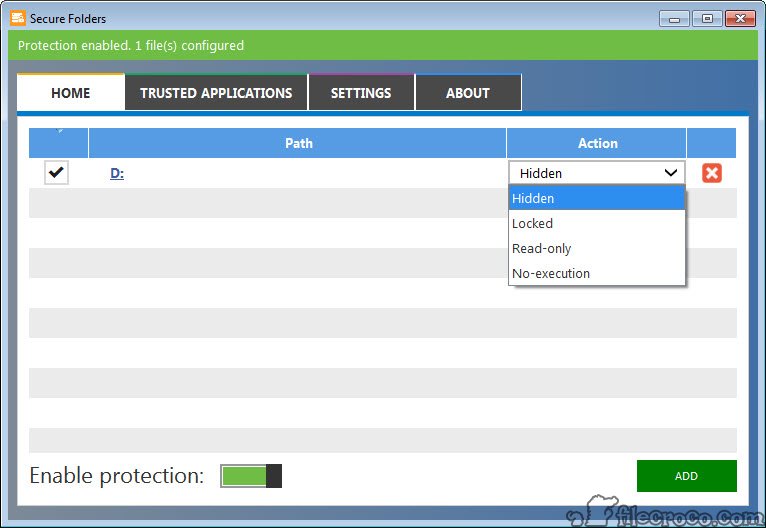
Hide removes the item from view entirely. Lock leaves it visible and refuses access. Read-only permits opening but blocks any change. No execution allows the folder to be browsed while preventing anything inside it from running.
The last two are the interesting ones. A reference folder can be readable by everyone and editable by nobody, and a downloads folder can be browsable while nothing in it launches, which suits a shared machine. For protecting a handful of documents rather than a location, an archiver with password protection is the simpler answer.
The trusted applications list
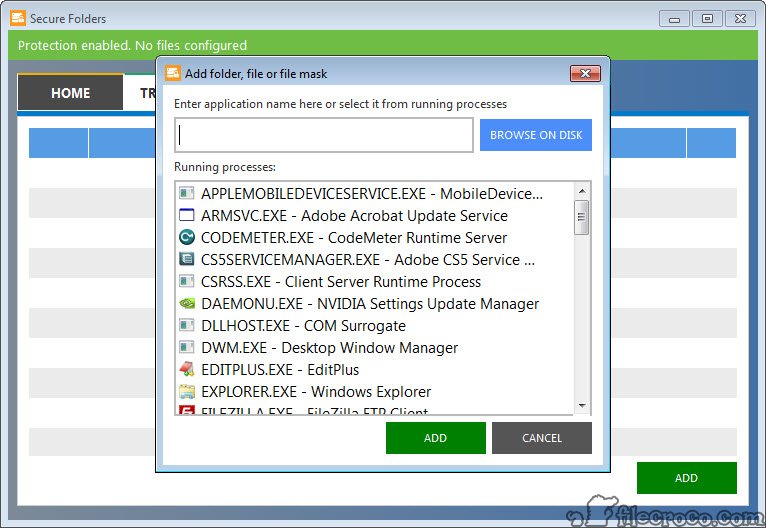
This is the feature that lifts Secure Folders above the category. Specific programs can be nominated as trusted, and those programs reach protected items normally while everything else is refused.
The value appears immediately. A backup tool keeps working through a folder the file browser cannot see, and a media player reaches a library nobody browsing will find. Protection stops being all or nothing and becomes a question of which software you trust with what.
Without it, protecting a folder means protecting it from yourself too, which is why so many tools in this category get switched off and never switched back on.
Enforcement that survives the program closing
Secure Folders does not rely on its own window being open. Ending the process does not lift the protection, which is the first thing anybody curious will try, and the arrangement holds.
The program itself takes a password, so items cannot be quietly removed from protection by somebody who finds the interface. A hotkey opens it, it can start with the system, and it runs from the command line for anyone scripting a change.
One usability complaint is documented and fair. When access is refused, the message is a bare denial with no explanation, so whoever hit it has no idea whether the file is missing, corrupt or deliberately blocked. On a shared machine that produces questions rather than understanding. When the goal is that a file should not exist rather than not be reachable, a shredder that overwrites before deleting is the correct instrument.
What the protection actually is
Here is the part that determines whether this suits your situation, and it deserves stating plainly because the category invites the wrong assumption.
Secure Folders controls access. It does not encrypt. The files sit on the disk exactly as they were, in their original form, and the protection is enforced by a component running on that installation. Take the disk out and attach it to another machine, or start the same machine from other media, and everything is readable.
So the protection is real against a person sitting at that computer with that system running, which honestly covers most household and office situations. It is not protection against somebody who takes the drive, and treating it as such is how people lose data they believed was secured.
Where the threat is theft rather than curiosity, VeraCrypt encrypts a container or a whole volume, so the contents stay unreadable wherever the disk is attached.
For files in a synchronised cloud folder, Cryptomator encrypts the contents and the filenames before they leave.
Conclusion
Secure Folders is a sensible tool for a specific and common situation, which is a shared computer where certain things should be out of reach, unchangeable or unlaunchable. The four levels are more thoughtful than the usual single switch, and the trusted applications list solves the problem that makes most folder lockers annoying enough to abandon.
Match it to the right threat. It stops a family member, a colleague or a visitor from reaching what you put behind it, and it stops nobody who can attach the drive to another machine.
If that describes your situation, it does the job neatly. If your concern is a lost laptop or a stolen disk, the files need encrypting rather than hiding, and no amount of access control substitutes for that.
Features & benefits
Pros & Cons
- Four protection levels rather than a single on and off switch
- Read-only and no-execution modes cover cases other folder tools ignore
- Trusted applications continue to reach protected items while everything else cannot
- Protection survives the program being closed or its process ended
- The interface itself is password protected against unauthorised changes
- Hotkey, startup and command-line control for setting things up once
- Controls access rather than encrypting, so the files remain readable elsewhere
- Removing the drive or booting another system defeats it entirely
- A refused access shows a bare denial with no explanation of the cause
- No longer developed, with the original maker's presence gone
- Protecting individual files scales badly compared with protecting a location
Frequently asked questions
No, despite what the category suggests. It blocks access through the running system while the files stay in their original form on the disk. Encryption is a different mechanism and needs a tool built for it.
No. Ending the process does not restore access, and the interface is password protected so items cannot be taken out of protection by somebody who finds it running.
Nominating programs that should still reach protected items. A backup tool or a media player carries on working while everything else is refused, which stops protection from getting in your own way.
No, and this is the limit to understand before relying on it. Attached to another machine, or with the same machine started from other media, the files are read normally because nothing about them was changed.


(46 votes, average: 3.85 out of 5)