

ASUS GPU Tweak III
About ASUS GPU Tweak III
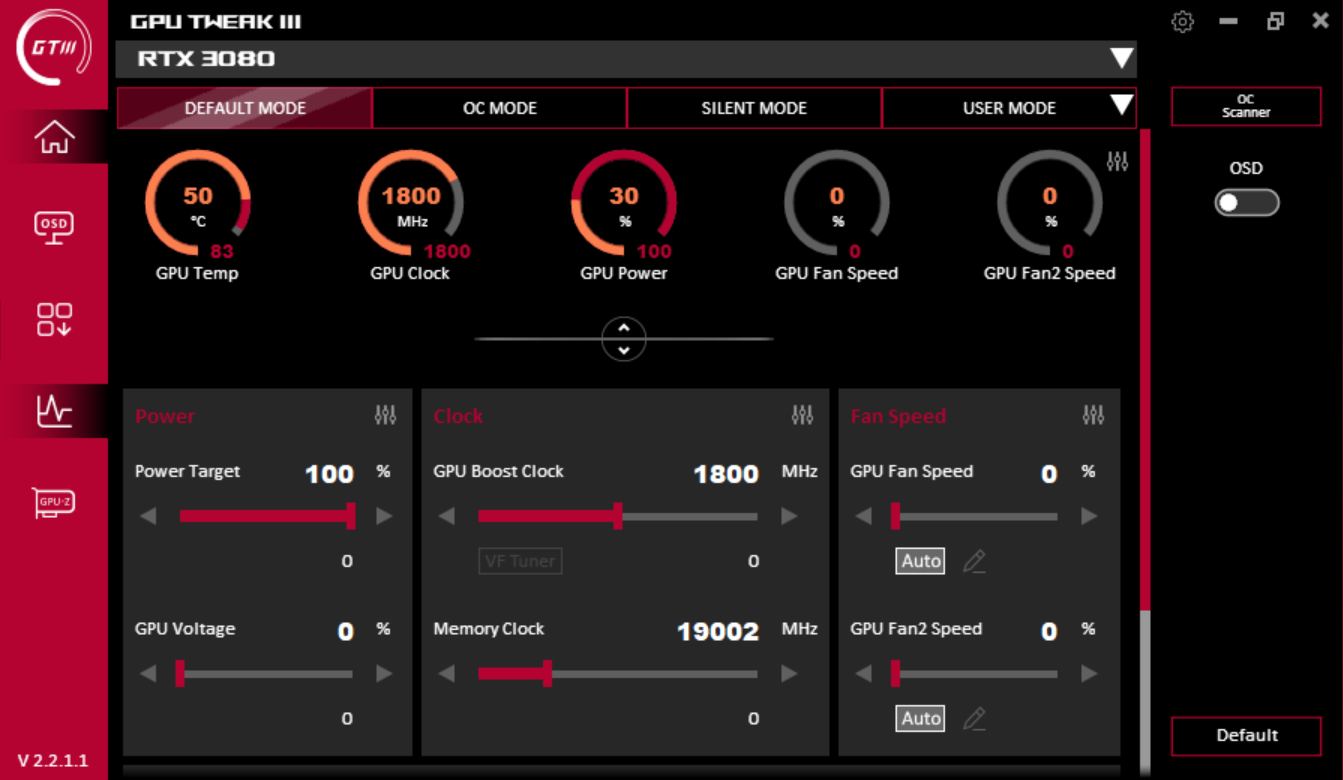
ASUS GPU Tweak III tunes a graphics card from one window. Pick a preset, OC Mode for a modest boost, Silent Mode for a quieter card, or Default to leave the driver’s settings alone, and the clocks, the power limit and the fan curve change together.
Go further and the sliders set core and memory clock offsets by hand, along with voltage and the power and temperature targets. Press OC Scanner and the card is tested at rising clocks until it finds the highest stable setting on its own, which it saves as a profile. An overlay shows frame rates and temperatures, clocks too, in the corner of any game, and a monitor window logs the same figures to a file.
It carries the maker’s name, and the first question people ask is whether it works on cards from anyone else. ASUS GPU Tweak III does, for most of what it does. The presets, the manual tuning, the OC Scanner on recent cards, the monitoring and the overlay work across brands, and reviewers have confirmed the three presets switching clocks and power on a rival’s card. A handful of features are tied to the maker’s own hardware, the extra fan headers and the power-drop LED among them.
The sections below cover the presets and the scanner, the voltage-frequency tuner, the fans and the 0dB mode, the overlay and monitoring, profiles that follow games, and where the tool stands beside the long-time favourite.
Presets and the OC Scanner
The ASUS GPU Tweak III home screen is three buttons and a set of sliders. Default hands control back to the driver. OC Mode raises clocks and the power limit by a safe margin. Silent Mode lowers the power limit, to around nine tenths on a tested card, and lets the fans rest, which is the setting for a quiet evening of light games.
Each preset is a profile that can be edited, so Silent becomes as quiet as your own tolerance allows.
Manual tuning
The ASUS GPU Tweak III sliders adjust the core and memory clock offsets, the voltage where the card permits it, the power target and the temperature target, with a lock that ties the last two together. OC Scanner automates the whole thing for recent cards from the larger of the two graphics chip families.
It runs the card through a test at increasing clocks, backs off when it finds instability, and writes the result as a profile without touching the driver’s own settings.
A return to default is always one click. For stress-testing the result properly after the scanner has finished, FurMark gives the card a sustained load that a quick scan does not.
The voltage-frequency tuner
VF Tuner in ASUS GPU Tweak III opens the curve that decides what clock the card runs at each voltage. Dragging points on the curve is how enthusiasts undervolt, holding a high clock at a lower voltage so the card runs cooler and quieter at the same speed. It is also how they push a particular voltage point higher than the preset. The current release rebuilt this screen after complaints that it was hard to use, with fewer clicks to reshape the curve and preset shapes to start from.
It is the deep end. A curve that asks too much of a chip crashes a game or the driver, and the tool rolls back to the previous settings after a crash so the machine recovers. Change one point at a time, run a long test, and save the curve as a profile only when it survives an evening.
For the same curve editing with a different interface and a long record, MSI Afterburner remains the tool most guides are written for.
Fans and the 0dB mode
The ASUS GPU Tweak III fan editor draws a curve of speed against temperature with as many points as you like, and adds two controls that most tools lack. Hysteresis sets how far the temperature must change before the fans react, so a card that hovers around a threshold does not ramp up and down every few seconds. The update period sets how often the fan speed is recalculated. Together they stop the pulsing that makes a graphics card audible even when it is cool.
0dB Fan stops the fans entirely below a temperature you choose, so a card idles in silence and the fans only start when a game warms it. Some cards do this in hardware regardless, and the tool gives software control over the exact threshold.
On cards from the maker’s own range with extra fan headers, case fans plugged into the card follow the same curve, which keeps the whole case quiet or loud together.
The overlay and the monitor
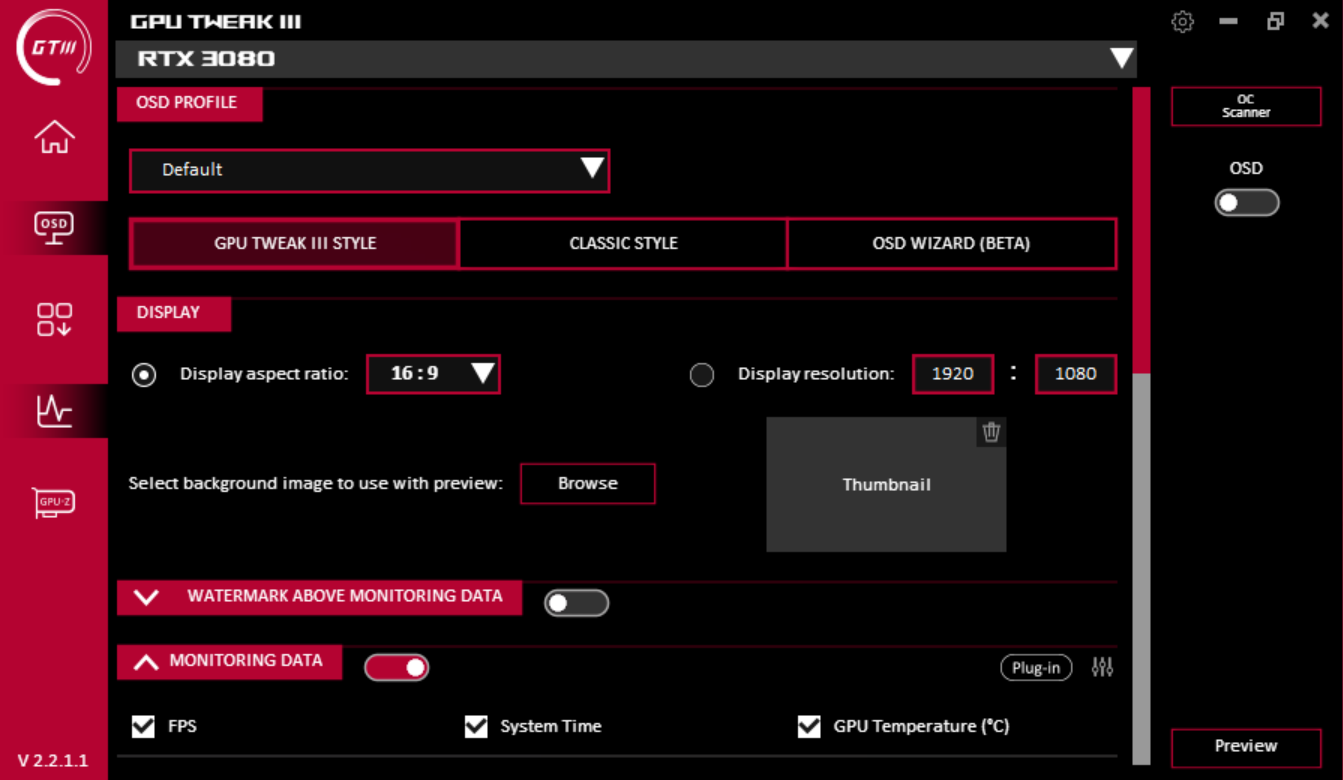
The ASUS GPU Tweak III overlay draws over any game with the figures you choose. Frame rate and frame times, with the one percent and point one percent lows added in a recent release, sit beside GPU and memory clocks, temperatures and usage, and voltage and power draw. The layout is rearranged by dragging, columns resize, and the overlay can be anchored to any corner. Two styles ship, a classic one from the previous generation of the tool and a new one with the maker’s own font.
The monitor window shows the same figures as live graphs and logs a session to a file for review afterwards. That is how a stutter in a game is traced to a thermal dip or a power limit. A built-in copy of a well-known hardware inspector sits in its own panel, and a companion mobile app shows the monitor on a phone beside the screen.
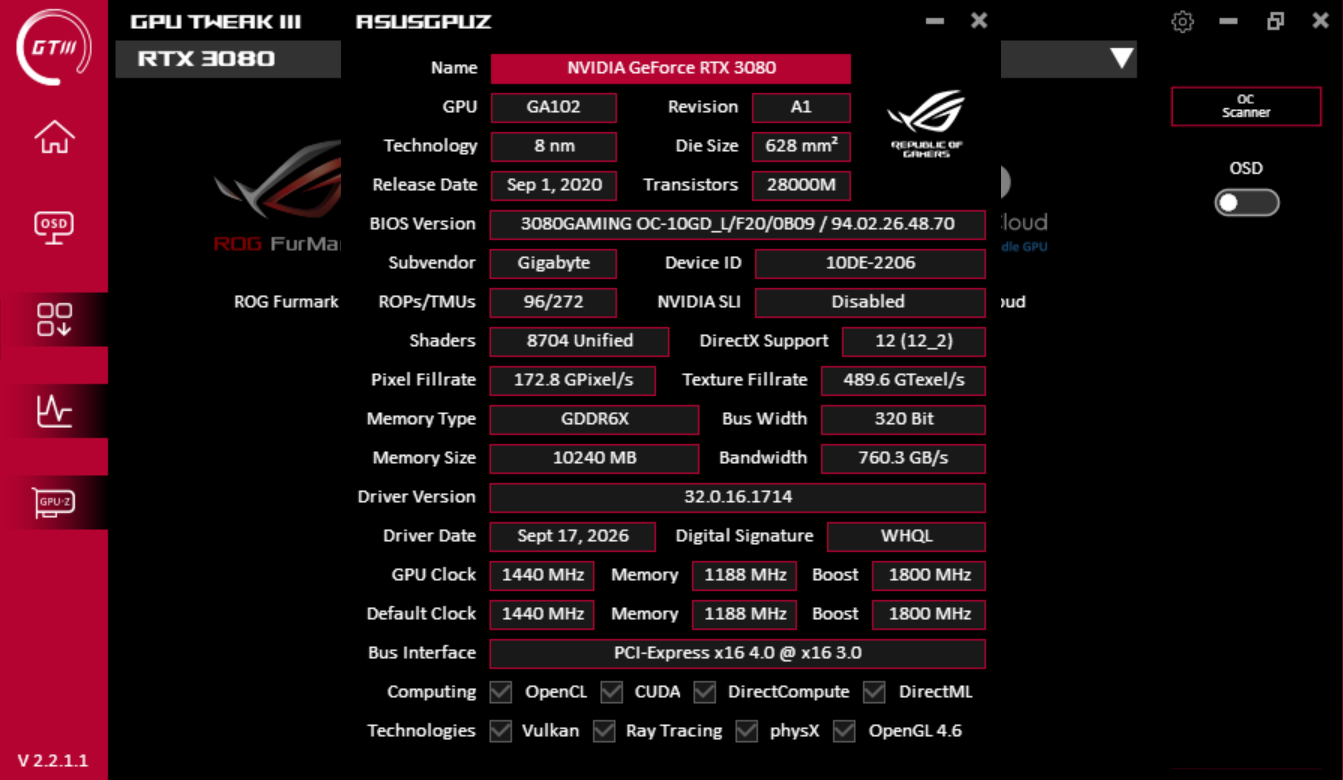
For a lighter read of what card and memory are installed before any tuning, a hardware identification tool does that one job.
Profiles that follow games
Every combination of clock, fan and overlay settings in ASUS GPU Tweak III saves as a profile, and Profile Connect links a profile to a game or a program. The tool scans the machine for installed games, and any it misses can be added by pointing at the executable. Launch the game and the matching profile applies, close it and the default returns. A competitive shooter runs with the fans loud and the clocks high while a film plays in silence, with no clicks between.
Overlay profiles work the same way, with a different set of figures for each game. Several cards in one machine save into one combined profile. The tool also adds its own touches, a warning when the power supply’s voltage drops on cards with the detector for it, and an automatic shutdown timer that can be adjusted in the settings.
Beside the long-time favourite
The comparison every reviewer makes for ASUS GPU Tweak III is with the tuning tool from a rival board maker that has been the default for years. That tool has the longer record, the larger body of guides and the wider habit among enthusiasts. This one answers with features the other lacks. The fan hysteresis and update period, the 0dB threshold, the profiles that follow games, the logged monitoring, and presets that work in one click on a card from any brand. The interface is busier, and a few owners find the number of panels more than the job needs.
Two cautions carry over from the whole category. Overclocking and undervolting change how the card behaves, so test every change under load and keep a profile that returns to default. And a card from another brand gets most of the tool, not all of it, with the hardware-tied extras reserved for the maker’s own.
Conclusion
ASUS GPU Tweak III suits anyone who wants to tune a graphics card for speed or for silence, from a newcomer who presses OC Scanner once to an enthusiast reshaping the voltage curve. It works on far more than the maker’s own cards. The presets, the fan controls with hysteresis and 0dB, the logging monitor and the game-linked profiles are what set it apart.
It is busier than it needs to be, a few of its best touches are reserved for one brand’s hardware, and every tuning change wants a long test. Start with a preset, let the scanner find the ceiling, set the 0dB threshold, and link a profile to the game that matters most.
Pros & Cons
- One-click Default, OC and Silent presets that work on cards from any brand
- OC Scanner that finds a stable overclock automatically on recent cards
- VF Tuner for undervolting and curve editing, rebuilt to need fewer clicks
- Fan curves with hysteresis and update period, plus a 0dB silent threshold
- Overlay with frame time lows and a monitor that logs sessions to a file
- Profiles linked to games that switch automatically
- Interface is busier than the job sometimes needs
- Some features are tied to the maker's own cards
- OC Scanner supports only recent cards from one chip family
- Overclocking carries the usual risk of instability until tested
Frequently asked questions
Yes, for most features. Presets and manual tuning work across brands, as do the OC Scanner on supported cards and the monitoring and overlay. Extra fan headers and the power-drop warning are tied to the maker's own cards.
It tests the card at rising clocks until it finds the highest stable setting. The result is saved as a profile without changing the driver's defaults.
Enable 0dB Fan in the fan editor and set the temperature below which the fans stop. Hysteresis and the update period smooth the fans when the card warms.
Yes. Profile Connect links a tuning profile and an overlay profile to a game, applies them when it launches and restores the default when it closes.
Yes. VF Tuner edits the voltage-frequency curve, so a high clock is held at a lower voltage for a cooler, quieter card. Test each change under a long load and save the curve as a profile only when it holds.


