

SpeedFan


About SpeedFan
SpeedFan reads the temperatures, voltages and fan speeds that a motherboard’s sensor chip reports, and on hardware that allows it, takes over the fans. You decide which temperature each fan should respond to, how warm is acceptable and how warm is alarming, and the program raises and lowers fan speeds to keep the system inside those limits. The usual result is a quieter PC at idle and a cooler one under load, with no trip into the firmware setup.
It is also a program whose development stopped long ago. The sensor chip support it carries is extensive for older hardware and thin for current boards, so whether it does anything useful on a given machine depends on the chip the motherboard uses.
Owners of older desktops and home servers keep it because nothing else matched its control, while owners of recent boards often find it reports temperatures but cannot touch a single fan.
What it reads, and from where
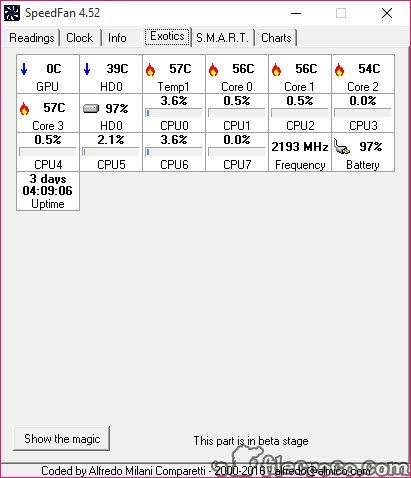
The main window of SpeedFan lists every sensor the program could identify. Temperatures come from the motherboard’s monitoring chip, from the processor’s own sensors, from graphics cards and from hard drives through their SMART data, which the program reads even from SCSI drives. Voltages and fan tachometer readings sit beside them, each with a small arrow showing whether the value is rising or falling.
The drive section goes beyond temperature. SpeedFan displays the full SMART attribute table for each disk and condenses it into a fitness percentage, which drops sharply when attributes that predict failure start moving.
For a dedicated view of drive health with alerts, a SMART monitoring tool is more thorough, but having the warning inside the same window as the fan controls is convenient on an always-on machine.
Automatic fan control, the simple way
The basic method in SpeedFan pairs each fan with one or more temperatures. For every sensor you set a desired temperature and a warning temperature, and for every fan a minimum and maximum speed. Tick Automatic fan speed, and the program slows fans while temperatures sit below the desired level and speeds them up as they approach the warning, with the response spread across the range you allowed.
The hard part is finding out which control moves which fan, because the chip reports them as PWM1, PWM2 and so on with no names. The method that works is to lower one control at a time while watching the fan readings and feeling for the fan that slowed.
Do that before enabling automatic mode, and set the minimum speeds high enough that no fan stops entirely, since a fan that stops may not restart until the PWM climbs well above the point where it stalled.
Response curves for fine control
Advanced Fan Control in SpeedFan replaces the two-point approach with curves. Each fan gets a graph of speed against temperature, with control points you drag or nudge in steps of one or ten percent. Several temperatures can drive the same fan at once, so a case fan can respond to both the processor and the drive bay. A hysteresis setting stops the fan hunting up and down around a threshold.
That is the feature long-time users refuse to give up. A gentle slope at low temperatures keeps a living room PC inaudible, and a steep rise near the limit keeps a summer gaming session in check. The whole profile lives in the program rather than in a firmware menu that takes a reboot to reach. Modern tools reproduce the idea, and FanControl does it with far broader hardware support on current boards, which is where most new users should start.
Charts and events
The Charts tab in SpeedFan plots any combination of readings over time, which is how you discover that a drive runs ten degrees hotter at night when the room’s air conditioning is off. Readings can also be logged to a file for longer studies, with the PWM values included, so a week of data shows whether a fan curve is doing what you intended.
Events add automation beyond fans. When a temperature crosses a value you choose, or a fan reading drops, the program can show a message, play a sound, send an email, run a program or shut the system down.
A home server that mails its owner when a drive climbs past a threshold, then powers off if it keeps climbing, is the sort of setup this was built for.
The configuration that decides everything
Whether fans respond at all is settled in the Advanced tab of the SpeedFan configuration. Each sensor chip exposes its PWM modes there, and on many boards the controls do nothing until a mode is switched from the firmware’s automatic setting to software controlled. Some chips offer a choice between PWM and plain voltage output per fan, which matters for three-pin fans that ignore PWM. A Remember it box keeps the change across restarts and resumes from standby.
Administrator rights are required for this low-level access, and the program should never run alongside another tool that also drives the fans, since the two will fight. On recent boards the chip may simply be absent from the supported list.
The program then shows what it can read and offers nothing to adjust, and a hardware monitor that only reads sensors becomes the more practical choice.
Conclusion
SpeedFan suits owners of older desktops and home servers who want fan curves, temperature-driven events and SMART monitoring in one small window, and who are prepared to work out which control moves which fan. On supported hardware its control is as fine as anything that followed.
On recent motherboards it is often a monitor and nothing more, and its configuration rewards patience over enthusiasm. Check what it can control on your board first, and if the answer is nothing, a newer tool with current chip support is the better route to a quiet machine.
Features & benefits
Pros & Cons
- Automatic fan control from any combination of temperature sensors
- Response curves with hysteresis for quiet idling and firm cooling under load
- Reads motherboard, processor, graphics card and SMART drive temperatures
- Charts and logs reveal patterns over hours or days
- Events can send email, run a program or shut down on a temperature threshold
- Development stopped, so recent sensor chips are often unsupported
- Matching PWM controls to fans is manual trial and error
- A wrong configuration can stop a fan and overheat a component
- Needs administrator rights and conflicts with other fan tools
Frequently asked questions
Either the sensor chip's PWM mode is still set to the firmware's automatic setting, which you change to software controlled in the Advanced configuration tab, or the chip is not in the supported list and cannot be controlled at all.
Lower one control at a time while watching the fan speed readings and listening to the case. Note each match before switching on automatic mode.
Not by itself, but a fan set too low can stop and let a component overheat. Keep minimum speeds above the stall point and set warning temperatures with alerts.
Sometimes for reading, rarely for control. Its chip support ends with hardware from the time development stopped, so a current board often needs a newer tool.


