

RetroShare
About RetroShare
RetroShare is a private communication and file sharing network that you build yourself, one friend at a time. There is no central server and no account with a provider. You create a cryptographic identity, exchange certificates with people you trust, and your computers connect directly to each other over encrypted links. Chat, mail, forums, channels, boards and shared folders then run across that web of friends and nothing else.
The result is a closed network that outsiders cannot join, search or monitor. Only your direct friends know your address, and traffic to friends of friends is relayed through the people in between. It is the opposite of a social network run from someone else’s servers, and it demands more effort in return, because every connection begins with two people swapping keys.
Certificates and the web of trust
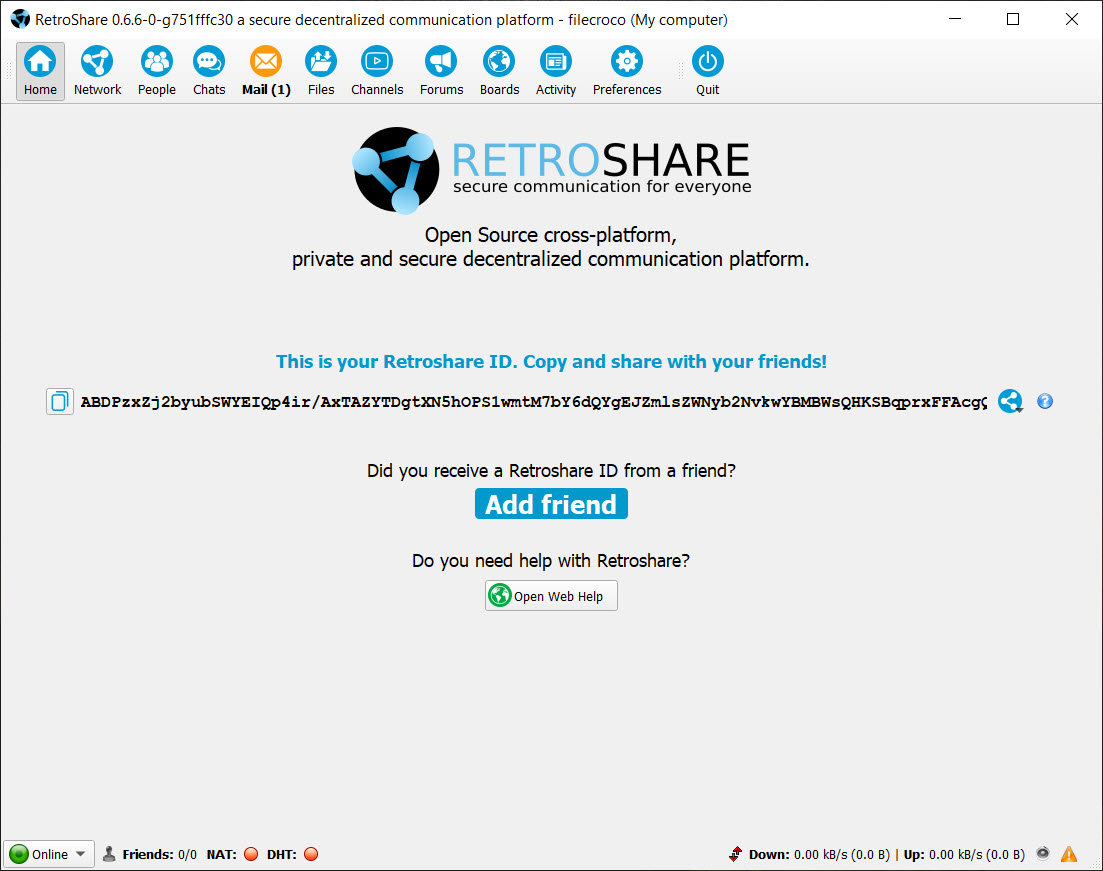
Everything starts with a certificate, a block of text that identifies your node and carries its public key. You send yours to a friend by any channel you like, paste theirs into RetroShare, and once both sides accept, the nodes find each other and connect. A distributed hash table helps locate friends whose addresses change, and that discovery service can be switched off for a stricter, fully closed network.
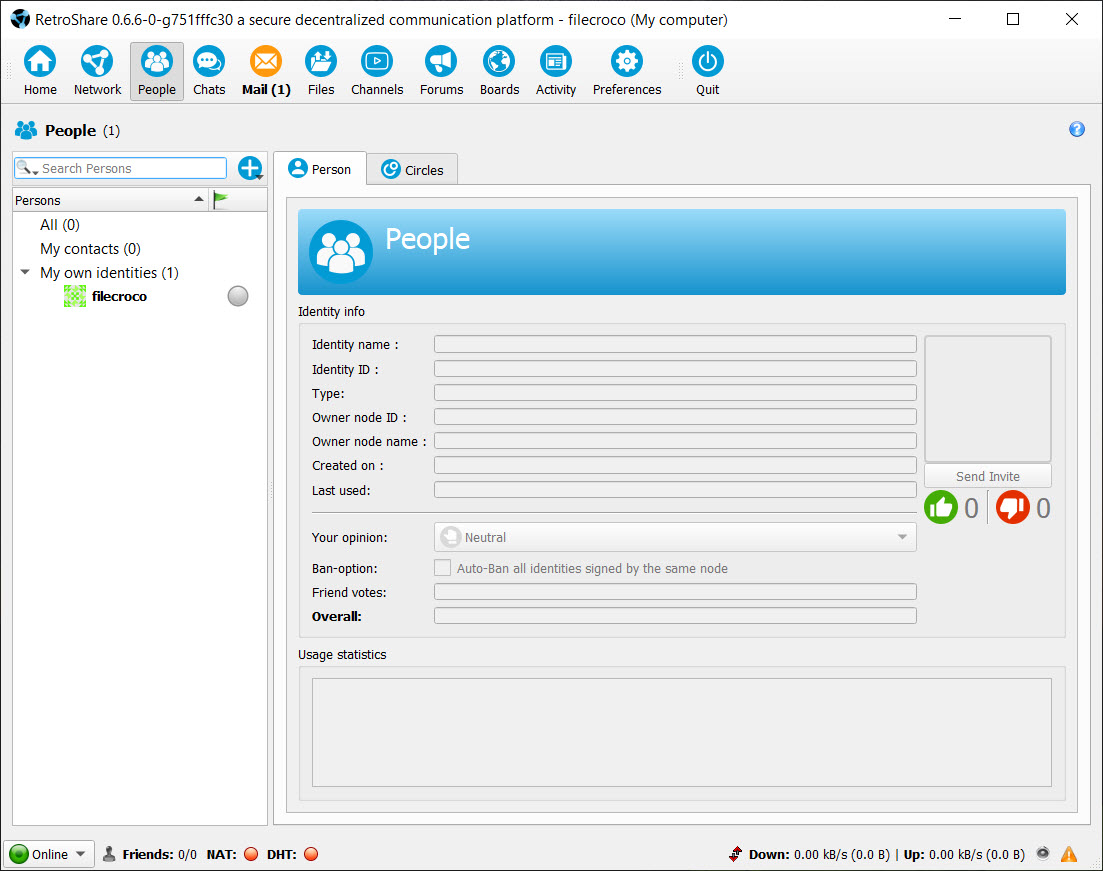
Trust is explicit. Each node can also hold several identities, pseudonymous ones for forums and boards alongside the real one tied to your friends, so what you post publicly need not be linked to who your friends know you as.
You sign the keys of people you have verified and set how far you trust them to vouch for others, which is the same web-of-trust model used by gpg4win for email encryption.
Friends of friends appear in a list, and you decide whether to connect to them directly or leave them reachable only through the mutual friend.
File sharing that hops through friends
Shared folders are visible to your friends, who can browse and download from them directly. The clever part is anonymous sharing beyond that circle. Searches and transfers can be routed through a chain of friends, so a file hosted by a friend of a friend reaches you without either end learning who the other is. Transfers are swarmed across several hops, and files are identified by hash, so links can be copied and shared as text.
Expect speeds to vary. Every hop adds latency, and the network is only as fast as the slowest friend in the chain, which makes it unsuited to large popular files. For those, a BitTorrent client remains the practical choice, while this network excels at sharing privately within a group.
Messaging and calls
Instant chat works one to one or in chat lobbies that friends can join, with a distance-chat option that reaches anonymous identities beyond your direct friends. Mail is store-and-forward and encrypted end to end, so a message to a friend who is offline waits with your mutual friends until it can be delivered.
Voice and video calls exist through a plugin, flagged as experimental, and quality depends heavily on whether the two nodes connect directly. For everyday private messaging with a phone in the picture, Signal Desktop is far simpler.
The strength of RetroShare is that messaging and files share one identity and one trust network.
Publishing inside the network
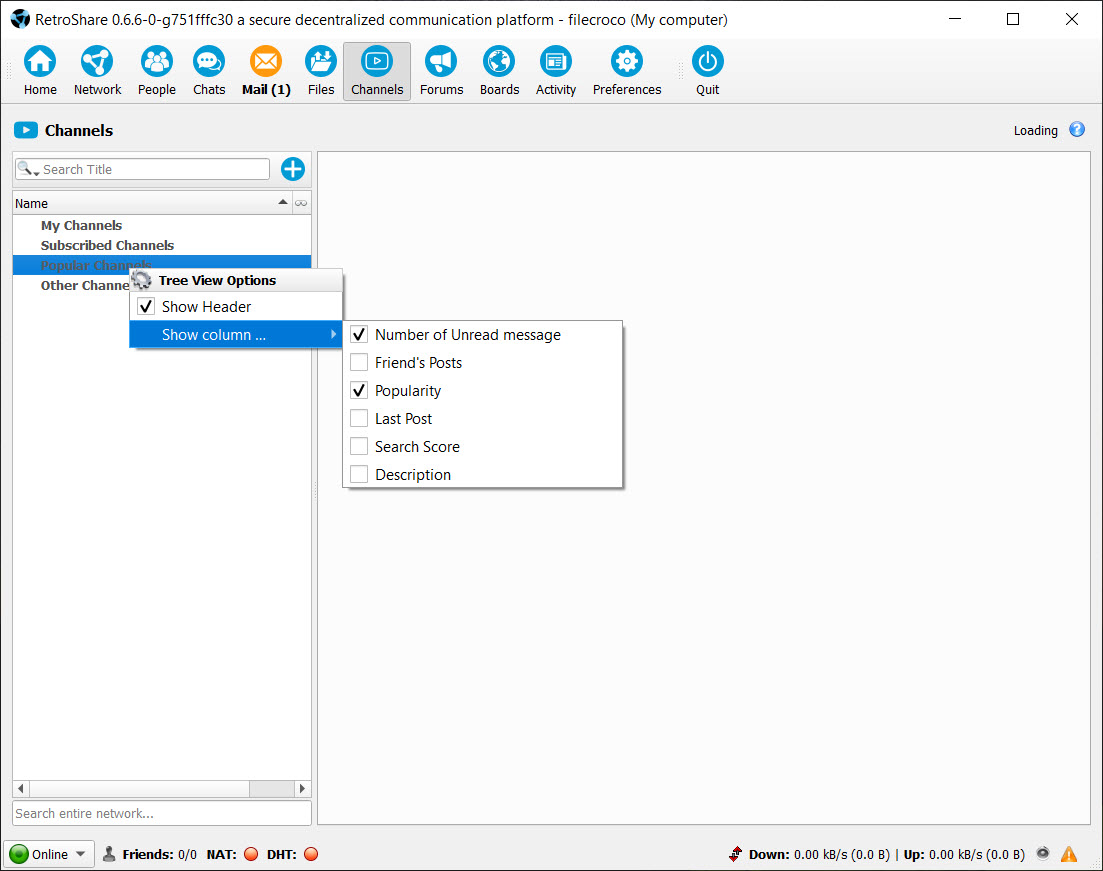
Three publishing tools give the network its community character. Forums work like message boards, with posts that can be signed or anonymous and that sync between friends whenever they are online, so you can read and write offline and let the network catch up later. Channels are subscription feeds where the owner pushes files or posts and subscribers receive them automatically, a private podcast or release channel in effect.
Boards collect links and images with votes and comments, a small private version of a link aggregator. Groups you leave are cleaned up automatically after a period without subscribers, which stops abandoned forums from piling up.
Circles restrict any of these to a chosen set of identities, so a family forum stays a family forum.
Hidden nodes over Tor and I2P
For people who want their address hidden even from friends, a node can be created as a hidden service over Tor or I2P. RetroShare sets up the hidden service itself when a Tor executable is present, and in that mode all the usual plumbing, from port forwarding to relays, becomes unnecessary.
Hidden nodes connect reliably through hostile networks because Tor is hard to filter, though noticeably slower. One practical note from the project’s own guidance. A hidden node can be reached by ordinary nodes but not the other way round, so mixed networks need care when adding friends.
Run as a regular node when speed matters and friends are trusted, and as a hidden one when location privacy comes first.
Conclusion
RetroShare suits groups who want private communication and sharing with no provider in the middle, from families and clubs to activists and researchers who need a closed network they fully control. The combination of trust-based friends, multi-hop sharing and offline forums is unusual and effective.
It is work to set up, slow for big files and only as lively as the friends you bring to it. For those willing to trade convenience for independence, few tools offer this much under your own control.
Features & benefits
Pros & Cons
- No central server, provider or account, only direct encrypted links between friends
- Messaging, publishing and file sharing share one identity
- Anonymous multi-hop file search and transfer beyond direct friends
- Forums and mail work offline and sync when friends reconnect
- Hidden node mode over Tor or I2P hides your address from everyone
- Every connection requires a manual certificate exchange
- Transfer speeds depend on the slowest friend in the chain
- Voice and video calls are experimental
- Small networks feel empty until enough friends join
Frequently asked questions
Yes. The network is friend-to-friend, so you exchange certificates with people you trust and reach others through them. Without friends, there is nothing to connect to.
Only your friends can browse your shared folders directly. Anonymous sharing to friends of friends routes through intermediaries, so neither end learns the other's address.
Create the node as a hidden service over Tor or I2P. The program configures the hidden service itself when Tor is installed, and your address stays hidden even from friends.
Mail and forum posts are stored and forwarded through mutual friends, so they arrive once the recipient reconnects. Direct chat and file transfers need both nodes online.


