

UAC Pass
About UAC Pass
Some programs need elevated rights every single time they run, and the consent prompt that appears becomes a reflex you stop reading within a week. The usual response is to drag the protection slider down, which is the worst possible answer because it hands silent elevation to everything on the machine. UAC Pass offers the narrow version instead, removing the prompt for one program you chose and leaving it in place for everything else.
The mechanism is not a bypass in the sense of defeating anything. It creates a scheduled task configured to run with the highest privileges, then a shortcut that triggers that task. Tasks set that way have always started without a consent prompt, because the scheduler was designed to run things unattended.
Drag, drop, done
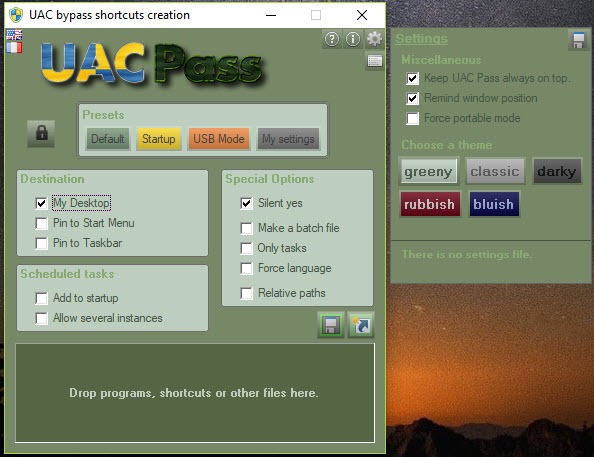
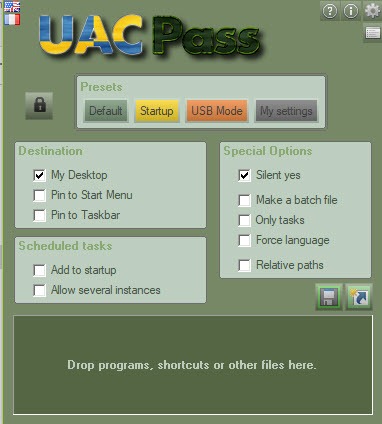
Using UAC Pass is one gesture. Drop a program, a shortcut or a file onto the window and it builds both pieces, the task and the shortcut, in one step.
Presets cover the situations people actually want. A desktop shortcut is the default and suits most cases. Others produce an entry that runs at startup, or a shortcut intended for a removable drive so the arrangement travels with it.
Beyond the presets sit options for allowing multiple instances at once, producing a batch file rather than a shortcut, using relative paths, and pinning the result to the start menu or the taskbar. The same options are available as command-line arguments, so a shortcut to the tool itself can carry your preferred settings.
Keeping track of what you created
The feature that separates this from a one-line scheduler recipe is the list. Every task made through the program appears in it, and from there entries can be launched, deleted individually, or removed all at once, with a button that opens the scheduler directly if you want to inspect one properly.
That matters because the alternative arrangement, building tasks by hand, leaves you with entries scattered among the several hundred the system already has, and no memory of which ones you added or why.
For a wider view of what starts automatically on a machine, including tasks created this way, Autoruns lists every startup location at once and is the tool for auditing a system somebody else configured.
The narrow exception is the right shape
The argument for the UAC Pass approach is the one that applies across security configuration generally. A global setting that switches protection off is easy and indiscriminate. A per-item exception is more work and affects only the thing you decided about.
That principle shows up repeatedly in tools worth using. A utility that carves per-file exceptions rather than disabling the scanner takes the same position about antivirus exclusions, and the reasoning transfers directly.
Where UAC Pass improves on the manual scheduler approach is not capability but discipline. Both produce the same task. One of them keeps a record.
What it asks you to think about
The maker is unusually straight about this, and the warning deserves repeating rather than softening. A shortcut made this way runs its target at the highest elevation, permanently and silently, so each one you create is a hole you deliberately opened.
Two consequences follow. The task points at a path, so if the program at that path is ever replaced or updated into something else, the replacement inherits the same silent elevation. And the maker’s specific advice is to avoid doing this for programs that connect to services you do not trust, since a compromised application with standing elevation is a considerably worse problem than one without.
The startup preset deserves extra thought for the same reason, because it combines silent elevation with running unprompted at every login.
Checking your work, and one reassurance
Confirming what is actually running elevated on a machine takes a moment with Process Explorer, which shows the integrity level of every process and settles whether an entry did what you intended.
For the broader habit of understanding a change before making it, a configuration tool that marks each setting with a risk level is a good model for how decisions like this should be presented, and a reminder that UAC Pass offers no such indicator.
One reassurance to close on. Creating or deleting one of these entries requires confirming an elevation prompt, so this is not a route to administrator rights for somebody who does not already have them.
Conclusion
UAC Pass solves a real irritation in the right way. Somebody who runs the same three administrative tools daily is going to stop reading those prompts eventually, and a person who stops reading prompts is worse off than one who never sees them for three programs they chose deliberately.
Use it sparingly and keep the list short. Point it at tools you understand, avoid anything that talks to the internet on your behalf, think twice before the startup preset, and review what you created every few months. Treated that way it makes a machine both more pleasant and no less protected. Treated as a way to stop being interrupted, it quietly becomes the weakest thing on the system.
Pros & Cons
- Removes the prompt for one chosen program instead of weakening protection everywhere
- Uses the scheduler as designed rather than exploiting any weakness
- Drag and drop creates both the task and the shortcut in a single step
- Keeps a list of everything it created, with individual and bulk removal
- Presets cover desktop, startup and removable drive scenarios
- Options and presets are available as command-line arguments
- Portable, with no installation and nothing left behind once entries are removed
- Every shortcut created is a permanent silent elevation for that program
- The task points at a path, so a replaced executable inherits the same privileges
- The startup preset combines silent elevation with running automatically at login
- Nothing warns you when a target program is a poor candidate for this treatment
- Managed machines may block scheduled task creation entirely
Frequently asked questions
By creating a scheduled task set to run with the highest privileges and a shortcut that triggers it. Tasks configured that way start without a prompt by design, so nothing is being defeated or exploited.
No, and that is the point of it. Protection stays active for everything on the machine except the specific programs you created shortcuts for, which is a far narrower exception than lowering the setting globally.
Yes. Creating or deleting an entry requires confirming an elevation prompt, so it cannot be used to gain rights you do not already hold. It removes a repeated prompt for someone who would have approved it anyway.
That the program runs with full rights silently, forever. If it is later compromised, or the file at that path is replaced, the replacement gets the same treatment with nothing asking your permission. Reserve it for programs you would trust with the machine.


