

SSD Tweaker
About SSD Tweaker
SSD Tweaker gathers a dozen system settings that affect solid-state drives and puts them behind checkboxes in one small window. Prefetching, search indexing, last-access time stamps, short 8.3 file names, boot tracing and a few memory options can each be switched with a click.
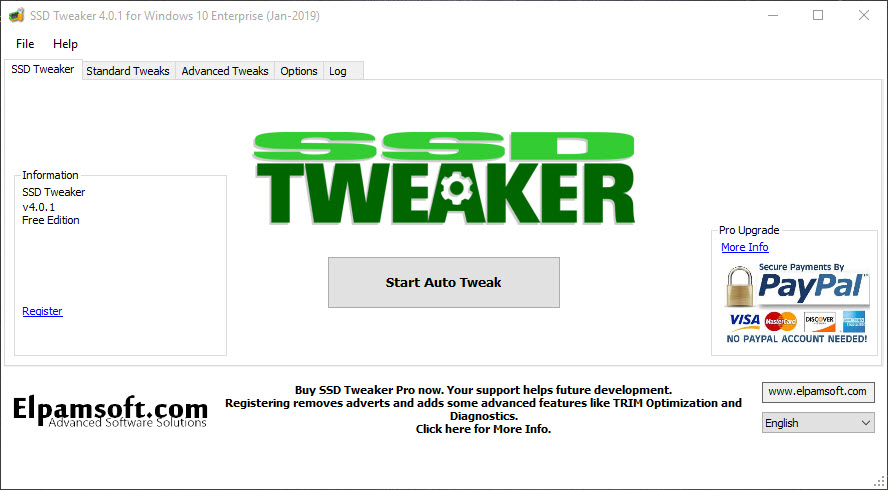
The Auto Tweak button flips them all at once. Before anything changes, the program creates a system restore point, and a reset button returns every setting to its default.
The idea dates from the first SSD generation, when systems treated every drive as a spinning disk and users had to hunt through forums for the right registry edits. Current systems detect SSDs and handle most of this on their own, which changes what the tool is for.
It is now less an optimiser and more a tidy control panel for settings you might still want to adjust deliberately.
What the checkboxes actually change
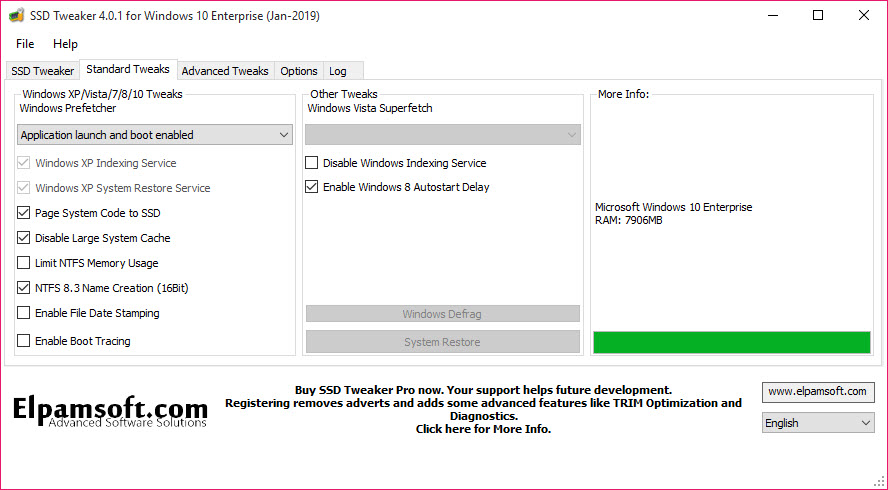
The standard tab covers settings that generate background disk activity. The prefetcher and its memory-caching companion preload program files that a fast SSD does not need preloaded. SSD Tweaker lets you turn them off or dial them back. Last-access date stamping writes to the file system every time a file is merely opened, and short 8.3 file name creation adds a second name for every file. Both can be disabled to reduce writes.
Boot tracing, the scheduled defragmenter and System Restore can be switched off too, and two memory options adjust the large system cache and NTFS memory usage.
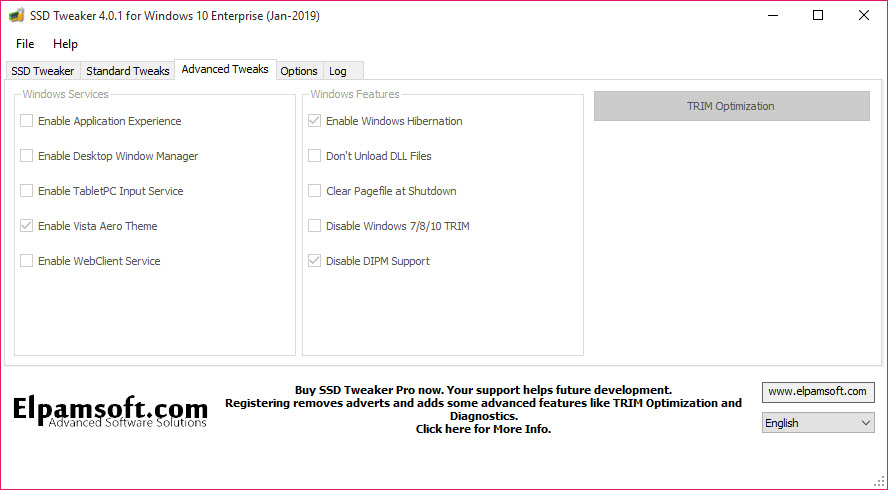
A DIPM setting enables device-initiated power management on the drive, which lets an SSD drop into low-power states on its own and helps laptop battery life.
Why Auto Tweak deserves caution
Auto Tweak applies the whole recommended set in one go, which is tempting and the reason many people install the program. The problem is that it does not show which changes it made, and several of them have side effects you may not want.
Disabling indexing entirely makes system search noticeably slower, when the better move is to exclude only the SSD from the index. Turning off 8.3 names can break old installers and some legacy programs that still expect them.
Switching off System Restore removes your undo button for every future problem, not just this one. The program mentions these risks, but only in a small help pane that is easy to skip.
Use the manual tabs, read each note, and change one thing at a time. For broader system settings with clearer explanations, a general tweaking suite is the more careful tool.
TRIM, hibernation and what the top edition adds
Press F9 and the program reports whether TRIM is active, the command that lets the drive clean up deleted blocks in the background and keeps write speeds from decaying. Seeing that status is useful, since an SSD behind an old controller driver can silently run without it.
Changing TRIM, adjusting hibernation and controlling background services are reserved for the top edition. Hibernation is the one worth thinking about, because the hibernation file occupies as much space as your memory, and desktop users who never hibernate can reclaim it.
Drive makers’ own utilities, such as Intel SSD Toolbox for its drives, handle TRIM and firmware for their hardware without an upgrade.
Where it fits today
On a current system, most of what SSD Tweaker does is already done. The defragmenter skips SSDs and runs TRIM for them, prefetching adapts to fast storage, and indexing is a settings page away. The remaining value lies in convenience and in the handful of settings the system does not expose cleanly, such as date stamping, 8.3 names and DIPM.
Treat it as a checklist rather than a performance booster. If the drive feels slow, check its health and wear first with a SMART monitor, because a worn or nearly full SSD will not be rescued by any checkbox. Then apply only the tweaks whose side effects you have read and accepted.
Conclusion
SSD Tweaker suits users who want the classic SSD settings in one place and are willing to read the notes before ticking boxes. The restore point and reset button make experimenting reasonably safe, and the TRIM check and DIPM option still earn their place.
It will not make a modern SSD faster, and its one-click mode hides what it does. Used manually and sparingly, it is a convenient control panel. Used blindly, it can slow your searches or break old programs for no gain.
Pros & Cons
- Twelve SSD-related settings in one window instead of scattered registry edits
- Creates a system restore point before changing anything
- Reset button returns all settings to their defaults
- Shows TRIM status with one key press
- DIPM control can improve laptop battery life
- Auto Tweak does not show which changes it applied
- Some tweaks slow search or break old software
- TRIM and hibernation controls are limited to the top edition
- Most of its job is already handled by current systems
Frequently asked questions
Mostly as a convenience. Current systems already skip defragmentation, run TRIM and adapt prefetching for SSDs, so the useful parts are settings like date stamping, 8.3 names and DIPM.
Yes. It creates a system restore point before applying tweaks, and a reset button restores every setting to its default.
Better not. It applies all tweaks without listing them, and some have side effects such as slower search. Use the manual tabs and change one setting at a time.


