

OldNewExplorer
About OldNewExplorer
The ribbon at the top of File Explorer has divided opinion since the day it appeared, and for the people who never stopped missing the compact command bar, OldNewExplorer is the fix. It’s a tiny shell tweaker that restores the classic Explorer look piece by piece.
Ribbon hidden or replaced, details pane back at the bottom where it lived for years, drives grouped the old way, and the This PC window cleared of the folder shortcuts nobody asked for.
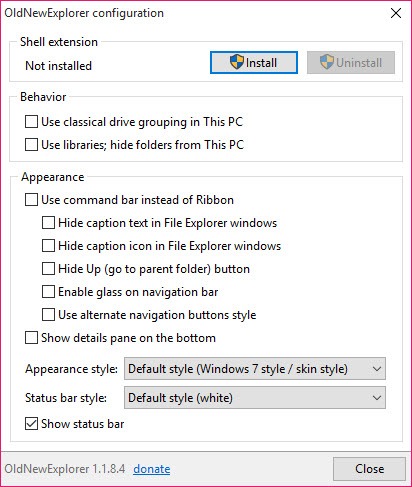
The whole program is a single small window of checkboxes. Tick what you want changed, hit Install once so the shell extension hooks in, and the changes apply to every Explorer window immediately, no restart ceremony.
Untick and the modern look returns just as fast, which makes experimenting cheap.
What each checkbox actually does
The behavior section carries the two most-wanted fixes. Classical drive grouping restores the old This PC layout, hard drives together, removable media together, instead of one long mixed list. Remove-folders strips the Documents,
Pictures, and similar shortcuts out of This PC entirely, returning the window to a clean list of drives. Anyone who works by drive letter rather than by library folders knows exactly why that option exists.
The appearance section goes further. The ribbon can be hidden outright or swapped for a command bar in the older style, the details pane moves from the right side to its classic position along the bottom (where file information reads horizontally instead of eating a vertical strip), and a status bar returns to the lower edge. Caption text and icons in Explorer title bars can be hidden individually, and a style dropdown offers a few finishes for the navigation area for people matching a broader retro theme.
None of these are registry hacks you apply blind. Everything toggles live, so you see each change the moment you tick it, and the combination you settle on is entirely yours. Half the users just want the bottom details pane. The other half rebuild the whole classic look.
How it hooks in, and why that matters
OldNewExplorer works as a shell extension rather than a theme or a patched system file, which is the polite way to do this sort of surgery. System files stay untouched, updates to the OS don’t get blocked, and removal is the same one-click Uninstall in the same little window. Compare that with the old era of hacked system libraries, where every monthly update was a gamble, and the appeal of this approach is obvious.
The flip side is fragility of a different kind. Because the tool reaches into Explorer’s interface, a redesign of Explorer itself can pull features out from under it, and that’s precisely what happened over the years.
On the ribbon-era Explorer it was built for, everything works as described. On the newest OS generation, which rebuilt Explorer’s interface entirely, this tool no longer applies, and its spiritual successor ExplorerPatcher is the project carrying that torch now.
Check which Explorer you’re actually running before installing, because that single fact decides whether this download does anything for you.
One piece of a larger retro puzzle
File Explorer is only half of the nostalgia equation, and this tool deliberately stays in its lane. The Start menu side of the classic look belongs to Open-Shell, the community continuation of the beloved Classic Shell, and pairing the two used to be the standard recipe for a fully classic desktop.
For tweaks beyond appearance, a broader tweaking utility covers hundreds of settings this program never touches.
That narrowness is a feature. The program does its dozen tricks, weighs almost nothing, runs no background process after the extension is installed, and never nags about anything.
The honest limitations are the reverse of the same coin. No new features have arrived in a long while, the compatibility window is closing rather than opening, and users on current systems are firmly pointed elsewhere. What remains is a precise instrument for the machines it still fits.
Conclusion
OldNewExplorer is for the user who considers the ribbon a demotion and the bottom details pane the correct answer. Longtime users keeping an older machine the way they like it, and retro-desktop builders assembling the classic look element by element, are its natural audience. Within its compatibility window it remains the cleanest, most reversible way to get that Explorer back.
If your machine runs the redesigned Explorer, skip it without regret and go straight to its successor. This tool’s era is specific, and inside that era it still does exactly what it promises.
Pros & Cons
- Restores the bottom details pane, classic drive grouping, and command bar
- Cleans the This PC window of forced folder shortcuts
- Every change applies live and reverses with an untick
- Shell extension approach leaves system files untouched
- Single tiny executable with no background process
- Does not work on the newest Explorer redesign
- No active development to chase future changes
- Purely cosmetic and layout scope, no functional Explorer additions
- A few style options look dated against current themes
Frequently asked questions
It can hide or replace the ribbon with a command bar, move the details pane to the bottom, restore classical drive grouping, remove the folder shortcuts from This PC, add a status bar, and adjust title bar text and icons.
No. It installs as a shell extension, leaving system files untouched, and the same window uninstalls it completely with one click.
No, every checkbox applies to Explorer windows immediately, and unticking reverses the change just as instantly, so trying combinations is risk-free.
It targets the ribbon-era File Explorer. The newest OS generation redesigned Explorer entirely, and there this tool has no effect. ExplorerPatcher is the equivalent project for that environment.
No, it only touches File Explorer. The classic Start menu is Open-Shell's territory, and the two are commonly installed together for the full retro desktop.


