

MEmu
About MEmu
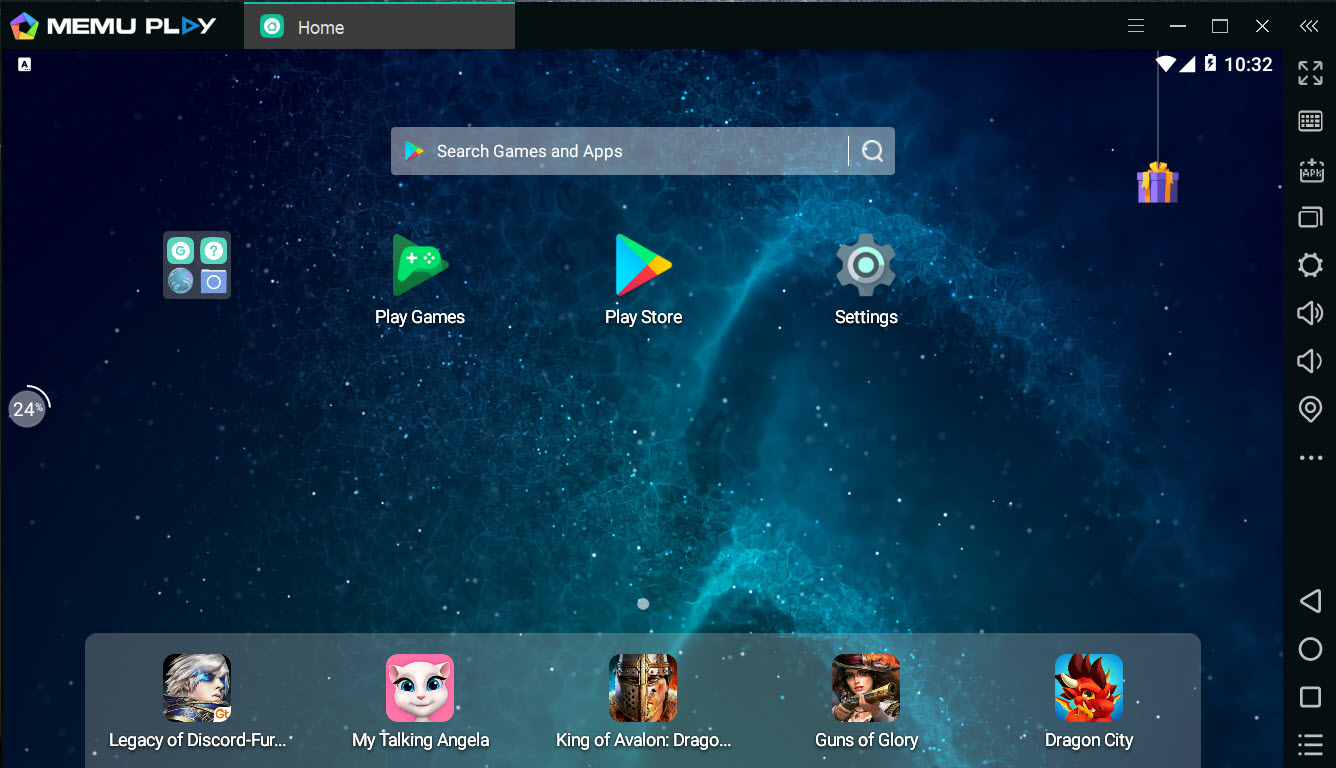
MEmu runs Android on your computer, so the games and apps built for a phone screen play out on your monitor instead, driven by your keyboard, mouse, or a gamepad. It is aimed squarely at gamers who are tired of squinting at a small display and fat-fingering touch controls. Install it, sign into the app store inside it, and the mobile game that lives on your phone is suddenly running full-size with proper controls.
The pitch is simple. A phone is a compromised gaming device. The screen is small, the controls are your thumbs covering the action, and the whole thing overheats and drains its battery after an hour. MEmu takes the same game and gives it a big screen, real input devices, and the cooling and power of a desktop. For the right kind of game, the difference is night and day.
It is not only for play, either. Developers use it to test apps without a rack of physical phones, and plenty of people simply prefer running messaging and utility apps on a desktop where typing is comfortable.
But make no mistake, the heart of this is gaming, and that is where it has spent its effort.
Key mapping is what makes it worth using
The single feature that justifies an emulator like this is control mapping, and MEmu does it well. The key-mapping editor lets you assign keyboard keys, mouse buttons, and gamepad inputs to the on-screen touch controls of any game. So a shooter that expects you to drag your thumb to aim instead responds to your mouse, while movement maps to the usual keys. For a competitive mobile shooter, that is the difference between fumbling and actually aiming.
It goes beyond simple one-key-one-tap bindings. There is a smart key system tuned for popular titles, and a macro editor that lets you chain a whole sequence of actions, keystrokes, clicks, delays, even loops, onto a single button.
For the repetitive grind that so many mobile games rely on, a macro turns ten taps into one keypress. Gamepad support rounds it out, so a controller works just as naturally as the keyboard.
Running many games, or many accounts, at once
The MEmu multi-instance manager is the other headline feature. It lets you run several independent Android environments side by side, each with its own apps, its own logged-in account, and its own performance settings. You can farm resources in one window, play a different game in a second, and keep a chat app open in a third.
This matters most to people juggling multiple accounts in the same game. You can run several copies at once, and there is even a synchronization option that mirrors your inputs across every instance, so an action you perform in one is replicated in all of them.
For multi-account players, that capability is close to essential, and it is handled more gracefully here than in a lot of rivals. Each instance can be tuned separately, with its own slice of CPU cores and memory, so you balance the load to match what your machine can handle.
Switching Android versions for stubborn apps
Here is a quieter feature that sets it apart. Most emulators lock you into one version of Android. MEmu lets you switch between multiple kernels, so when a particular game or app insists on a specific version to run correctly, you are not stuck. You download the version you need and create an instance on it.
That flexibility is useful. An older game that misbehaves on a newer kernel, or a new app that demands an up-to-date one, can each get the environment it wants without you uninstalling anything.
Combined with drag-and-drop installation, where you simply drag an app file onto the window to install it, it makes sideloading and compatibility far less painful than it usually is.
Performance and the hardware question
Performance is where MEmu has built much of its name. It tends to stay stable on mid-range machines where heavier emulators start to choke, and it works with both Intel and AMD processors, which older emulators were often picky about. A high-FPS mode and the ability to switch graphics renderers give you levers to pull when a game does not run smoothly out of the box.
That said, be realistic about your hardware. Running Android on top of your existing system is demanding by nature, and a heavy 3D game on a weak, GPU-less laptop will struggle no matter how you configure it.
On a modest machine you can get good results with conservative settings, a lower resolution, a capped frame rate, and a couple of CPU cores assigned, but the laws of physics still apply. It rewards a decent PC and merely tolerates a poor one.
How it stacks up against the competition
The Android emulator space is crowded, and MEmu has plenty of competition. BlueStacks is the best-known name, with a polished interface and broad compatibility, though it tends to be heavier on resources. LDPlayer and NoxPlayer chase the same gaming audience with their own key-mapping and multi-instance tools, and for the most resource-starved machines, a stripped-down option like SmartGaGa aims even lower.
Where this one carves out its place is the combination of strong performance on ordinary hardware, the multiple-Android-version flexibility, and a mature multi-instance system. It is not dramatically different from its closest rivals in what it does, but it does the core jobs reliably and tends to feel lighter than the biggest names.
The honest truth is that the best emulator often comes down to which one runs your specific game best, and this is well worth being one of the two or three you try.
The downsides worth weighing
It is not flawless. The sheer number of settings, while powerful, can overwhelm someone who just wants to install a game and play. Between Android versions, renderers, CPU and memory sliders, and key-mapping panels, there is more to learn than a casual user might expect.
Compatibility, too, is not perfect. Most mainstream games run fine, but a niche app here and there can misbehave, and squeezing a demanding title onto a weak machine takes patience and tinkering.
None of this is unique to this tool, every emulator shares these rough edges, but they are real, and going in expecting effortless perfection will lead to frustration.
Conclusion
MEmu is for the mobile gamer who wants their games on a real screen with real controls. The shooter player who needs mouse aim, the strategy fan running several accounts, the person whose phone simply cannot keep up with a demanding title. Its key mapping is strong, its multi-instance system is mature, and its knack for switching Android versions solves compatibility headaches that trip up other emulators.
It asks a little patience in return, since the depth of options can be daunting and a weak PC will need careful tuning. But it is light enough for ordinary hardware, reliable in the everyday jobs, and capable enough for serious play. In a field of close rivals, it earns its spot as one of the first emulators worth trying, and for many players it ends up being the one they keep.
Pros & Cons
- Excellent key-mapping editor turns touch controls into keyboard, mouse, and gamepad input
- Macro support automates repetitive in-game actions with a single keypress
- Mature multi-instance manager runs many games or accounts at once
- Input synchronization mirrors actions across instances for multi-account play
- Switches between multiple Android versions for app compatibility
- Stable performance on mid-range hardware, with Intel and AMD support
- Drag-and-drop app installation and a shared folder with your PC
- The depth of settings can overwhelm beginners
- Demanding 3D games still need capable hardware to run well
- Occasional compatibility hiccups with niche apps
- Getting smooth performance on a weak PC takes manual tuning
Frequently asked questions
It runs Android games and apps on your computer with keyboard, mouse, and gamepad controls. Most people use it to play mobile games on a big screen, though developers also use it for app testing.
You open the key-mapping editor and assign keyboard keys, mouse buttons, or gamepad inputs to a game's on-screen touch controls, so you can play with proper controls instead of simulated taps.
Yes. The multi-instance manager runs several independent Android environments side by side, each with its own account and settings, and can even synchronize inputs across them for multi-account play.
Yes. Unlike many emulators, it lets you switch between multiple Android kernels, so an app or game that needs a specific version can get the environment it requires.
It can, with conservative settings like a lower resolution, capped frame rate, and limited CPU cores. Light games and apps run acceptably, but demanding 3D titles need more capable hardware.
You can install from the built-in app store, or simply drag and drop an app file onto the window to sideload it directly, which makes adding apps outside the store straightforward.


