

FreeUndelete
About FreeUndelete
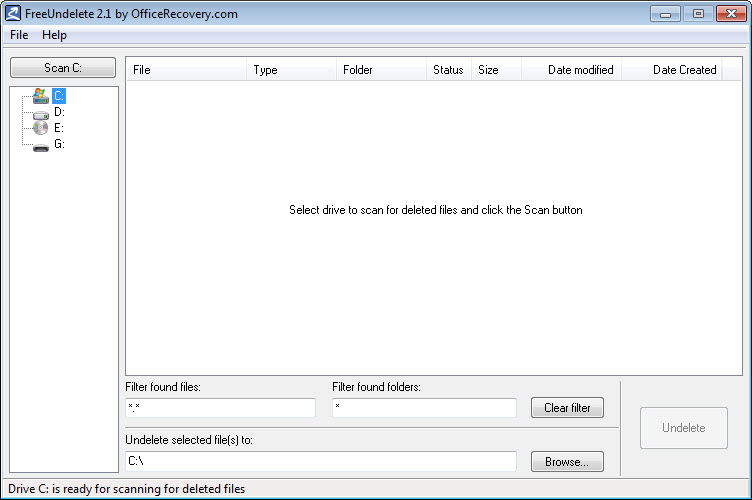
FreeUndelete brings back files that were deleted and are no longer in the Recycle Bin. Pick a drive, let it scan, and the files it finds appear in a folder tree that mirrors the drive they came from, with the deleted items marked. Tick a file or a whole folder, type a destination on another drive, press Undelete, and the files are copied there. The scan is quick, since the program reads the file tables rather than the whole disk, and it works on NTFS and the FAT family, which covers internal drives, external drives, sticks and cards.
It is an undelete tool and nothing more. FreeUndelete does not search for lost partitions, does not rebuild damaged disks, and does not carve files by their content when the file system is gone. What it does is the common case, a file emptied from the bin an hour or a week ago, and on that case it is fast and uncomplicated.
It has not been updated in a long time, and the interface shows it in a few habits that catch new users. The sections below cover the scan, the tree and the filter, what it recovers well, and where to go when it is not enough.
Scanning a drive
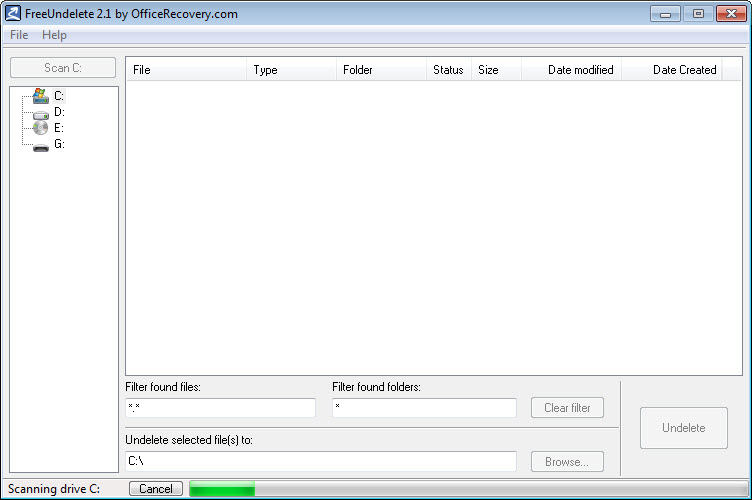
The main FreeUndelete window lists the drives it can see. Choose one and the scan starts, reading the file tables for entries that have been marked deleted but not yet reused. On a drive with few deleted files that takes seconds, and on a busy system drive a few minutes. Because the program reads the tables rather than every sector, it is one of the faster undelete scans, and it uses little of the machine while it runs.
The results arrive as the drive’s own folder structure, with the deleted files and folders placed where they used to live. That is the strength of a table-based scan. A file comes back with its name, its folder path and its dates, so a recovered document is recognisable rather than a numbered fragment.
Navigating the tree and filtering
The FreeUndelete folder tree is also where newcomers stumble. Open a folder and the window shows its contents. The way back up is a double-dot entry at the top of the list rather than an obvious button, which reviewers call out as the thing people miss.
The tree shows the possible locations of a file rather than pinpointing it, so a file whose folder was also deleted may need a little browsing to find.
Filtering and choosing what to recover
Filter Found Files narrows the list by name, which is enough when you know what you lost and not much help when you do not. There are no filters by date or type. Files and folders are ticked for recovery, and a folder tick takes everything inside it.
For a friendlier search with a wizard, a condition rating and a preview, Recuva covers the same ground with more hand-holding.
What comes back, and what does not
A deleted file is recoverable in FreeUndelete as long as nothing has been written over its space. The longer a drive is used after the deletion, the more likely a new file has taken the space, and a system drive is written to constantly. That is why the destination folder must be on a different drive. Saving a recovered file onto the drive it came from can overwrite the next file you wanted.
The program handles ordinary documents, pictures and media well on both NTFS and FAT, and users have reported it finding files that other undelete tools missed on some NTFS drives. It lists files whose space has already been reused too, which come back damaged, so check a recovered file before trusting it. For a drive that has lost its partition or its file tables entirely, an undelete tool is the wrong instrument. A partition recovery and file carving tool finds partitions and carves files when the tables are gone.
Where it stops
Age is the main FreeUndelete limit. The interface has not changed in a very long time, and the file system list stops at NTFS and FAT with no exFAT. The program needs installing, which is itself a write to a drive, so install it on a drive other than the one being recovered. There is no preview on the current build, no deep scan by content and no sorting of results by how intact they are. The filter is a name filter only.
For FAT drives that have lost their boot sector or file table, the small File Recovery tool covers a case this one does not. This one is for the deleted file on a drive that is otherwise fine, and there it does its job quickly.
Conclusion
FreeUndelete suits anyone who has emptied the Recycle Bin and wants a deleted file back from an NTFS or FAT drive quickly, with its name and folder intact. The table-based scan is fast and the folder tree makes a recovered file easy to recognise.
It is old, its filter is thin and its tree has a learning curve, and it does nothing for a drive whose tables are gone. Install it on a different drive, recover to a different drive, and move to a partition tool when the problem is bigger than a deleted file.
Pros & Cons
- Fast table-based scan that finishes in seconds to minutes
- Recovered files keep their names, folder paths and dates
- Folder tree mirrors the original drive layout
- Works on NTFS and the FAT family, including sticks and cards
- Recovers single files or whole folders in one step
- Not updated in a very long time, with an interface that confuses newcomers
- Name filter only, with no date or type filters
- No exFAT support, no preview and no content-based deep scan
- Must be installed rather than run from a stick
Frequently asked questions
Yes, as long as their space on the drive has not been reused. Scan the drive, find the files in the folder tree and recover them to a different drive.
Use the double-dot entry at the top of the folder's list. It is the way up the tree and the thing most new users miss.
No. It reads the file tables for deleted entries and needs them intact. A formatted or damaged drive needs a partition recovery or file carving tool.
On a different drive from the one you are recovering. Saving back to the same drive can overwrite other deleted files you still want.


