

Autodesk SketchBook
About Autodesk SketchBook
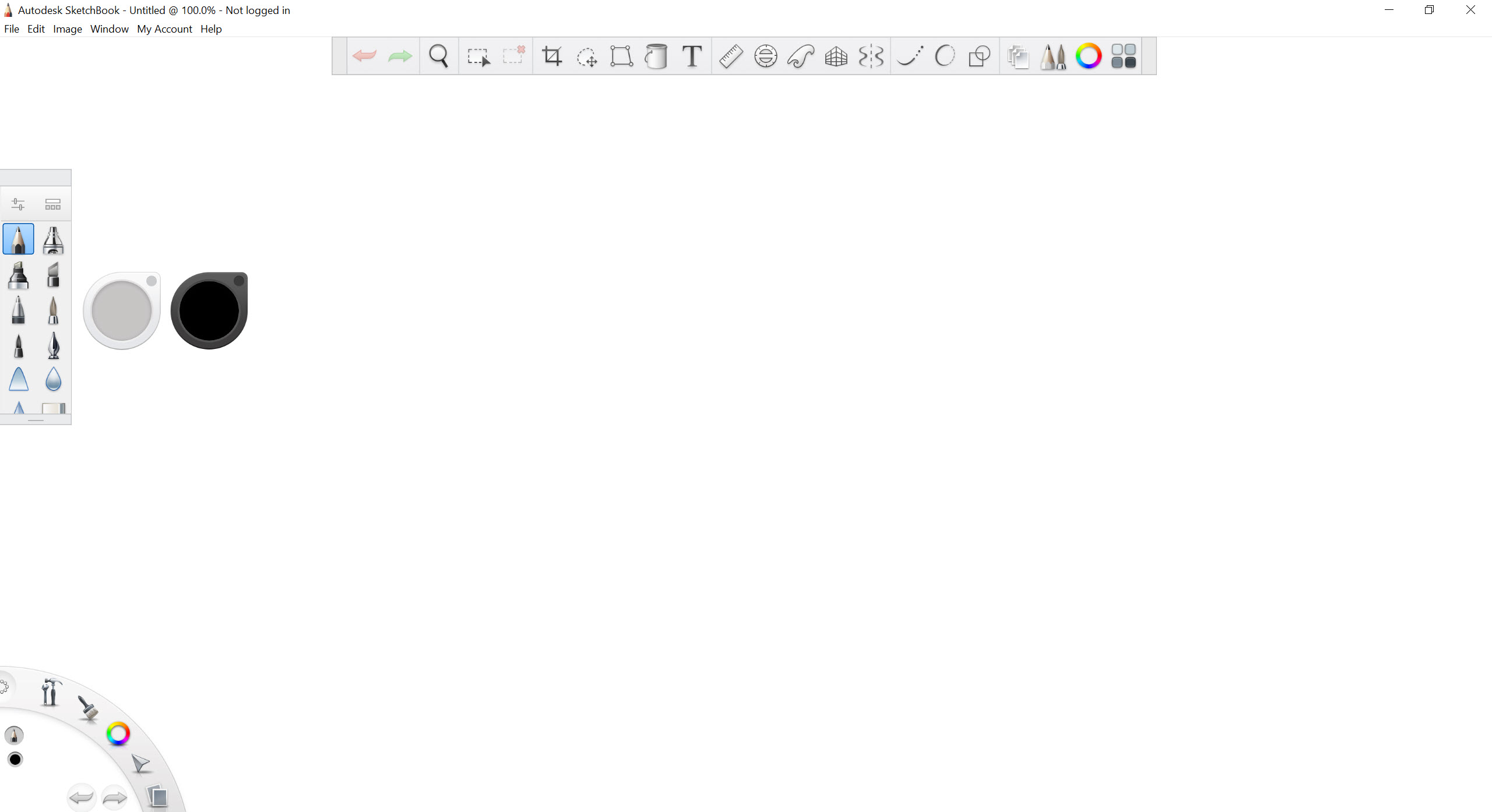
Where most digital art software gives you palettes, toolbars, and panels on all four sides of the canvas, Autodesk SketchBook hides everything until you ask for it. The default view is a blank canvas and a thin top bar. Tools live behind a circular marking menu you summon with a click and dismiss when you stop drawing. The philosophy is that a sketching application should feel like a piece of paper, not a control surface, and the design has been consistent about that since the original StudioPaint days at Alias.
This is the free legacy version that Autodesk released in 2018 and ceased updating in mid-2021 when the brand was spun off to Sketchbook Inc. The application still works on current Windows builds, still supports modern stylus hardware, and still contains the feature set that made it popular among concept artists and illustrators in the first place.
What it does not get is new development, which matters less than you might think for software this mature.
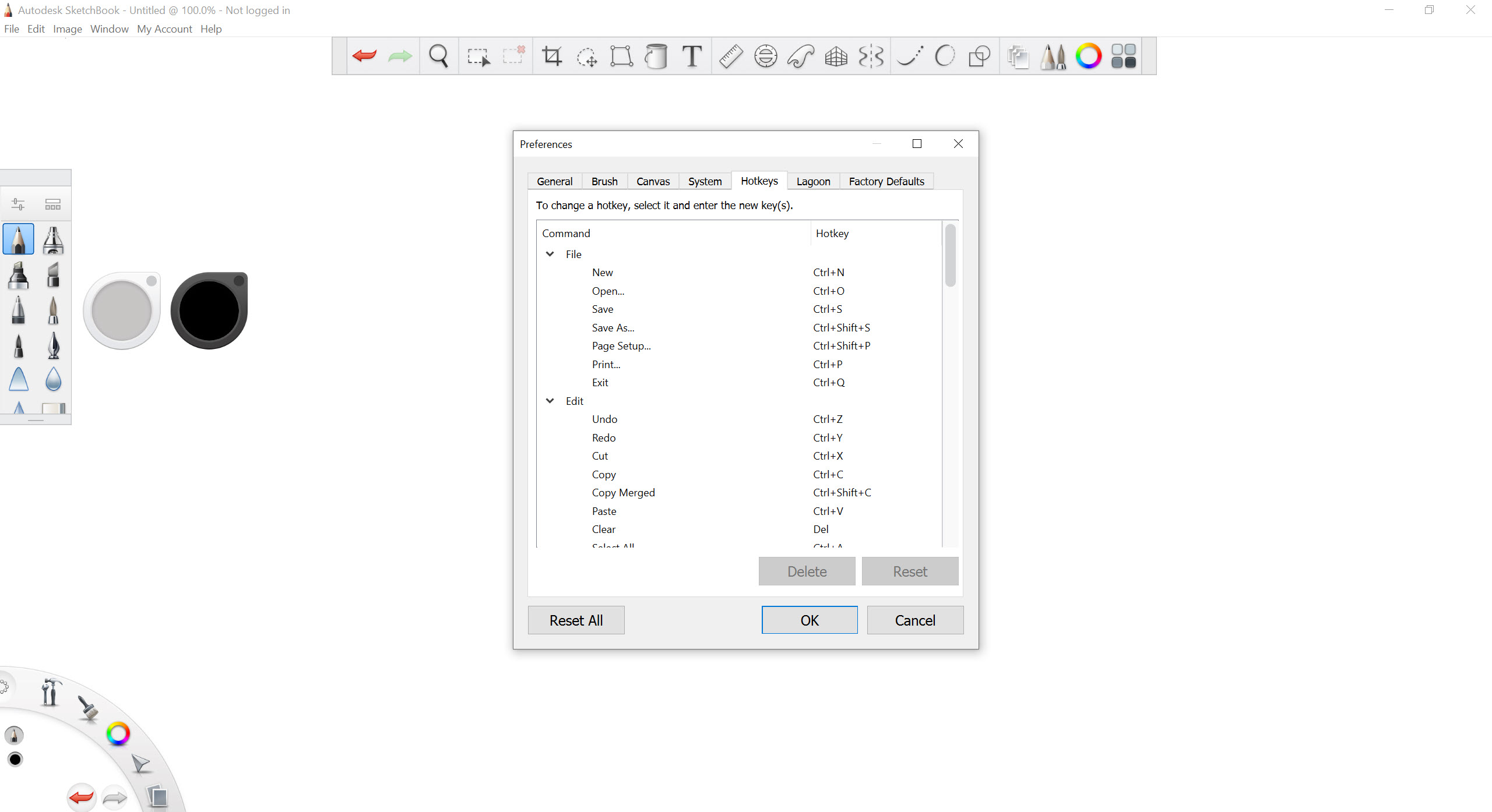
The marking menu is the interface
Click and hold anywhere on the canvas and a radial menu (Autodesk called it the lagoon) appears around your cursor with the most common tools arranged like a clock face. Brush, eraser, layers, undo, color, transform. Pick one with a quick gesture and the menu vanishes. With practice, the gestures become muscle memory and you stop looking at the menu entirely, just flicking in the direction of the tool you want.
This is not new design language, marking menus go back to Maya and other Alias products, but Autodesk SketchBook committed to it harder than most consumer drawing applications did. The result is a workspace where the canvas occupies essentially the whole window and the interface only appears when invoked. For users coming from busier applications like GIMP or Photoshop, the empty workspace can feel disorienting at first and then liberating once you internalize the gesture system.
The puck (a small ring that follows your stylus) provides quick access to brush size and opacity. Drag the puck outward and the brush gets bigger, drag inward and it shrinks. Tap the inner ring and you cycle through recently used brushes. None of this requires moving your stylus away from where you are drawing.
Brushes, and what makes the brush engine feel right
The application ships with over 190 brushes organized into sets: pencils, inking pens, markers (including a complete Copic marker library), airbrushes, paint brushes, smudge tools, blenders, and pattern brushes. Each one is configurable across the parameters you would expect (size jitter, opacity falloff, scatter, angle, hue variation) but the defaults are tuned well enough that most users never open the brush editor.
What sets the brush engine apart from competitors is the responsiveness to stylus pressure and tilt. The lag between pen movement and visible stroke is among the lowest in the category, which matters more than feature count when you are drawing thousands of strokes per session.
On hardware with Wacom drivers, Surface Pen, or other Windows Ink-compatible styluses, the pressure curve is calibrated rather than just linear, so the response feels closer to a real pencil or brush than to an abstract digital tool.
The Copic marker set deserves a specific mention. Copic Sketch and Ciao markers are an industry standard for concept art and manga illustration, and the digital simulation in this application is accurate enough that the marker numbers match the real-world equivalents. Concept artists who already know their Copic palette can pick the exact numbers they would use on paper and get visually consistent results. Few digital painting alternatives bother with this kind of color-system fidelity.
Perspective guides that actually constrain your strokes
This is the feature most users return to. Activate a perspective guide (one-point, two-point, three-point, or fisheye) and the application draws faint construction lines from the vanishing points across the entire canvas. So far this is what every other drawing application does. The difference is what happens when you start drawing.
With perspective guides locked, every stroke you make snaps to a vanishing point automatically. You can rough out a city street, an interior, or a vehicle without manually rotating your pen for each line. The guide system does the geometric work and you focus on the actual drawing. The fisheye guide is especially well done, simulating the curved-perspective look of action comic panels without requiring you to draw the curves freehand.
For technical illustration, architectural sketching, and concept design where perspective accuracy matters, this single feature explains why the application has a loyal following among professionals. The closest competitor with comparable perspective tools is Clip Studio Paint, and Clip Studio is paid software.
Symmetry, rulers, and the steady stroke
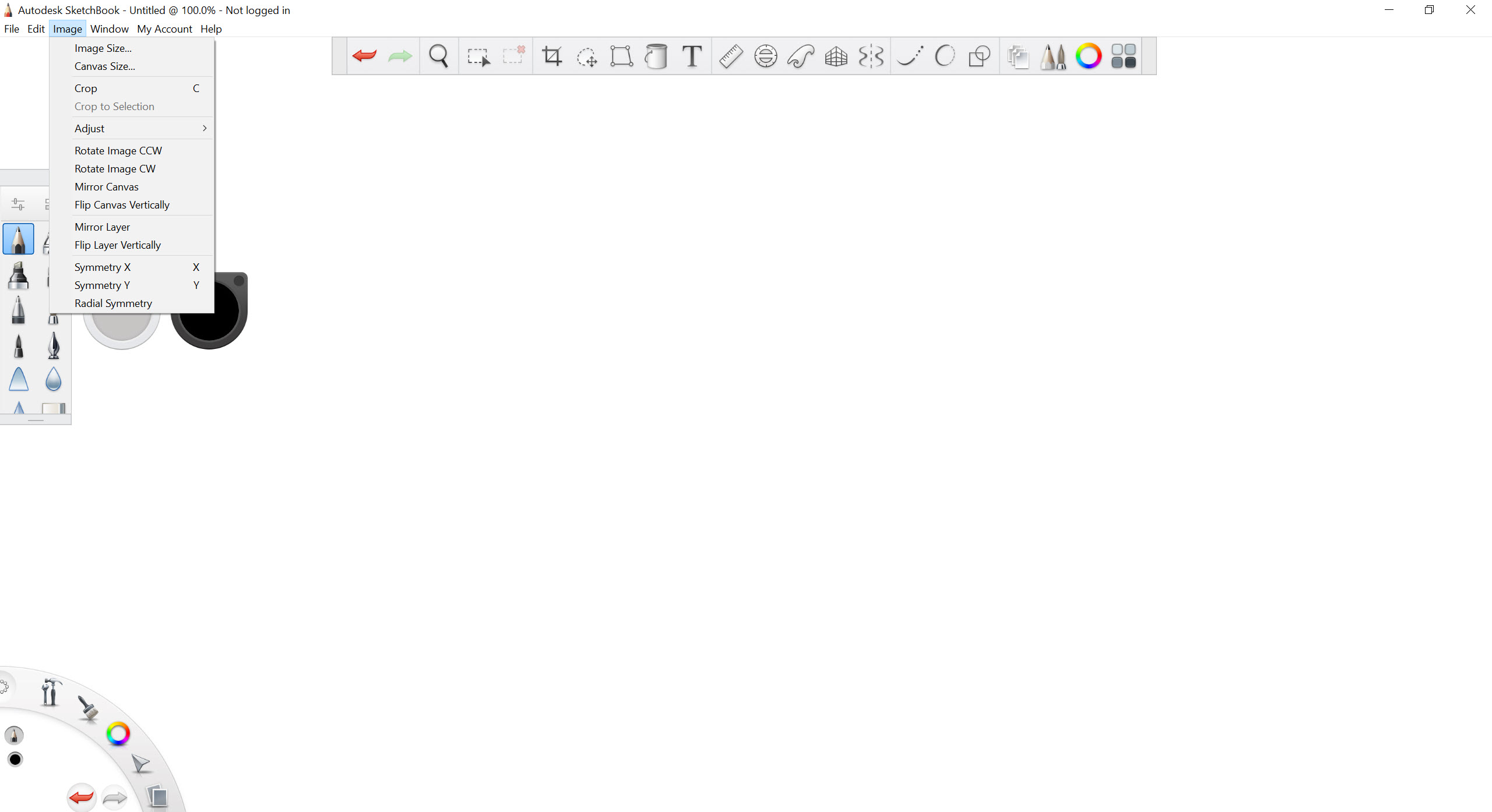
Three smaller features that add up to a significant productivity boost. The symmetry tool mirrors your strokes across an X axis, Y axis, or radial center, useful for character design, mandala patterns, and architectural elements that need to be balanced. The ruler tool constrains strokes to straight lines or arcs without forcing you to use vector tools instead of brushes.
The Steady Stroke option smooths out hand tremor by introducing a configurable lag between your stylus position and the actual stroke. The effect is that wobbly lines become clean lines. Set the smoothing too high and the cursor lags behind your hand uncomfortably, set it too low and your shake comes through. The sweet spot lets you ink cleanly without the rigid feel of vector tools.
Layer system and what it does not do
Layers work the way you expect. Add, group, reorder, set blend modes (16 of them including the standard Multiply, Screen, Overlay, plus less common modes like Linear Burn and Pin Light), adjust opacity per layer, set per-layer transformations. You can create clipping masks where one layer is constrained to the visible pixels of the layer below it, useful for shading inside line art without painting outside the lines.
What the application does not do is provide adjustment layers in the Photoshop sense. There are no Curves or Levels layers that non-destructively modify what is below them. The Color Balance and Brightness/Contrast operations exist as one-shot modifications, not as adjustment layers. For sketching and concept work this is rarely a limitation, for finished illustration it can mean you need to commit to color decisions earlier than you might in a more layer-heavy editor.
There is also no liquify or transform-by-mesh tool, no smart object equivalent, no scripting. The application stays narrowly focused on the act of drawing rather than expanding into general image editing territory.
Flipbook animation as a sketching feature
The Flipbook tool lets you create frame-by-frame animations directly in the application. Each frame is a layer-like canvas, you can onion-skin the previous frame to see your drawing in motion, and the output exports as MP4 or animated PNG. It is not a replacement for dedicated animation software, but for storyboarding, motion studies, and quick animatics it lives directly inside the same workspace as your static sketches.
The frame rate is configurable (the default is 12 FPS, suitable for traditional animation timing) and there is a basic timeline for adjusting frame duration. No tweening, no rigging, no advanced keyframe interpolation. The intended workflow is hand-drawn frame animation, the same way it has been done since the cel days.
File format support and where it falls short
The native format is .skb, which preserves layers, brush metadata, and animation frames. Export options include PSD (with layers intact for round-tripping into Photoshop), PNG, JPEG, BMP, TIFF, and PDF. Import is limited to common raster formats, the application does not read AI, SVG, or other vector formats.
The PSD export is functional but imperfect. Layer blend modes that exist in both applications transfer correctly, but a few application-specific brushes and the Copic marker effects flatten to regular pixels when exported. Round-tripping a file repeatedly between this tool and Photoshop loses fidelity, but a one-time handoff at the end of a sketch session works as expected.
Conclusion
Autodesk SketchBook is the right choice for users who want a focused digital sketching application without the complexity of a full image editor. Concept artists, illustrators, students learning digital drawing, hobbyists who want a clean workspace, and anyone using a pen tablet for quick visual ideation will find the marking menu interface and brush engine well-matched to their workflow. The perspective guides alone make it worth keeping installed for anyone who sketches environments or technical subjects.
What you accept by using it is the no-updates situation. The application was complete when development stopped, and complete is not the same as obsolete, but it does mean that any limitation you encounter today will be there permanently. For working artists who depend on their tools getting better over time, this is a meaningful concern.
For everyone else who wants a stable, capable, free sketching tool that respects the act of drawing, the legacy build holds up better than most software a half-decade past its last release.
Pros & Cons
- Marking menu interface keeps the canvas visible and tools out of the way without sacrificing access
- Brush engine is highly responsive to pressure and tilt, with one of the lowest input lag rates in the category
- Perspective guides snap strokes to vanishing points automatically, removing geometric overhead from technical sketching
- Copic marker simulation is accurate to the real-world color numbers, useful for artists with existing marker workflows
- Symmetry, ruler, and steady stroke tools work without requiring vector mode
- Free, no account required, no subscription, no upsell prompts
- Stable on current operating systems despite no longer receiving updates
- Last update was in 2019, so no new features or bug fixes are coming
- No adjustment layers or non-destructive image editing tools
- Limited file format import (no vector formats, no PSD with editable text)
- PSD export does not preserve all brush effects and blend modes perfectly
- The marking menu has a learning curve that initially feels slower than traditional toolbars
- Flipbook animation is basic, with no tweening or advanced timing controls
Frequently asked questions
The application is built specifically for drawing and sketching with a pen or stylus. The interface, brush engine, and tools are optimized for stroke-based workflows rather than photo editing, vector design, or compositing. Tasks like color correction or retouching photos are not what it is designed to do.
Yes, the brush editor exposes parameters like size variation, opacity falloff, jitter, scatter, angle, and pressure curves. Custom brushes can be saved to user-created sets, and brush textures can be imported from PNG files for stamp-style brushes.
The application supports pressure and tilt input from any Windows Ink-compatible stylus, including Surface Pen, Wacom tablets and displays, and other major brands. The pressure curve is calibrated rather than linear, giving a more natural feel under varied pressure levels.
PSD files open with layers and most blend modes intact. Photoshop-specific features like adjustment layers, smart objects, and text layers do not transfer correctly, but the raster content and layer structure come through. The application can also export back to PSD for handoff to Photoshop.
In 2018, all premium features were unlocked in the free version, including perspective guides, layer effects, flood fill, brush customization, and the full brush library. The free version is fully featured, with the only practical difference being that it no longer receives updates.
The application runs comfortably on any modern computer with a stylus-capable display or tablet. A graphics tablet (Wacom Intuos or similar) is the typical input device, but Surface devices, Wacom displays, and other Windows Ink-supported hardware all work. There is no specific GPU requirement beyond basic 2D acceleration.


I am so excited to learn this application. I always try to increase my knowledge to make my students can enjoy learning happily and meaningfully. That’s why l need some variation in teaching-learning.
Thank you so much for this special moment for me because l am just an English teacher in a small village.