

Attribute Changer
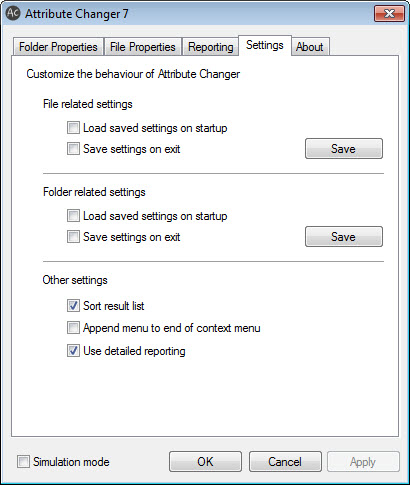
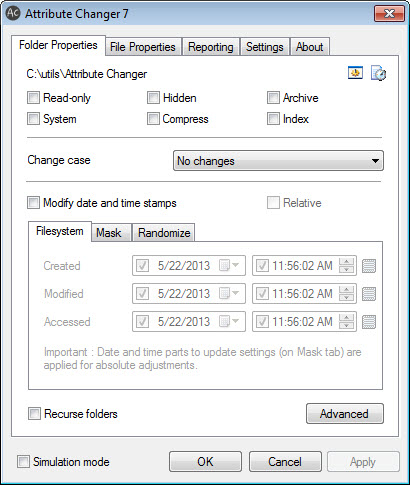
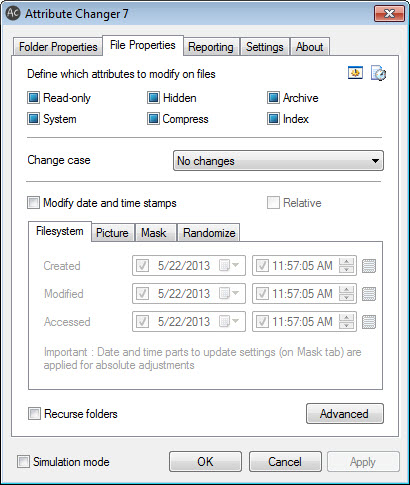
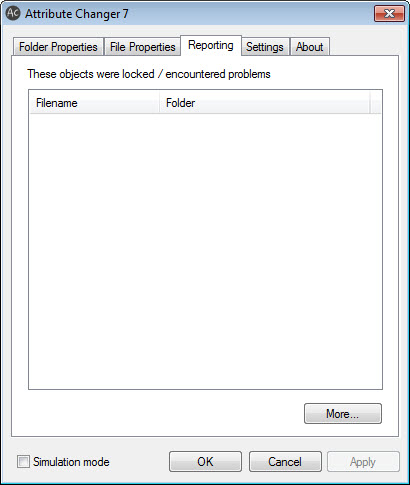
About Attribute Changer
A photo library that refuses to sort correctly is usually not a photo problem. Attribute Changer exists because files carry several different dates, software disagrees about which one to use, and copying anything between places quietly rewrites some of them.
Attribute Changer arrives as an addition to the right-click properties rather than as a program you open, so it works where you already are, on whatever you have selected.
From there it changes the attributes and the dates, on one file or on an entire tree, and the dates are where the real capability lies.
Four dates, and software disagrees about them
Here is the explanation for the sorting problem, and it makes Attribute Changer make sense.
The file system keeps three dates for every file, meaning when it was created, when it was last changed, and when it was last opened. A photograph carries a fourth, recorded by the camera inside the image itself, which is when the picture was actually taken.
The file manager sorts by the file system dates. Photo software sorts by the one inside the image. Those are different numbers and nothing keeps them in step.
Copying is what breaks them apart. A file copied to a new folder, restored from a backup, or moved through a service arrives with a creation date of today, because as far as the file system is concerned it was created today. The picture inside still knows when it was taken, and the folder now claims the whole holiday happened last Tuesday.
That mismatch is what this fixes, by setting the file dates from the date inside the photograph, across as many files as you point it at.
For browsing and sorting a folder of images once the dates behave, FastStone Image Viewer reads them properly.
It can add a date that was never there
The related Attribute Changer capability covers a case the previous one cannot.
Scanned photographs have no camera date, because no camera was involved. The same is true of images produced by older devices and of pictures edited by software that discarded the original information.
A date can be written into those files rather than only adjusted, which means a scanned family album can be given the dates the pictures actually belong to, and photo software will then place them correctly rather than clustering them on the day you scanned them.
That is the difference between an archive that is merely digitised and one that is organised.
The date operations go well beyond setting one
The Attribute Changer range is unusual, and the useful parts are the ones nobody advertises.
Adding or subtracting a fixed amount handles the camera whose clock was wrong, or a set of pictures taken in another time zone, without touching their relative order.
Partial updates change one component and leave the rest, so the day can be corrected while the time of day stays as it was. That matters when a camera had the right time and the wrong date.
Synchronisation copies one date onto the others, which is how you make all three file system dates agree with the photograph’s own.
Sequence mode applies increasing values across a selection, and limits constrain everything to a range so a mistake cannot push dates somewhere absurd.
Simulation before anything happens
The Attribute Changer feature to use every time, and the one separating a careful tool from a dangerous one.
A simulation runs the whole operation and changes nothing, reporting exactly what it would have done to each file. Detailed logging switches on automatically when you use it, so the result is a record rather than a screen you have to remember.
That matters because these operations are irreversible and recursive. Pointing this at a folder tree and confirming means every file underneath is changed, with no undo, and the dates that were there are gone.
Reading the simulation is a minute against an afternoon, and it is the same discipline that any tool doing bulk changes deserves.
Confirming which files a filter will actually catch is a sensible companion step, and a search tool that lists matches across the whole drive as you type does that instantly.
The attributes themselves
The original Attribute Changer purpose, still useful and now the smaller half.
Read-only, hidden, system and archive can be set or cleared in bulk, which is how somebody clears the read-only flag from a folder tree copied off a disc, or removes hidden flags applied by something that should not have applied them.
Name casing is here too, converting a selection to upper case, lower case or capitalised, which tidies files that arrived from a system with different conventions.
For the images themselves rather than their properties, IrfanView handles batch conversion and resizing across the same selection.
Filters apply across all of it, so an operation can be limited by name, by extension or by date, with exceptions for names you want left alone.
Randomised dates, and what that is for
Being straightforward about an Attribute Changer feature that invites the obvious question.
Dates can be randomised across a selection rather than set to anything meaningful. The legitimate uses are narrow, meaning testing software that behaves differently by date, or producing sample data.
The other use is obvious and the tool makes no judgement about it. What a file’s timestamps say, and whether changing them matters, depends on the context you are in rather than on the software.
Conclusion
Attribute Changer solves a problem most people misdiagnose. A photo library in the wrong order is rarely a fault in the photo software, it is the gap between the dates the file system holds and the date the camera recorded, and copying files is what opens that gap.
Use the simulation before every real run. These changes apply through an entire folder tree, there is no undo, and the dates you overwrite are not recoverable. Read what it says it will do, confirm it matches what you meant, and then let it work.
Pros & Cons
- Sets file dates from the photograph's own recorded date, fixing sort order
- Writes a date into images that never had one, including scans
- Adds and subtracts, for wrong camera clocks and time zone shifts
- Partial updates change one component and leave the others alone
- Simulation reports exactly what would happen, with logging switched on automatically
- Works from the right-click properties rather than as a separate application
- Free, with no tier withholding anything
- Operations are irreversible and apply recursively through a whole tree
- The date randomiser has narrow legitimate use
- Only the photograph format's own date information is handled, not every image type
- The range of options makes the dialog dense on first sight
- Nothing here fixes the underlying habit of copying that resets dates
Frequently asked questions
Because the file manager sorts by the file system's dates and photo software uses the date recorded inside the image. Copying resets the file system dates to today while the image keeps the original, so the two disagree.
File system dates, the date recorded inside a photograph, the file attributes such as read-only and hidden, and the casing of names, on one file or recursively through a folder tree.
Yes. A date can be written into an image that never carried one, which is how a scanned album gets placed correctly by photo software rather than clustered on the day it was scanned.
Yes, and it should be used every time. Simulation performs the whole operation without changing anything and reports what it would have done, with detailed logging enabled automatically.


