

TheGreenBow VPN Client
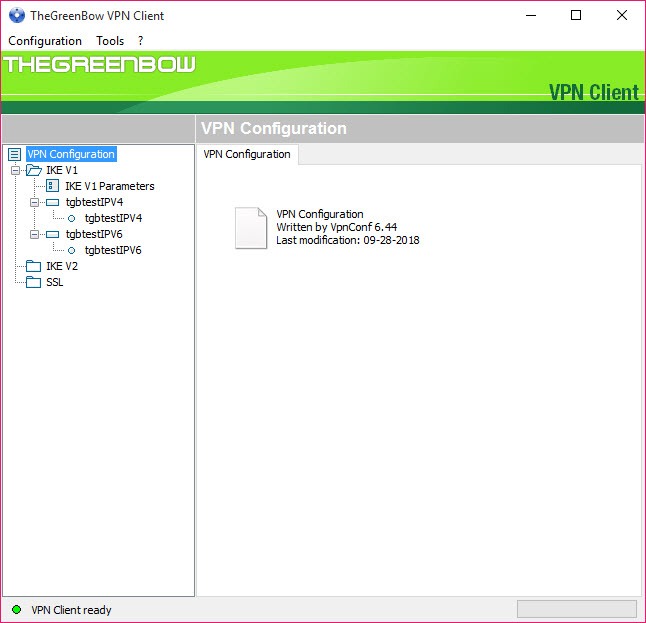
About TheGreenBow VPN Client
TheGreenBow VPN Client is the piece of software that sits on a work computer and opens the encrypted tunnel into the office. It brings no servers of its own and sells no anonymity. Instead it speaks the standard VPN protocols so fluently that it can connect to practically any gateway an organisation already runs, from big-name firewalls to an open-source box in a rack, which is precisely why it exists.
That makes the first decision simple. Anyone looking for a privacy service with a fleet of exit servers and a map of countries wants a consumer VPN subscription, full stop. This client is for the other job, connecting employees to office networks, and in that trade it is one of the most serious tools you can install.
One client for whatever gateway you already own
The quiet problem of corporate VPNs is that every firewall maker ships its own client, and a fleet of laptops ends up running three of them. TheGreenBow VPN Client positions itself as the universal replacement, a single client configured against whatever mix of gateways the organisation runs, which simplifies support in a way IT departments feel immediately.
It has also been audited and certified by an independent body for securing the communications of critical infrastructure operators and public administrations. For most readers that certification is a proxy, and a useful one.
Software examined at that level tends not to cut corners anywhere else.
Fluent in both dialects of corporate VPN
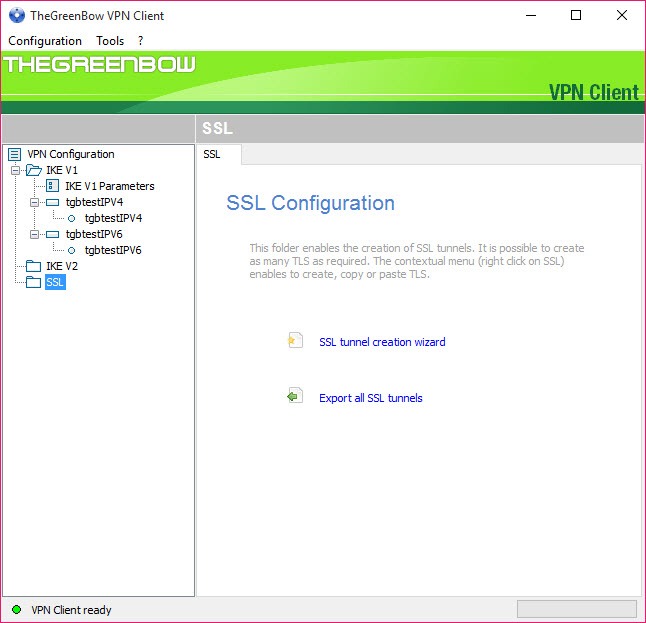
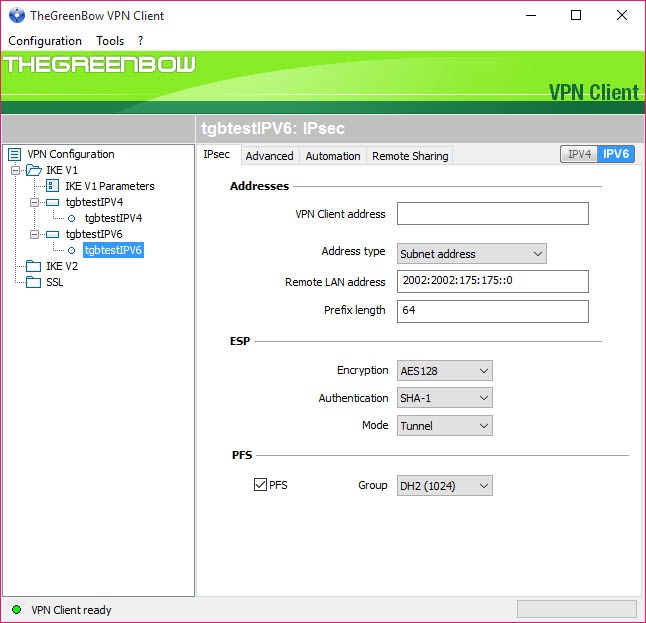
Tunnels come in two families here. IPsec with IKEv2 (and the older IKEv1 where legacy gateways demand it), and SSL tunnels for gateways that prefer the TLS route, with both IPv4 and IPv6 carried inside. Wizards build the common configurations, while the full panel exposes every negotiation detail, from encryption proposals to NAT traversal, for the connections that refuse to be common.
The honest warning belongs right here. This is a tool that assumes somebody on the other end knows the gateway’s settings, and a home user without that counterpart will drown in acronyms within minutes. Hobbyists building their own server from scratch are better served starting with OpenVPN on both ends.
This client’s depth is for matching an existing corporate configuration exactly.
The tunnel employees never see
TrustedConnect is the mode that changes daily life. The client detects whether the machine is sitting inside the trusted office network, and the moment it leaves, at home, in a hotel, on conference wifi, the tunnel opens by itself and stays up. The employee does nothing, sees at most a small status indicator, and cannot forget to connect, which closes the single most common hole in remote work security.
The interface scales down to match. TheGreenBow VPN Client can present its full configuration panel to administrators, a minimal connect-disconnect panel to users, or no visible panel at all, so the person typing emails in the hotel lobby never meets a setting they could mangle.
Authentication up to smartcard grade
Passwords are the weakest link of any VPN, and this client is built for organisations that have moved past them. Certificates load from files, from the system certificate store, or from smartcards and USB tokens through standard PKCS#11 interfaces, with a PIN prompt guarding the key. Pull the token out, and the credentials leave the building with its owner.
The checking runs in both directions, too. When the gateway presents a certificate signed by an authority the client does not know, the tunnel refuses to open rather than connecting with a warning, which is exactly the uncompromising behaviour you want from software guarding an office network against impostors.
Two deployment-grade details stand out. A tunnel can be opened before logon, so a machine authenticates to the domain through the VPN and logon scripts run as if the laptop were in the office. And in USB mode, the whole VPN configuration lives on a removable stick, with the tunnel available only while the stick is inserted, a physical on-off switch for network access.
Built to stay up and to be rolled out
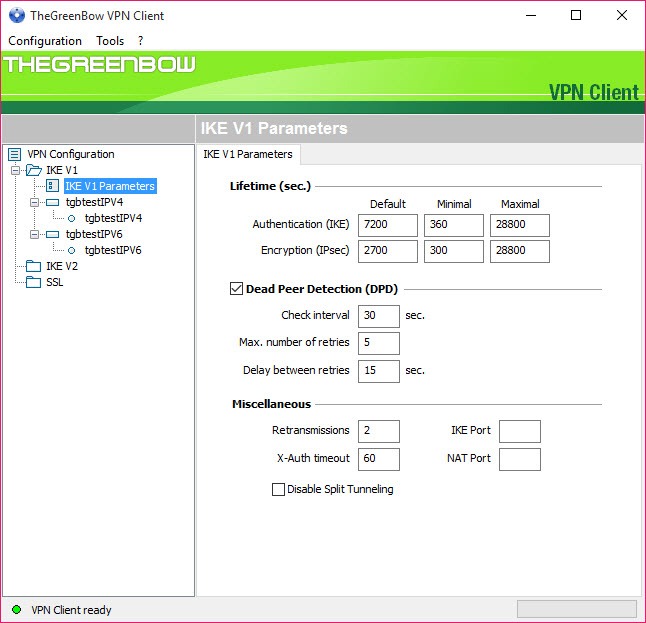
Service continuity gets the engineering it deserves. Dead Peer Detection notices a gateway that stopped answering, a redundant gateway takes over when the primary fails, and a fallback tunnel can switch an IPsec connection to SSL automatically when a hostile hotel network filters the first protocol. Several tunnels can also run at once for people who straddle networks.
For the people deploying it, TheGreenBow VPN Client installs silently with preconfigured and locked settings, takes administration through group policies, and runs scripts when tunnels open or close, so mapping drives or launching the ticketing system happens without user involvement.
A console with detailed logs and a trace mode handles the inevitable day when one laptop in a hundred will not connect and somebody has to find out why.
Conclusion
TheGreenBow VPN Client is written for organisations, and it shows in every choice. IT teams consolidating a mess of gateway-specific clients, security officers who need certified software and smartcard authentication, and admins deploying to hundreds of laptops will find the tooling unusually complete, with TrustedConnect alone justifying the switch for mobile workforces.
The same seriousness makes it the wrong download for someone who just wants to appear to be browsing from elsewhere. Judged on its actual job, connecting workers to office networks reliably and invisibly, it has few genuine rivals.
Pros & Cons
- Connects to practically any gateway, replacing a zoo of maker-specific clients
- TrustedConnect opens and maintains the tunnel automatically off-site
- Smartcard, token and certificate authentication through standard interfaces
- A tunnel can open before logon, so domain scripts run remotely
- Automatic fallback from IPsec to SSL survives hostile networks
- Silent, locked, script-capable deployment built for fleets
- Includes no servers, so it is useless without a gateway to connect to
- Configuration vocabulary assumes real networking knowledge
- Home users will find it heavy for anything a consumer service does
- The interface is utilitarian throughout, built for function over charm
Frequently asked questions
No. It is purely the client half of a VPN, built to connect to a gateway your organisation already operates. Without such a gateway it has nothing to talk to.
Practically any that speak standard IPsec or SSL, across hardware makers, which is the point. One client covers a mixed fleet of firewalls instead of each maker's own software.
Yes. The pre-logon mode opens the tunnel first, so domain authentication and logon scripts behave exactly as they would inside the office.
Yes, through standard PKCS#11 interfaces, with PIN protection, and certificates can also come from files or the system certificate store. Removing the token removes the access.


