

Service Security Editor
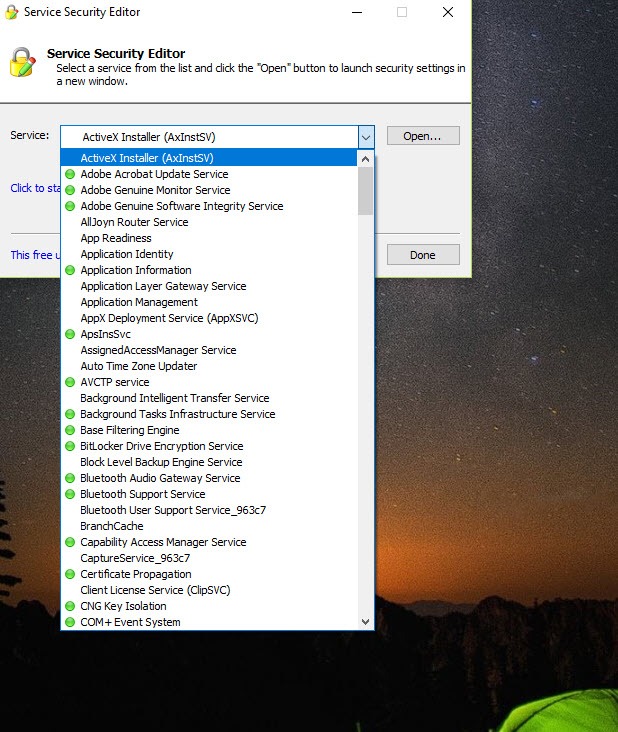
About Service Security Editor
Service Security Editor is a specialized utility designed to give administrators granular control over the security permissions applied to Windows services. It addresses a specific need that the standard Windows tools handle awkwardly at best: viewing and modifying the access control lists that determine who can start, stop, configure, or otherwise interact with services on a system.
For system administrators, IT professionals, and developers who need to delegate service management permissions without granting full administrative access, or who simply need to audit and adjust service security in environments with strict access requirements, this tool provides a clear, focused interface that makes a normally cumbersome task practical and approachable.
Granular service permission management
The defining feature of Service Security Editor is its ability to display and modify the security descriptors associated with any Windows service in a clear, accessible way.
Each service in Windows has an access control list that determines which users and groups can perform specific actions like starting it, stopping it, querying its status, or changing its configuration. By default, modifying these permissions requires obscure command-line tools and detailed knowledge of security descriptor syntax, but this software replaces that complexity with a graphical interface that handles the underlying details automatically.
For administrators who need to delegate specific service-related tasks without granting broader privileges, this capability transforms what would otherwise be a complicated and error-prone process into a manageable one that can be completed reliably and quickly.
Clear visual representation of permissions
Permissions for each service appear in a familiar Windows-style access control interface, similar to what users see when adjusting file or folder permissions.
User and group entries are listed clearly, with the specific rights each one has displayed in checkbox form for easy review and modification. This visual approach makes it easy to spot misconfigurations, audit existing permissions, or simply understand the current security state of a service without needing to parse complex security descriptor strings or interpret cryptic command-line output.
For environments where security audits require documenting and reviewing service permissions, this clarity makes the tool genuinely valuable as both a configuration utility and a diagnostic resource.
Support for all standard service permissions
The application supports the complete range of Windows service permissions, allowing administrators to grant or deny each specific right independently.
These rights include start, stop, pause/continue, query status, query configuration, change configuration, interrogate, user-defined control, delete, read access control, and change access control. By exposing all these permissions individually rather than treating service security as an all-or-nothing proposition, this tool enables the kind of nuanced delegation that proper security practices actually require in real-world environments where strict separation of duties matters significantly.
Add and remove user entries
Adding new users or groups to a service’s access control list is handled through standard Windows account selection dialogs, which feel familiar to anyone who has worked with Windows security before.
Existing entries can be modified or removed with similar ease, giving administrators full control over the access list without needing to know special syntax or use external tools. For administrators managing services across multiple systems with consistent security requirements, this straightforward approach to adjusting permissions saves significant time compared to the manual command-line alternative that would otherwise be required.
Apply changes safely with proper validation
Before applying permission changes, this software validates the modifications and confirms the operation, which prevents accidental misconfigurations that could lock administrators out of services or grant inappropriate access.
The validation includes checking that the resulting security descriptor remains valid and applicable, since Windows services require properly formed permissions to function correctly.
This kind of careful design protects against the easy mistakes that plague manual security descriptor editing, where a single character error can produce permissions that prevent even legitimate administrators from managing the affected service.
Practical for delegation scenarios
A common use case for this tool is delegating limited service management permissions to users who should not have full administrative access.
For example, an application support technician might need the ability to restart a specific application service without being granted broader system administration rights. Using this software, an administrator can grant exactly the permissions needed for that role, neither more nor less, supporting proper least-privilege security practices that mainstream Windows tools make awkward to implement effectively.
This kind of focused delegation matters significantly in larger organizations where role separation reduces both security risks and the impact of mistakes by users with limited expertise.
Useful for development and testing
Developers building Windows services often need to test how their applications behave under various permission configurations, and this tool provides a fast way to set up test scenarios.
Rather than writing scripts or manually crafting security descriptors, developers can configure permissions through the graphical interface, test their applications, and adjust as needed during development cycles. This iterative workflow speeds up development of services that need to operate correctly across various security contexts, which is particularly valuable for software intended to be deployed in environments with strict access controls.
Audit and documentation support
Beyond just modifying permissions, this software serves as an excellent audit tool for reviewing the current security state of services across a system.
Administrators can examine permissions for individual services to verify they match documented requirements or to investigate unexpected behavior that might result from misconfigured access controls. For organizations with compliance requirements around service security, this auditing capability provides clear visibility into the current state of service access controls, supporting compliance documentation and remediation activities effectively.
Conclusion
Service Security Editor fills a specific niche that mainstream Windows tools handle poorly, offering administrators a practical way to manage service permissions without resorting to obscure command-line utilities or complex security descriptor syntax.
Its focused functionality, clear interface, and complete coverage of Windows service permission rights make it genuinely useful for delegation scenarios, security audits, and development workflows that involve service security configuration.
For system administrators, IT professionals, and developers who actually need to work with service permissions, Service Security Editor provides exactly the tool that should have been built into Windows itself but never was, transforming a frustrating task into a manageable one that can be performed reliably and efficiently.
Pros & Cons
- Granular control over service permissions enables proper least-privilege delegation scenarios
- Clear graphical interface replaces obscure command-line tools and complex security descriptor syntax
- Complete support for all standard Windows service permission rights without limitations
- Validation prevents accidental misconfigurations that could break service management
- Practical for delegation, audit, and development scenarios across diverse environments
- Focused design avoids feature bloat and stays approachable for its specific purpose
- Lightweight installation with no unnecessary background processes or system impact
- Niche utility that is only useful for users who actually need to manage service permissions
- Requires understanding of Windows service security concepts to use effectively for serious work
- Commercial license required for ongoing use, which may be a barrier for some users
- Interface design feels utilitarian rather than visually polished compared to broader system tools
- Documentation could provide more guidance for complex permission scenarios beyond the basics
Frequently asked questions
This tool addresses the difficulty of viewing and modifying Windows service permissions, which normally requires obscure command-line utilities and complex security descriptor syntax. It replaces that complexity with a graphical interface that makes service security management practical for everyday administrative work.
Granting full administrator rights for tasks that only require specific service operations violates least-privilege security principles. This software lets you delegate just the necessary permissions, like the ability to restart a specific service, without granting broader access that increases security risks unnecessarily.
Yes, this tool works with any Windows service that has an associated security descriptor, which includes essentially all services on a Windows system. Whether you are managing built-in Windows services, applications installed as services, or custom services from your own software, the permissions can be viewed and modified through the application.
The application includes validation to prevent obviously broken permission configurations, but creating overly restrictive permissions intentionally could limit your access to a service. Standard administrative tools and the recovery options built into Windows can typically restore proper access if such a situation occurs accidentally.
Command-line tools offer the same underlying capability but require knowledge of security descriptor syntax and specific command parameters. This software provides equivalent functionality through a graphical interface, which is significantly more practical for interactive use and for administrators who do not work with these specific commands daily.
Both use cases work well with this tool. For one-time configuration, it provides a quick way to set up permissions correctly during initial deployment. For ongoing management, it serves as an audit and adjustment tool when permission requirements change or when investigating service-related access issues.
This software lets you view and review permissions clearly, which supports compliance documentation. Export functionality varies by version, but the visual presentation of permissions makes it straightforward to capture the current state through screenshots or manual documentation when formal compliance records are required.
Yes, modifying service security descriptors requires administrator rights, since these permissions control access to system-level functionality. This tool requests appropriate elevation when launched and uses standard Windows mechanisms to apply changes through proper system interfaces.
Yes, permission changes are written to the system configuration and persist across restarts just like permissions configured through any other method. The changes become part of the standard Windows service security configuration once applied through this application.
Capability for remote management depends on the specific version and configuration. The primary use case is managing services on the local computer where the application is running, with remote management typically requiring additional setup or being handled through other tools designed specifically for remote administration scenarios.


