

Microsoft Safety Scanner
About Microsoft Safety Scanner
Sometimes you suspect your computer might have something on it that shouldn’t be there, but you’re not sure whether your existing security software has caught everything. Maybe you ran into something suspicious online, opened an email that turned out to be sketchy, or just have that vague feeling that something isn’t quite right.
Microsoft Safety Scanner is the on-demand security tool from Microsoft (also known as MSERT, the Microsoft Support Emergency Response Tool) designed exactly for this scenario: a portable scanner you download, run when you suspect a problem, and discard when you’re done.
It’s not a replacement for proper antivirus software, and Microsoft is explicit about this. The tool exists alongside Microsoft Defender and other security solutions, providing a second-opinion scanning capability that uses the same threat definitions as Defender but operates as a standalone, downloadable scanner rather than continuously running protection.
For users who want to verify their system isn’t compromised, or for technicians investigating suspected infections, this targeted approach addresses a real need that real-time antivirus doesn’t quite cover.
A portable scanner without the installation step
The defining feature of Microsoft Safety Scanner is that it’s a single executable that runs without installation. Download the file, double-click it, accept the license terms, and the scanner runs. When you’re done, you delete the file. There’s no system integration, no background service, no permanent installation that you need to manage or uninstall later.
This portable design makes the tool particularly suitable for technician use cases. You can carry it on a USB drive and run it on customer machines without leaving installed software behind.
You can use it on multiple computers without needing to install on each one. And you avoid any potential conflicts with whatever real-time antivirus is already running on the target system.
The single-executable approach also keeps things simple for less-technical users. There’s no setup wizard, no configuration to worry about, no decision about which features to enable. Run the executable, choose your scan type, and the scanner does its work.
Three scan modes for different scenarios
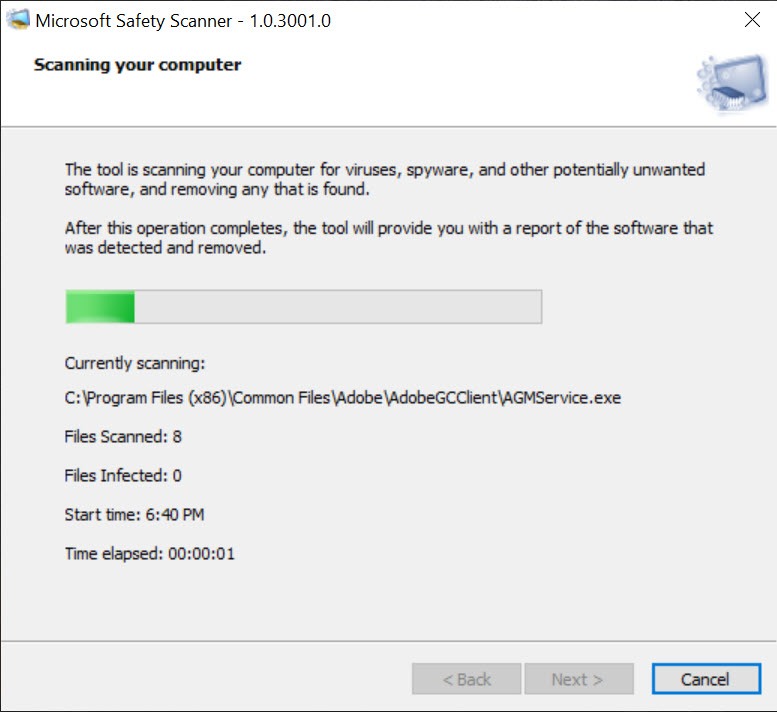
The scanner offers three scan types that target different use cases. The Quick Scan examines the locations most likely to contain active malware, including running processes, common malware locations, and recently modified system files.
This finishes relatively quickly and catches the most prevalent threats, making it the right starting point for routine “is anything wrong with my computer” investigations.
The Full Scan covers the entire system thoroughly, examining all files on all drives. This takes substantially longer (often several hours on systems with significant storage) but provides comprehensive coverage that catches dormant malware, infected files in archives, and threats hiding in less common locations.
For users who suspect a serious infection or want to verify a system is genuinely clean, this thorough approach is the right choice despite the time commitment.
The Customized Scan combines a Quick Scan with specific folders you choose. This is useful when you have particular suspicions about specific locations (a folder of downloads, an external drive, a USB stick someone gave you) without wanting to commit to a full system scan. The flexibility lets you target investigation precisely rather than choosing between brief and exhaustive options.
Same threat intelligence as Microsoft Defender
A practical consideration when choosing between security tools is the underlying threat intelligence each one uses. This software uses the same threat definitions as Microsoft Defender Antivirus, which means the detection capabilities match what Microsoft’s primary security product can identify.
For users who already run Defender as their main antivirus, this overlap might seem redundant, but the second-opinion scenario is genuinely useful. Sometimes malware specifically targets the active antivirus, disabling it or hiding from it in ways that wouldn’t affect a standalone scanner running independently.
Sometimes a real-time scanner misses files that aren’t currently being executed but contain threats that would activate later. The on-demand scanner catches these scenarios where it can find what the active protection might have missed.
For users running third-party antivirus, the scanner provides an independent perspective on the system’s status. Different security vendors detect different things, and having Microsoft’s detection capability available without conflicts with your installed antivirus can identify threats that slipped past your primary protection.
The 10-day expiration as a feature, not a bug
A particularly notable design choice is that the downloaded scanner expires 10 days after download. After that point, you need to download a fresh copy if you want to scan again. This sounds inconvenient initially, but the reasoning makes sense: malware threats evolve quickly, and a scanner with outdated definitions misses recent threats while giving false confidence that the system is clean.
By forcing a fresh download every 10 days, the design ensures users always run with current threat intelligence. The alternative would be requiring update mechanisms in the scanner itself, which would either complicate the standalone design or fail when users run an outdated copy that they downloaded months ago and forgot to update.
For technicians who use the tool regularly, this just means downloading a fresh copy as part of starting a new investigation. For occasional users, it eliminates the failure mode of relying on a scanner that’s been sitting on a USB drive for two years and no longer detects current threats.
Removal and remediation, not just detection
Beyond detecting threats, the scanner attempts to remove identified malware and reverse changes that threats may have made to the system. This active remediation goes beyond simple identification, providing the cleanup capability that turns detection into actual problem resolution.
The remediation can address registry changes, file modifications, scheduled tasks, and various other persistence mechanisms that malware uses to maintain itself on infected systems. For users who just want their computer fixed rather than wanting a list of problems to resolve manually, this active remediation is significantly more useful than detection-only scanning.
That said, the remediation isn’t always complete, and seriously infected systems often require additional tools and manual intervention to fully clean. The scanner provides a substantial first pass at remediation, but technicians dealing with complex infections typically use it alongside other specialized tools rather than as a standalone solution.
When to use it versus other tools
The on-demand nature of the scanner makes it particularly suitable for specific scenarios that real-time antivirus doesn’t address well. Situations like: you just opened a suspicious email attachment and want to verify nothing got through, you’re inheriting a computer from someone else and want to check it before using it, you’re troubleshooting weird behavior and want to rule out malware as a cause, or you’re a technician investigating a customer complaint.
For ongoing protection, it’s not the right tool. Real-time antivirus software (whether Microsoft Defender or a third-party product) provides continuous monitoring that catches threats as they appear, which the on-demand scanner can’t do. The two approaches genuinely complement each other rather than competing.
For users wanting comprehensive system protection, the typical recommendation is real-time antivirus running continuously plus this on-demand scanner for second-opinion scans when concerns arise. This combination provides both ongoing protection and verification capability, with neither tool trying to replace what the other does best.
Conclusion
Microsoft Safety Scanner has earned its place as a useful complement to real-time antivirus protection by addressing the specific scenario of on-demand verification scanning.
The combination of portable design, the same threat intelligence as Microsoft Defender, multiple scan modes, and active remediation delivers exactly what the typical “I want to make sure nothing is wrong” use case needs.
It’s not a replacement for proper continuous protection, and Microsoft is clear about this distinction. But for users who want a free, official, no-installation tool to verify their system status when concerns arise, Microsoft Safety Scanner delivers exactly that, with the 10-day expiration mechanism ensuring users always run with current threat detection rather than relying on outdated scanners that might miss recent threats.
Pros & Cons
- Portable single-executable design requires no installation
- Three scan modes accommodate different investigation scenarios
- Same threat intelligence as Microsoft Defender
- Free with no licensing or registration requirements
- 10-day expiration ensures users run with current threat definitions
- Active remediation removes detected threats and reverses their changes
- Can run alongside existing antivirus without conflicts
- Both 32-bit and 64-bit versions available
- Suitable for both casual users and technician use cases
- Not a replacement for real-time antivirus protection
- Full scans can take several hours on systems with substantial storage
- 10-day expiration requires fresh downloads for repeat use
- Remediation may not fully clean seriously compromised systems
- Limited interactive feedback during scanning operations
- Single-purpose tool without additional security utilities
Frequently asked questions
This software is an on-demand security scanner that detects and removes malware, spyware, and unwanted software from your computer. It's designed to run when you suspect a problem rather than provide continuous protection, using the same threat definitions as Microsoft Defender to identify and remediate threats during the scan operation.
No, they're different tools that share threat intelligence but serve different purposes. Microsoft Defender provides continuous real-time antivirus protection that runs constantly in the background. This software is an on-demand scanner that you run manually when you want to investigate a specific concern. The two tools complement each other rather than replacing each other.
The 10-day expiration ensures users always run scans with current threat intelligence. Malware evolves quickly, and an outdated scanner misses recent threats while providing false confidence that the system is clean. By requiring a fresh download every 10 days, the design eliminates the failure mode of relying on a scanner with outdated definitions.
Quick Scan examines locations most likely to contain active malware and finishes relatively quickly. Full Scan covers all files on all drives and takes substantially longer but provides comprehensive coverage. Customized Scan combines Quick Scan with specific folders you select, allowing targeted investigation without committing to a full system scan.
No, the on-demand design means it runs independently without conflicting with real-time antivirus software. You can use it alongside Microsoft Defender, third-party antivirus products, or any other security tools without compatibility issues. This makes it particularly useful for getting a second opinion on whether your primary antivirus has caught everything.
Yes, the portable design specifically supports USB drive use. Carry the executable on a USB drive and run it on any compatible computer without installation. This is particularly useful for technicians who service multiple machines and don't want to install software on customer computers.
Yes, the scanner attempts to remove identified threats and reverse changes that malware may have made to the system. The active remediation goes beyond detection-only scanning, providing actual cleanup rather than just a list of problems to resolve manually. Complex infections may still require additional tools, but the scanner handles substantial remediation on its own.
Full Scan duration varies significantly based on the system's storage size and content. Computers with smaller drives and few files complete in an hour or two, while systems with substantial storage and many files can take several hours. For users wanting faster scans, Quick Scan or Customized Scan provide alternatives that finish much sooner while still catching most active threats.
The two tools complement each other rather than duplicating functionality. Defender provides continuous protection that catches threats as they appear, while this on-demand scanner provides a second-opinion capability for when you specifically want to verify the system is clean. Running both is reasonable when concerns arise.
No single security tool catches every threat, and a clean scan doesn't guarantee a completely clean system. If you still suspect issues after this scan, running additional security tools (like Malwarebytes or ESET Online Scanner) can provide additional perspectives. For serious cases, professional remediation services may be appropriate.


