

Homedale
About Homedale
Homedale is a Wi-Fi scanner and signal monitor. It lists every access point your wireless adapter can hear, shows how strong each one is right now and how strong it was a minute ago, and draws a chart of which channels are crowded. That is the whole job, and there is no account to create and no paid tier hiding the useful parts.
It sits in the same corner of the toolbox as inSSIDer and Vistumbler, and of that group it has stayed the most current. It reads 802.11a/b/g/n/ac/ax/be networks across the 2.4 GHz, 5 GHz and 6 GHz bands, understands channel widths from 20 MHz up to 320 MHz, and labels WPA3 correctly rather than lumping it in with WPA2. If your adapter can see a Wi-Fi 7 router, this tool can describe it.
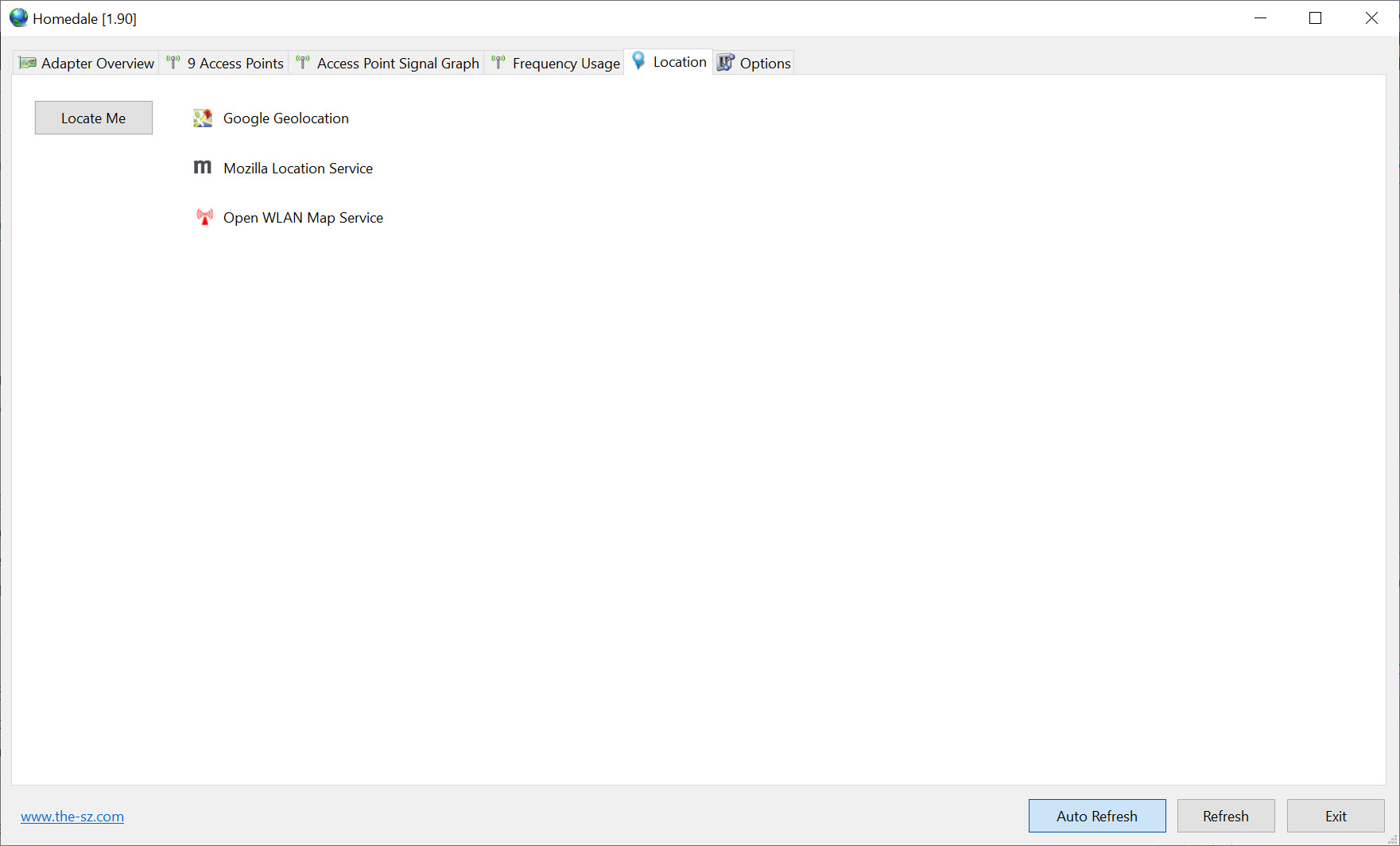
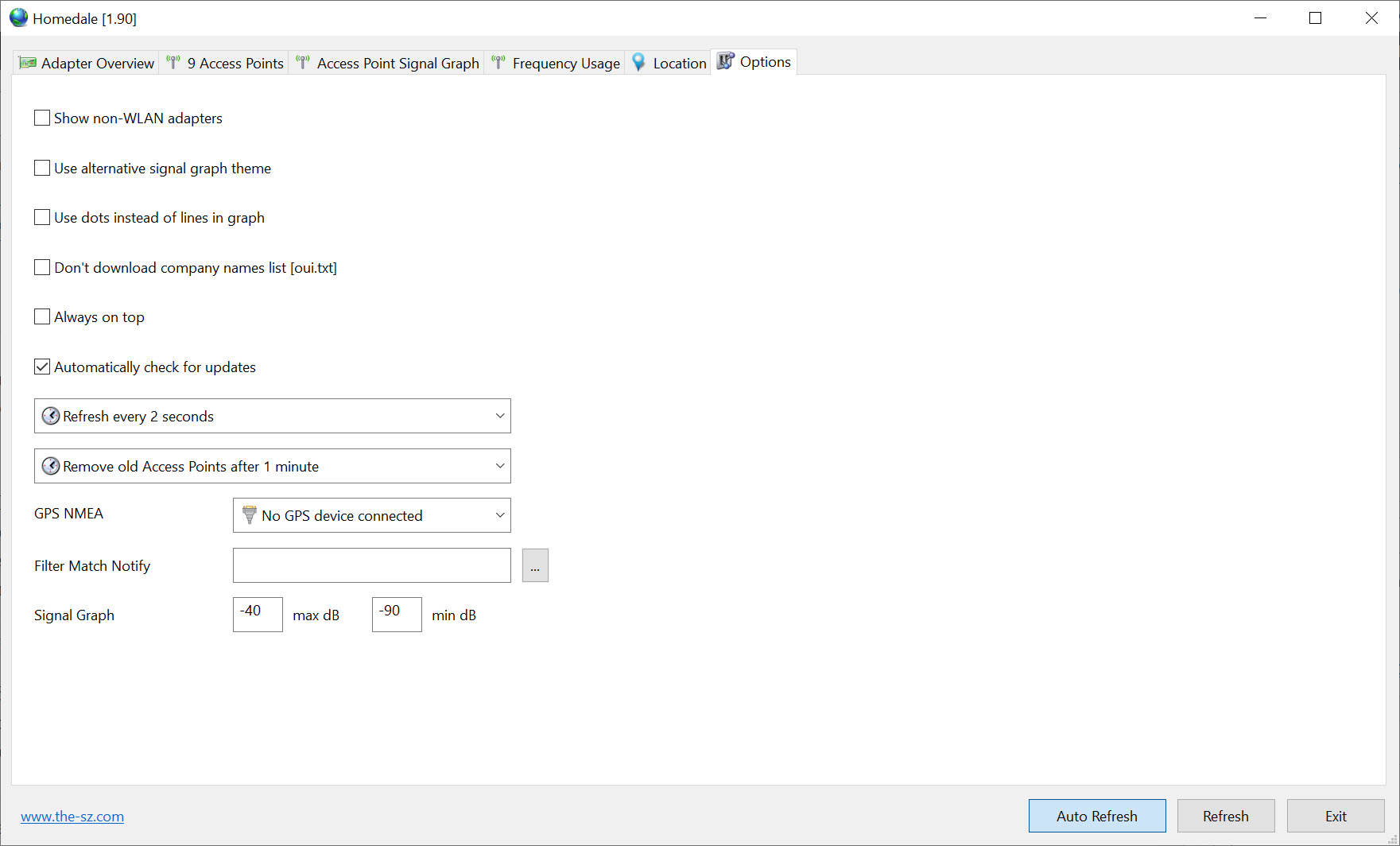
The window is six tabs. Adapter Overview, Access Points, Access Point Signal Graph, Frequency Usage, Location and Options. You will live in the second and fourth.
What the access point list actually tells you
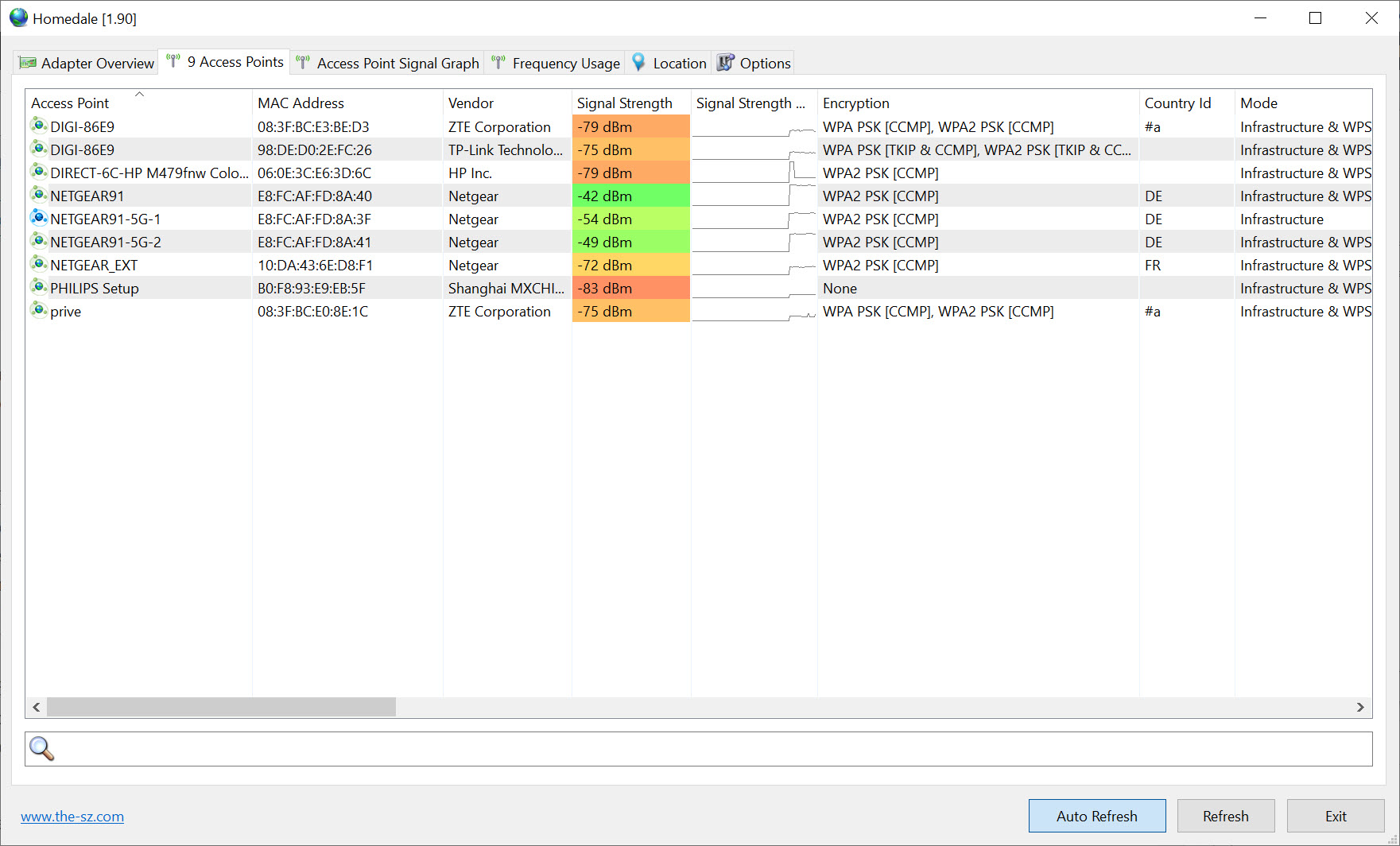
The Access Points tab in Homedale is a plain table, one row per BSSID, and it is denser than it first looks. Alongside the SSID you get the MAC address, the manufacturer derived from that address, signal in dBm, the security type (WEP, WPA, WPA2 or WPA3), the channel, the channel width, the frequency and the supported data rates. Rows whose MAC address has the locally administered bit set are drawn in gray, a quiet way of telling you that a phone hotspot or a randomized address is in the list rather than real infrastructure. Double-click a row and a details window decodes every information element the access point advertises, which is where you look when a laptop refuses to negotiate 160 MHz.
The filter box above the table is more capable than a filter box has any right to be. Multiple words must all match, a leading minus sign excludes a word, a leading pipe turns terms into an OR search, and @ssid: on its own lists only hidden networks. Type “*Ch 1 ” with the quotes and you get every access point on channel 1.
Signal graph over time, and why you would walk around with it
The Access Point Signal Graph tab plots the RSSI of whichever access points you tick, one colored line each, refreshing every five seconds by default. The graph keeps 600 samples unless you tell it otherwise, and when an access point drops out of range its last reading lingers for a configurable number of seconds before the line ends.
This is the tab for the walk. Tick your own router, pick up the laptop, and wander from the living room to the far bedroom while the line sags. You learn more in two minutes of pacing than in an hour of guessing where the dead zone starts. Right-click the graph to save it as a picture, or start logging every sample to a tab-separated text file.
Using the frequency usage tab as a wifi channel scanner
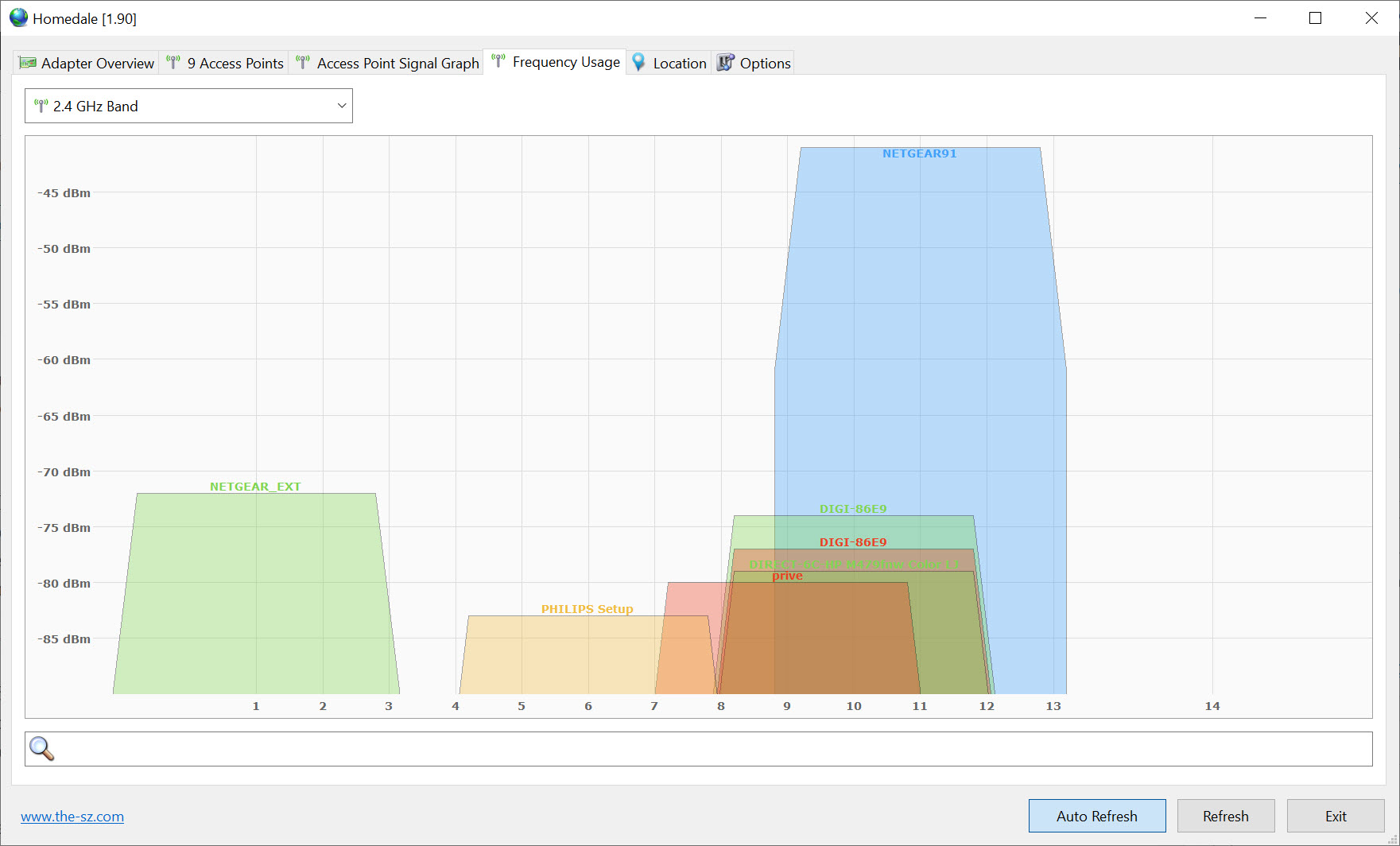
The Frequency Usage tab is where Homedale earns its spot on a laptop that already has other scanners installed. It draws a bar for every channel across all three bands, with the number of access points on it, the station count those access points report, and the channel utilization figure from each one’s beacon. That utilization number matters more than the raw count. Three idle networks on channel 6 are less of a problem than one busy one on channel 11.
Click the chart and it switches between grouping by SSID and by BSSID, which helps when a mesh system is advertising one name from four radios. Wide channels are drawn at their real width, so an 80 MHz neighbor on 5 GHz visibly swallows the four 20 MHz slots around it.
What it does not do is tell you which channel to pick. There is no recommendation and no green tick. You read the bars and decide, and on 2.4 GHz the answer is still 1, 6 or 11.
Connecting from the list
Right-click any access point and you can connect to it or disconnect from it without opening the system network menu. The blue icon marks the network you are on. A small convenience, but when you are cycling through three networks to compare their signal it saves a lot of clicking. Keep in mind that Homedale shows access points, not clients. It will never list the devices sitting on your own network, which is a job for a LAN device scanner rather than a Wi-Fi monitor.
Command-line switches for unattended logging
Where Homedale pulls ahead of point-and-click scanners is scripting. Launch it with /l followed by a filename and it logs from the first scan. Add /c to switch the log to comma separators, /s with a list of SSIDs or /m with BSSIDs to log only those, and /t with a number of milliseconds to make it quit on its own. A batch file that runs a two-minute capture and exits is four switches long.
/csv_save writes the whole access point table to a CSV on exit and /csv_load reads one back in, so you can compare a site before and after moving a router. Drop an empty file named portable.dat next to the executable and settings go into an ini file rather than the registry, which is what you want on a USB stick.
Vistumbler still wins for serious GPS wardriving, with its KML export and access point database, but it has not kept pace with 6 GHz. For a scriptable scan that runs on a schedule and leaves a text file behind, Homedale is the one to use.
Conclusion
Homedale is for anyone who suspects their Wi-Fi is slower than it should be and wants numbers rather than a hunch. Apartment dwellers picking a channel, home workers finding the spot where the signal holds, and technicians who want a scan logged to a file will all get what they came for.
It is not a site survey tool and does not pretend to be. There are no heatmaps (for those you want a survey tool that maps signal room by room), no recommendations, and the graph would embarrass a design student. If you know what dBm means and can read a bar chart, that is a fair trade for a program this small that already speaks Wi-Fi 7.
Pros & Cons
- Shows WPA3, 6 GHz and 320 MHz channels correctly
- Frequency usage chart shows station count and channel utilization per channel
- Full information element decoding for every access point
- Filter syntax with exclusion and per-column matching
- Complete command-line interface for scheduled or unattended logging
- No channel recommendation, you read the bars yourself
- Signal graph is plain compared with inSSIDer
- Filter syntax and command-line options are undocumented inside the program
- Occasionally hangs for a few seconds when closing
Frequently asked questions
Recent systems refuse to hand any program the list of nearby access points unless that program has been granted precise location access. Open the location privacy settings, allow Homedale through, and the list fills on the next scan. It does not read or send your position, it only needs the access point list.
The name comes from a lookup table of MAC address prefixes. Place a file called oui.txt in the same folder as the executable and the column fills in. For your own devices you can add an oui_add.txt with custom mappings, including full six-byte addresses.
Gray means the locally administered bit is set, so the address was assigned by software rather than burned in by the manufacturer. Phone hotspots and privacy features that randomize addresses both show up this way.
No. It measures radio signal and channel occupancy, not throughput. A strong signal on a quiet channel is the precondition for good speed, not proof of it.


