

OpenPuff
About OpenPuff
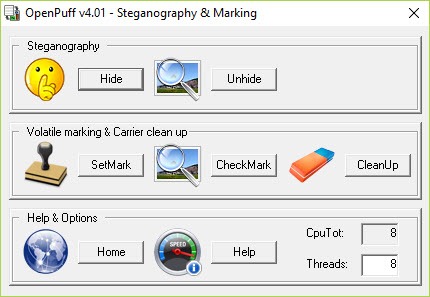
OpenPuff hides a secret file inside ordinary files that look untouched. Feed it a document to conceal and a handful of carrier files, images or music or video, and it buries the secret in the tiny, unnoticeable spaces those files carry. The carriers then save looking and playing exactly as before. Someone who receives the photo sees a photo.
Only the right passwords, carrier files and order among them pull the hidden data out. That is steganography, hiding the existence of a message rather than only its contents, and it is a different game from encryption, which scrambles a message in plain sight and announces that a secret exists.
The program layers real encryption underneath the hiding, so even a hidden stream that is somehow found is still scrambled. OpenPuff also does something few tools attempt. It can hide a decoy alongside the real secret, so that under pressure you reveal a harmless message with one set of passwords while the real one stays buried behind another.
It is a portable program that installs nothing, and its core cryptography is open source even though the rest is not. The sections below cover the hiding, the carriers and their chains, the three passwords and the deniable decoy, the watermarking, and the limits that steganography itself imposes.
Hiding a file in a carrier
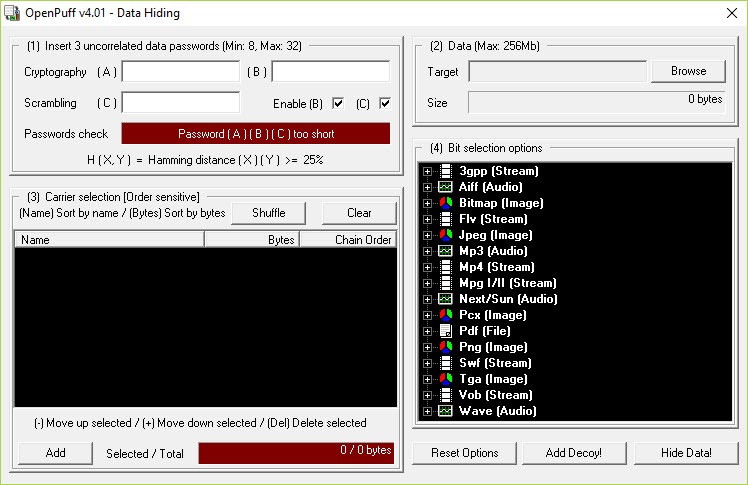
The OpenPuff hide screen asks for three things. The data to conceal, a set of carrier files to hide it in, and the passwords. Choose a photo, a song or a video as the carrier, and the program works out how much it can hold, since every carrier has only so much spare room. Press the button and it writes new copies of the carriers with the secret woven in, bit by bit, in places a casual look and a statistical test both pass over.
The carriers come out the same size and play or display normally. A photo is still the photo, a song still the song. To recover the data, the receiver loads the same carriers into the unhide screen, in the same order, with the same passwords, and the file comes back. Lose a carrier, reorder them or mistype a password, and nothing emerges.
For scrambling a file in plain sight rather than hiding that it exists, VeraCrypt is the encryption tool, and the two approaches answer different threats.
Carriers and the chains
The carriers OpenPuff supports are broad. Images in several formats, audio including MP3 and WAV, video including MP4 and the disc formats, and the document and flash formats round out the list. Each type hides data in its own unnoticeable corners, and the program picks the method to suit the carrier.
A single carrier holds only so much, so for anything large the program chains several together. The secret is split across a sequence of carriers, and only that exact sequence, in that exact order, reconstructs it. The last carrier is padded with random bits so it looks no different from the others.
A large file can be hidden given enough carriers, though the total carrier material must dwarf the secret. A bit-selection setting trades capacity against safety, since hiding more per carrier is easier to spot.
Three passwords, and the layers beneath
By default OpenPuff asks for three separate passwords, not one. They drive a stack of protections applied before a single bit is hidden. The data is encrypted with a combination of modern algorithms, scrambled, mixed with noise from a hardware-seeded random generator, and only then encoded into the carriers with a function that folds in the carriers’ own bits. The number of passwords can be dialled down to one, but three is the design and the recommendation.
The effect is that the hidden stream, even extracted, is a block of noise without the passwords. The hiding defeats the search, and the encryption defeats the find. For plain file encryption with a single password and a simpler model, AxCrypt covers that need, and it makes no attempt to hide that a file is encrypted.
The deniable decoy
This is the feature that sets OpenPuff apart. Alongside the real secret, a decoy can be hidden in the same carriers, protected by a different set of passwords. Hand over the decoy passwords under coercion and the examiner extracts a plausible, harmless message and is satisfied. The real secret stays hidden behind the other passwords, and nothing about the carriers reveals that a second layer exists.
That is deniable steganography, and it is built for the situation where refusing to produce a password is itself incriminating.
It works only if the decoy is convincing, since an obviously trivial one invites more pressure. It is a tool for a serious threat model, and it demands the user think like the adversary.
Watermarking
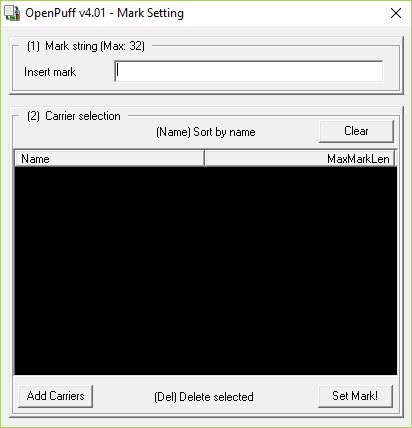
OpenPuff also marks files rather than hiding messages in them. A short invisible mark can be set into a carrier and checked later, which is how ownership of a photo or a recording is asserted without a visible stamp. The program reads the mark back from a file that carries it.
It is a smaller feature than the hiding, and it serves a different purpose, proving where a file came from rather than concealing what it holds. For anyone distributing images or audio who wants a quiet claim of origin, it is there alongside the main tool.
The limits steganography imposes
The method has hard limits. Carriers must be far larger than the secret, so hiding a big file means gathering a lot of carrier material. The carriers must then be shared or published without compression or re-encoding, because a messaging service that recompresses an image destroys the hidden data inside it. Every carrier must survive intact and in order, which makes the scheme fragile in a way a single encrypted file is not. The interface is dense and unlabelled in places, and reviewers agree it takes time to learn.
None of that is a flaw in the program so much as the nature of hiding data in plain files. Used correctly, with uncompressed carriers kept safe and the passwords remembered, it does what nothing simpler can, which is to make a secret invisible rather than merely unreadable.
For the common case where unreadable is enough, an encrypted container from a disk encryption tool is simpler and sturdier.
Conclusion
OpenPuff suits anyone who needs to hide that a message exists at all, rather than only keep it unreadable. That runs from a journalist moving notes past inspection to anyone whose threat model includes being forced to hand over a password. The carrier chains, the layered encryption and the deniable decoy make it one of the most capable tools of its kind.
It demands large carriers, careful handling that no recompression touches, and patience with a dense window. For the everyday need to keep a file unreadable, an encrypted container is simpler. For the rarer need to make a file invisible, this is the tool.
Pros & Cons
- Hides a file inside images and audio, video and documents, all looking unchanged
- Layers real multi-algorithm encryption under the hiding
- Chains many carriers to hide larger files, with the last one padded to match
- Deniable decoy revealed by a separate password set under coercion
- Invisible watermarking to assert ownership of a file
- Portable, installing nothing, with an open-source crypto core
- Carriers must be far larger than the secret
- Carriers break if a service recompresses or re-encodes them
- Every carrier must survive intact and in the right order
- Dense interface that takes time to learn
Frequently asked questions
Encryption scrambles a file and shows that a secret exists. OpenPuff hides the file inside ordinary images, audio or video so that nothing looks out of place, with encryption layered underneath.
A harmless second message hidden in the same carriers behind a different password set. Under coercion you reveal the decoy, and the real secret stays hidden.
A service or program recompressed or re-encoded the carrier, which destroys the hidden bits. Carriers must be shared without any re-encoding.
Three by default, which is the recommendation. It can be reduced to one, which weakens the protection.


