

iVCam
About iVCam
iVCam turns the phone or tablet already in your pocket into a webcam for your computer, and the camera on a modern handset usually runs circles around the one built into a laptop. Install the desktop client, pair it with the companion app on your device, and your phone’s camera shows up as a standard webcam that any video app can use. The result is sharper video, better color, and far stronger low-light performance than most built-in or USB webcams manage.
The reasoning is hard to argue with. Phone makers pour enormous effort into their cameras, while the webcam glued above your screen is usually an afterthought. iVCam bridges that gap, letting you point your handset’s good lens at yourself and feed that quality straight into a call, a stream, or a recording.
Once it is set up, your computer treats the phone exactly as it would any other camera, so nothing else in your workflow has to change.
Connecting over Wi-Fi or a cable
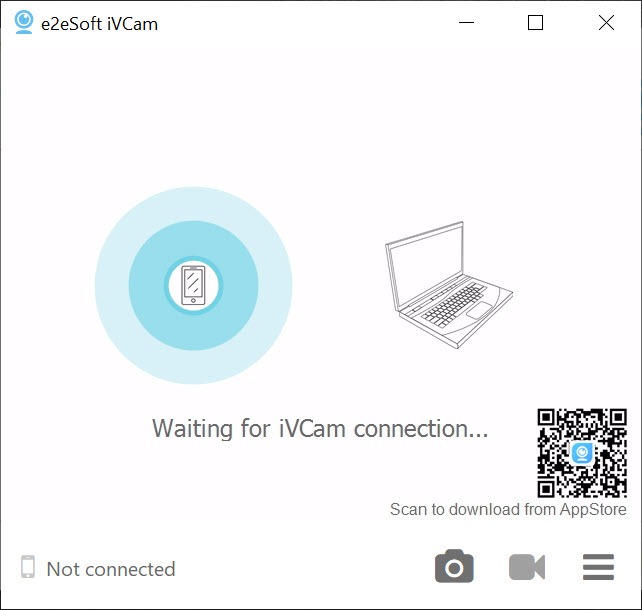
You have two ways to link the devices, and the choice shapes the experience. Over Wi-Fi, the app and the client find each other automatically as long as both are on the same network, with no addresses to type or settings to wrestle. You open the app on the phone, it locates your computer, and the feed appears. That convenience is the draw, because it lets you place the phone anywhere in the room without a cable tethering it down.
The wired route runs the phone to the computer over a cable instead, and it trades some of that freedom for rock-solid stability. A direct connection gives you the lowest latency and a feed that stays smooth even when your wireless network is congested. F
or a casual call, Wi-Fi is the easy pick. For streaming or recording, where a dropped frame or a lag spike is more costly, the cable is the safer choice. Having both options means you are not forced to pick one tradeoff for every situation.
It just shows up as a camera in your apps
The reason this slots so cleanly into any setup is that the desktop client installs a virtual camera. To the rest of your computer, the phone feed looks like an ordinary webcam device, so it appears in the camera dropdown of whatever software you already use. Video meeting tools, chat apps, and recording programs all see it without any special integration, because as far as they know it is just a regular camera.
That universality is the quiet strength of the whole approach. You do not need an app to be specifically compatible, you just select the iVCam camera in its settings and the phone feed takes over.
The same holds on the audio side, since the client can also expose your phone’s microphone as a virtual input device, letting your handset double as a wireless mic. For feeding that camera into a live broadcast specifically, a streaming suite like Streamlabs Desktop picks it up as a source the same way it would any webcam.
Camera controls a built-in webcam never gave you
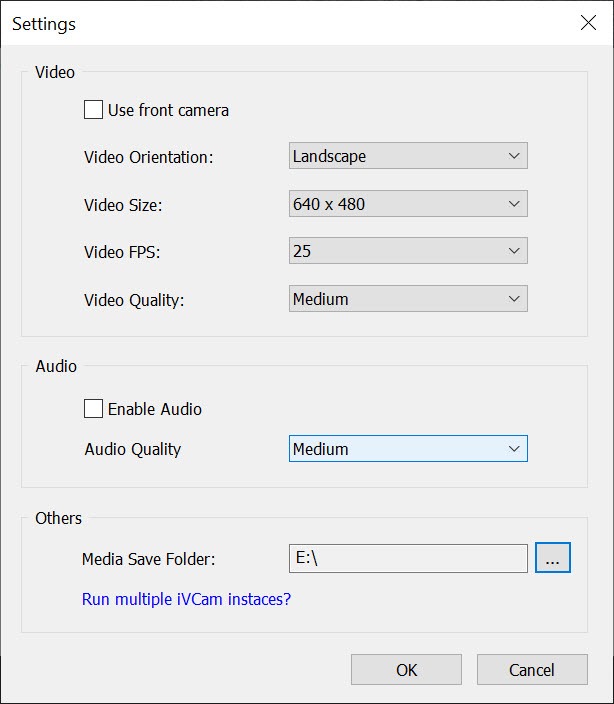
Because it is using a real phone camera, you inherit the kind of controls a cheap webcam simply does not offer. You can manage exposure, focus, white balance, and zoom, switch between the front and rear lenses, and on phones with multiple cameras, jump between wide and telephoto. Resolution scales all the way up to 4K when your device’s camera supports it, with lower settings available to ease the load on a slower network.
There is also a set of finishing touches aimed at how you appear on camera. Background replacement can blur, bokeh, or green-screen what is behind you without a physical backdrop, keeping your room private during a call.
Face beautify, flip and mirror, and manual focus round it out. One honest caveat belongs here. The background removal leans on your computer’s graphics hardware, so an older machine without a capable GPU may not be able to use it smoothly.
If you mainly want to record the resulting feed rather than go live, a capture tool like Debut Video Capture handles saving the video, and a lightweight recorder such as CamStudio covers simpler capture jobs.
Multiple angles and recording straight to your computer
The tool goes further than a single replacement webcam. It can connect several phones to one computer at the same time, so you can set up multiple angles and switch between them, the sort of thing that makes a stream or a tutorial feel produced rather than static. For anyone making content, that multi-camera capability is a genuine step up from a lone fixed webcam.
It can also record the feed directly to your computer, which sidesteps the limited storage on a phone and turns the setup into a remote video recorder. Global hotkeys let you snapshot, record, pause, or switch cameras without leaving your meeting or streaming window, so you keep control without breaking your flow.
If your goal is using an old handset as a wireless camera through the same kind of app, DroidCam Client offers another take on the phone-as-webcam idea worth comparing.
Conclusion
iVCam makes a strong case for never buying a dedicated webcam again, because the better camera is already in your hand. The automatic pairing, the virtual camera that every app recognizes, and the real camera controls turn your phone into a video source that outclasses most built-in and USB options, and the multi-angle and recording features push it toward genuine content-creation territory.
The rough edges are minor and honest. Background removal asks for decent graphics hardware, wireless audio can wander out of sync, and the whole thing leans on your network when you go cable-free. None of that undercuts the core promise.
For video calls, streaming, or recording where image quality matters, this is a practical way to put a far better camera to work using hardware you already own.
Pros & Cons
- Uses your phone's superior camera for sharper video than most built-in webcams
- Connects over Wi-Fi for freedom of placement or USB for the lowest latency
- Installs a virtual camera so any webcam-aware app recognizes it automatically
- Full camera controls for exposure, focus, white balance, zoom, and lens switching
- Background replacement and your phone as a wireless microphone, both built in
- Connects multiple phones for multi-angle setups and records straight to the computer
- Background removal needs a reasonably capable graphics card to run smoothly
- Audio over Wi-Fi can drift out of sync, so a wired link or the computer mic is steadier
- Wireless quality depends on your network, and a congested one shows in the feed
- It ties up your phone for the duration, so it is unavailable for other use meanwhile
Frequently asked questions
You install a desktop client and a companion app on your phone, and the client creates a virtual camera on your computer. Once the two are paired, your phone's camera feed appears as a standard webcam that any video app can select.
Both. Over Wi-Fi the app and client pair automatically on the same network for cable-free placement, while a USB cable gives the lowest latency and steadiest feed. Wi-Fi suits casual calls, and the cable is better for streaming or recording.
Because it installs a virtual camera device, virtually any webcam-aware program recognizes it, including video meeting tools, chat apps, streaming software, and recording programs. You simply select the iVCam camera in that application's settings.
Yes. Alongside the video, the client can expose your phone's microphone as a virtual audio input, so your handset doubles as a wireless mic. Note that audio over Wi-Fi can sometimes drift out of sync, in which case a wired link or your computer's own mic is steadier.
Yes. It supports connecting multiple phones to a single computer at the same time, letting you set up several camera angles and switch between them, which is useful for streaming and content creation that benefits from a multi-camera look.


