

IsoBuster
About IsoBuster
IsoBuster rescues files from discs, drives, memory cards and disk images that the system has given up on. It talks to the drive directly, sector by sector, instead of asking the operating system to mount the media. A scratched DVD, a half-finished CD session or a USB stick that “needs to be formatted” can still be opened and copied out.
The approach matters more than the long list of supported formats. Every file system the program knows is read independently, including the hidden or secondary ones that a disc may carry alongside the obvious one. Every unreadable sector is retried in several ways before being skipped.
That is the difference between a recovery tool and a file manager, and it is why this one has been the standard answer to “my old photo CD will not open” for so long.
Reading the disc the system refuses
Insert the damaged media, pick the drive, and IsoBuster mounts it with its own code. The tree on the left shows every session and track on an optical disc, and under each one, the file systems it found. A disc that the system reports as empty often turns out to hold several sessions, because a drag-and-drop burning program closed the disc badly, and the files sit in a session nobody mounted.
When a sector will not read, the program retries with different drive commands, can pause for a chosen number of seconds between attempts to let an ageing drive recover, and then moves on while marking the gap.
The disc properties afterwards show a map of every unreadable sector, which tells you how bad the damage really is and whether a second drive might do better.
Every file system, including the ones you did not know were there
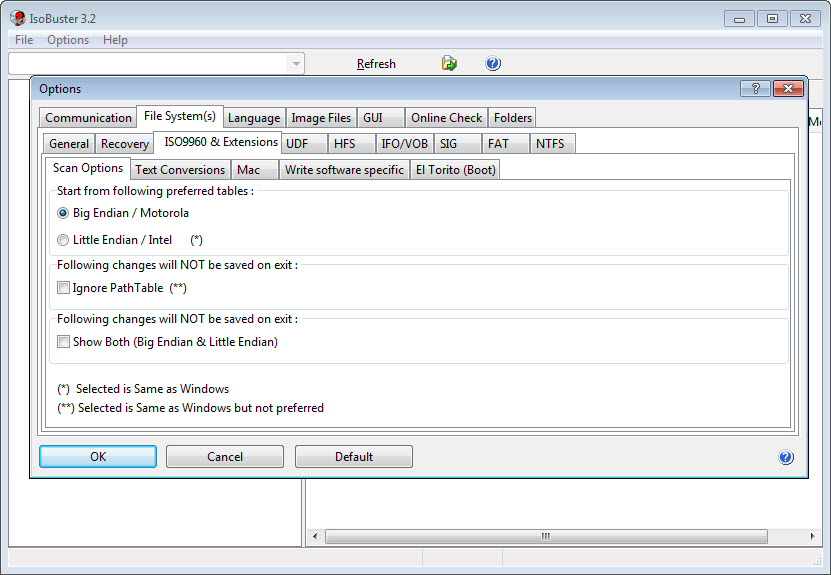
Optical discs can carry ISO 9660, Joliet, UDF, HFS and others at the same time, and IsoBuster lists them all. If the primary file system is corrupt, a secondary one often still points at the same data.
Hard drives, SSDs and flash media bring NTFS, every variant of FAT including ExFAT, EXT and XFS, and HFS. EFI and GUID partition tables are read as well. Even game console memory cards and video DVD structures with their IFO and VOB files are recognised on their own.
When no file system survives, a signature scan finds files by their content. Hundreds of file types are detected this way, from documents and archives to raw camera formats, which is how photos come back from a memory card that has been quick-formatted.
For deleted files on a healthy hard drive, Recuva is simpler, but it does not touch optical media or broken file systems the way this tool does.
Managed images, the feature professionals rely on
The managed image file is the strongest feature of IsoBuster for serious recoveries. Instead of extracting straight from a failing disc, you first create an image in its IBP and IBQ format. The program records which sectors were read and which failed, so the job can be stopped and resumed later, and the same image can be completed on a different drive that manages to read the sectors the first one could not.
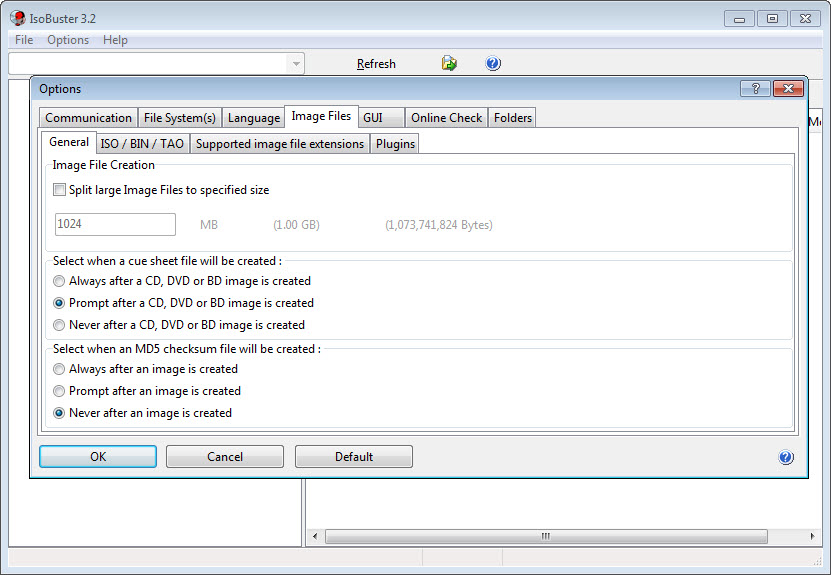
Once the image is as complete as it will ever get, every extraction happens from the image rather than the disc, which spares the fragile media from further wear. Images can also be split across several files, written alongside an MD5 checksum, and verified against that checksum automatically on opening.
Opens almost any image format
Beyond its own format, the program opens an enormous range of disc and drive images. ISO, BIN and CUE, NRG, IMG, MDF, CCD, DMG and dozens of burning-program formats open with their original track and session layout. So do virtual machine disks such as VHD, VHDX and VMDK, and forensic evidence containers in the E01 family.
That reach makes it a general image browser as well as a recovery tool. Files can be extracted from an image without mounting it, boot images can be pulled from a bootable disc, and video from VCD and SVCD discs can be converted to playable MPEG files during extraction.
Anyone who just wants to mount an image as a drive letter is better served by a virtual drive utility.
Checking before extracting
A surface scan in IsoBuster reads the whole disc and reports physical errors without extracting anything, which answers quickly whether a stack of old backups is still readable. A separate check tests whether every file and folder can be read, again without copying data to the hard drive, so you learn which files will fail before spending an hour on extraction.
Detailed lists of files and their sector locations can be exported, and raw sectors can be viewed and saved for examination. Once a recovered image is complete and verified, ImgBurn writes it back to a fresh disc.
Those features exist for forensic and professional use, but they also help an ordinary user understand why one particular file keeps failing while the rest of the disc copies fine.
Conclusion
IsoBuster suits anyone with damaged or unreadable discs, failing memory cards or odd image files, from a family rescuing old photo CDs to technicians recovering client data. Direct sector access, independent file system reading and managed images make it thorough where most tools simply fail.
It asks for patience with its dense interface and with slow reads from bad media, and it cannot conjure data from a physically destroyed disc. For everything short of that, it remains the most capable tool of its kind.
Pros & Cons
- Reads discs and drives directly, bypassing the operating system
- Shows every session, track and file system on a disc, including hidden ones
- Several retry strategies with pauses for fragile media
- Managed images that resume and can be completed on another drive
- Opens dozens of disc, drive, virtual machine and forensic image formats
- Signature scan recovers files when no file system survives
- The interface is dense and takes time to learn
- Physically destroyed media remains beyond recovery
- Extraction from a damaged disc can take many hours
Frequently asked questions
Often, yes. It lists every session on the disc independently, so files in a session the system never mounted appear in the tree and can be extracted.
An image of the disc that records which sectors were read successfully. The job can be paused and resumed later, even on a different drive, and files are then extracted from the image instead of the fragile disc.
Yes. It reads the file systems on flash media directly, including cards the system says need formatting, and falls back to a signature scan when the file system is gone.
Yes. Open the image, browse its file systems in the tree, and extract any file or folder straight to disk.


