

GifCam
About GifCam
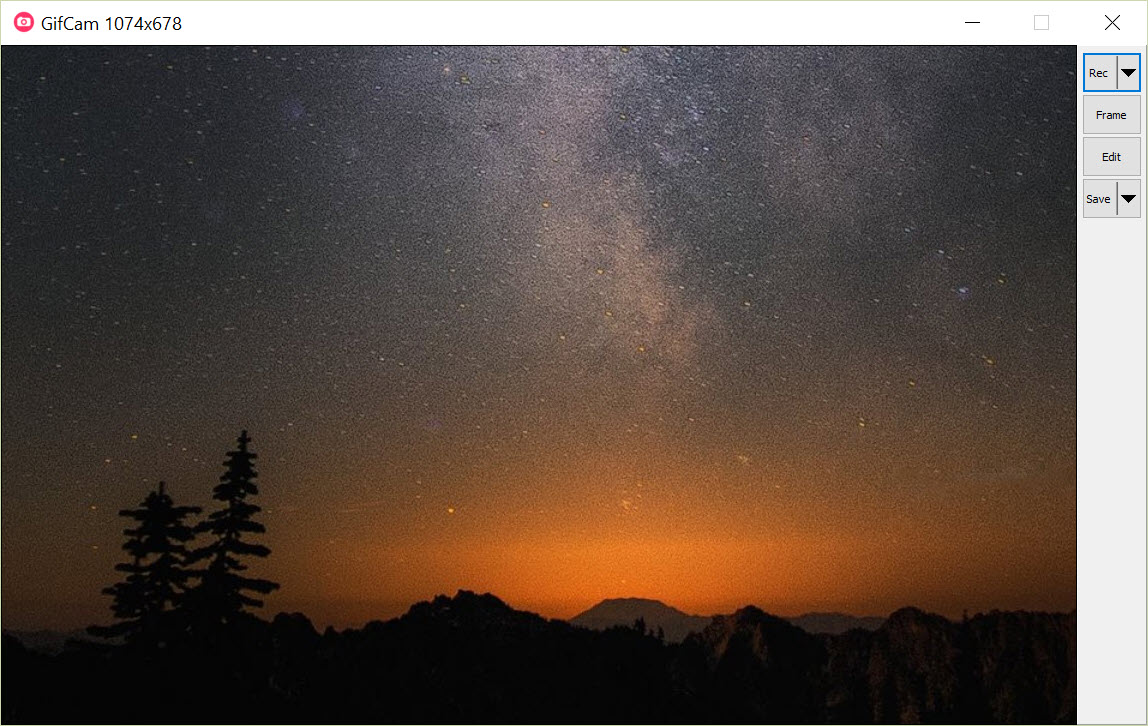
GifCam is a camera for your screen that shoots animated GIFs. The program is a transparent window with a frame around it. Drag the frame over whatever you want to capture, resize it to fit, press Rec, and everything inside the frame is recorded until you press Stop. Then press Save and a GIF appears. No installer, no settings to learn, no codecs to think about. The whole thing is a single small file that runs from wherever you unzip it. It has stayed deliberately simple while the tools around it grew heavy.
What lifts it above a quick-and-dirty recorder is what happens between Stop and Save. GifCam compares each new frame with the one before it, and when nothing has changed it does not store another picture. It adds a delay instead. When only part of the picture has changed, it stores only that part and paints the rest green, which the GIF format treats as transparent.
The result is a file a fraction of the size a naive recorder would produce, which matters for a format with no compression to speak of. A frame-by-frame editor and a few colour options sit behind that, and the sections below walk through the recording, the editing and the limits.
Recording, by frame rate or by hand
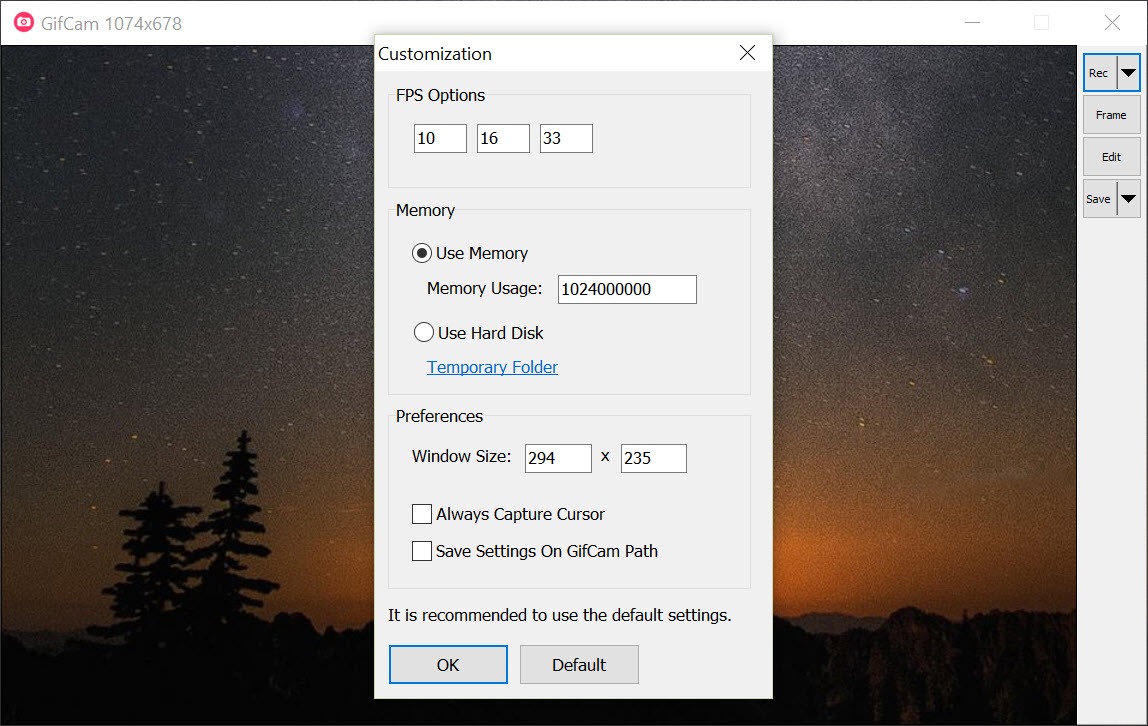
Two GifCam buttons do the capturing. Rec records continuously at a frame rate you pick, with ten, sixteen and thirty-three frames a second offered by default, and others available. Frame grabs a single frame each time you press it, which is how a step-by-step guide gets built with a click per step rather than a stream of near-identical pictures. A Full Screen option ignores the frame and captures the whole display.
The cursor can be included or hidden. A counter in the title bar shows how many frames have been recorded and how long the animation runs. There is no time limit beyond the memory in the machine, though a long GIF is a large GIF, and the format punishes length more than most. Keep recordings short. That is less a limitation of this tool than a fact of life about GIFs.
The program’s size-saving tricks are the reason it handles them better than most.
The green screen, and why files stay small
The green you see in the editor is the clever part. GifCam marks every pixel that has not changed since the previous frame as green, and the GIF format stores green as transparent, so the previous frame shows through. A recording of a terminal where only one line changes stores one line per frame, not a whole screen. A high quality option on recording makes the detection more generous, which produces a wider green area and a smaller file.
You can draw green yourself. Hold the tool over a region and paint it, and that region freezes across every frame while the rest keeps moving, which is how a cinemagraph gets made, a still photograph with one moving element. The green colour itself can be changed if the thing you are recording happens to contain the same shade.
A profile window shows a bar chart of each frame’s size, its colour count and how much of it is green. You can see exactly where the bytes are going.
Editing frame by frame
The GifCam Edit button opens a preview you can step through one frame at a time. Right-click any frame to delete it, to add or remove a tenth of a second of delay, or to delete everything before or after it, which is how a recording gets trimmed to the moment that matters. Text can be added to a frame. Frames can be cropped or resized, and hue and saturation adjusted, which rescues a capture that came out dim.
The editing is deliberately shallow. There are no arrows, no highlights and no annotations of the sort ShareX draws, and no timeline of the sort a video editor has. What it offers is enough to cut a mistake out of a recording and label a step. That is what most GIFs made from a screen actually need.
Colours, and the other output formats
Saving in GifCam offers several colour treatments. Quantize reduces the palette intelligently, Nearest picks the closest colours, 20 Colors and Grayscale and Monochrome do what they say, and a custom option lets you set the palette yourself. A colormap editor swaps every instance of one colour for another. GIF is limited to 256 colours per frame. The choice changes how a recording of a photograph or a gradient looks, and trying two is the way to find out.
The arrow beside Save exports the recording as video instead, as an uncompressed AVI or as an MP4 through the encoder already built into the system, which needs no extra software. That turns a short screen capture into a clip for a chat or a presentation without a separate recorder.
For a longer recording with audio, Rylstim Screen Recorder is the right tool, and this one stays with the short, silent loop.
Where it stops
GifCam has no audio, because GIFs have none, and no webcam. The editor cannot draw annotations, and the interface is a small window with a few buttons that looks exactly like the utility it is. Recordings of fast motion at low frame rates stutter, and a GIF of anything photographic will show colour banding no matter which palette you choose, which is the format’s fault rather than the program’s. Updates arrive rarely.
The closest sibling is LICEcap. It records the same way, through a frame on the screen, and trades this program’s editor and green-screen tricks for an even smaller footprint and a text-title overlay.
Conclusion
GifCam suits anyone who needs to show a few seconds of screen activity, a bug for the person who has to fix it, a trick for a colleague, a step in a guide, and wants it as a GIF that pastes anywhere and loads fast. The frame-over-the-screen design makes recording instant. The green-screen trick keeps the files smaller than any other tool in the class.
It is a loop recorder, not an editor or a video tool, and it shows its age in the window. Keep the recordings short, try two palettes before settling, and let a heavier tool handle anything that needs arrows or a soundtrack.
Pros & Cons
- Drag a frame over the screen, press Rec, press Save, and a GIF appears
- Stores only changed pixels and adds delays for still frames, so files stay small
- Frame-by-frame editor to delete, delay, crop, resize and add text
- Draw a green screen to freeze part of the picture for cinemagraphs
- Several palette options plus AVI and MP4 export
- Single small portable file with nothing to install
- No annotations, arrows or highlights in the editor
- No audio or webcam, by the nature of the format
- Fast motion stutters at low frame rates
- Rarely updated, with a dated interface
Frequently asked questions
It compares each frame with the previous one, stores only the pixels that changed, and adds a delay instead of a new frame when nothing moved. Unchanged areas are marked green, which the GIF format treats as transparent.
Yes. The arrow beside Save exports an uncompressed AVI or an MP4 through the system's built-in encoder, with no extra software needed.
Transparent areas that show the previous frame through. You can also paint green yourself to freeze part of the picture while the rest moves.
No. The editor adds text, trims frames, adjusts delays and crops or resizes, but it draws no annotations.


