

Bootice
About Bootice
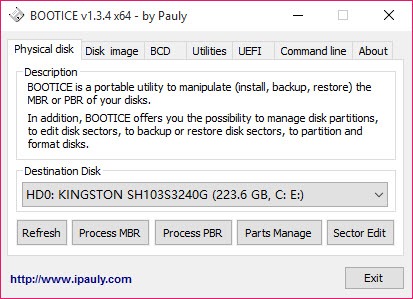
If you have ever needed to repair a damaged Master Boot Record, install Grub4DOS on a USB stick, or convince a stubborn flash drive to boot a Windows installer, you have already met the kind of low-level disk surgery that most utilities will not touch. Bootice is a tiny freeware boot sector editor that opens the hood and lets you work directly on MBR, PBR, BCD, and partition structures without going anywhere near a command line if you do not want to. It is the kind of tool you keep in your toolkit for the day everything else has failed.
The whole application is a single executable under a megabyte. No installer, no service running in the background, no telemetry. You launch it, it asks for admin privileges (it has to, because it writes to raw disk sectors), and you are looking at a tabbed window that exposes seven or eight different boot-related operations.
Compared to a heavyweight partition suite like DiskGenius, it does almost nothing graphical and almost everything technical.
Direct access to MBR and PBR sectors
The core of Bootice is the Process MBR and Process PBR tabs. You pick a physical disk, choose an MBR type from the list (Grub4DOS 0.4.5c, Grub2 for DOS, Windows NT 5.x/6.x MBR, USB-HDD+, USB-ZIP+, Plop Boot Manager, SYSLINUX, or a few others), and install it in place. The PBR side does roughly the same for partition boot records, with options for FAT-based partitions, NTFS, exFAT, and the various Grub4DOS PBR styles.
This is where Bootice earns most of its reputation. Tools like Rufus handle the common case of writing one ISO to one stick. Bootice handles the awkward middle ground where you already have a partitioned drive with files on it and you just want to swap the MBR or fix a damaged PBR without wiping the partition. That distinction matters when you are repairing a drive instead of preparing one from scratch.
There is also a backup function on both tabs. Before you overwrite a sector, you can dump the existing one to a .BIN file. Use it. The application warns you, but it does not stop you from rendering a drive unbootable if you click the wrong combination, and a 512-byte backup file is the cheapest insurance you will ever buy.
Sector editor for the brave
Tucked under its own tab is a raw sector editor. Hex on the left, ASCII on the right, jump to any LBA you want. It is not a polished hex viewer in the WinHex sense. The font is small, search is basic, and there is no diff mode. But it reads and writes individual sectors on physical disks and logical partitions, which is something most utilities will not let you do at all.
In practice you use this when something does not make sense and you need to see what is actually sitting at sector 0, or at the partition’s first sector, or wherever a tool claims it wrote something. It pairs well with whatever forensic or recovery workflow you already have.
For straightforward partition recovery work, dedicated software like MiniTool Power Data Recovery covers more ground. Bootice is for when you need to see and modify the bytes yourself.
BCD editing without the registry dance
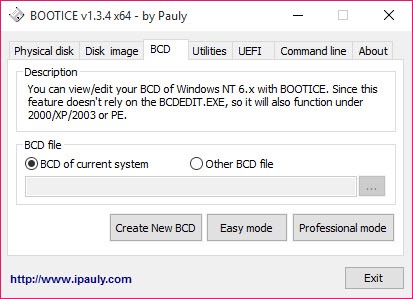
The BCD Edit tab is one of the more useful corners of the application. It opens Windows Boot Configuration Data stores directly, both the current system’s BCD and any BCD file you point at, and lets you add entries, change descriptions, set the default OS, toggle the boot menu timeout, and rebuild entries by hand. You can do all of this with bcdedit.exe at the command line, but the GUI here is a lot faster when you are juggling multiple Windows installs on one machine.
It is not a replacement for EasyBCD if your needs run toward sophisticated multi-boot setups with Linux entries, EFI loaders, and chainloaded environments. Bootice keeps things closer to the metal. EasyBCD is friendlier, with named profiles and templates.
Bootice assumes you know what an {default} GUID is and shows it to you.
Disk image creation and partition tools
The Disk Image tab can dump a partition or a whole disk to a raw image file, and write a raw image back to a target. There is no compression, no incremental, no scheduling. It is the dd-equivalent for people who do not want to install a Linux live environment just to clone a small partition. For real backup work you want something like AOMEI Backupper with its scheduling and incremental support. The image function here is for one-off clones and forensics, not for nightly backups.
Partition management is more limited. You can view the partition table, set the active partition, change partition IDs, format individual partitions in FAT16, FAT32, NTFS, or exFAT, and re-partition USB drives between the various USB-HDD, USB-ZIP, USB-FDD layouts that the older grub4dos workflows expect.
If you want to resize or move partitions on a system drive, you need a different tool. This is partition setup for boot prep, not partition management.
UEFI bootloader configuration
The UEFI tab is where the application starts to feel a little behind in spots. It reads NVRAM boot entries, lets you reorder them, rename them, and remove orphaned ones, which is helpful when Linux installers have littered your firmware with dead pointers. You can also add new entries that point to specific .efi files on EFI System Partitions.
What it does not do is generate signed Secure Boot entries or handle TPM-bound configurations. On modern firmware with Secure Boot strictly enforced, you will hit walls quickly. If your job is dual-booting a custom EFI loader, Clover EFI Bootloader gives you a real configuration system.
Bootice is fine for cleaning up the NVRAM and pointing at known-good loaders.
Bootable USB workflows
A lot of people land on Bootice because they are building a custom multiboot USB stick and the all-in-one builders feel too opinionated. Pair it with Grub4DOS for the boot logic, copy your ISOs and BIN files onto the partition manually, install the Grub4DOS MBR with Bootice, drop a menu.lst at the root, and you have a stick that does exactly what you told it to and nothing else.
For the common case where you just want one ISO on one stick, Ventoy is dramatically easier and probably the better starting point. Bootice comes into its own when Ventoy’s approach does not fit, or when you are migrating an existing layout that already works and you do not want to redo it from scratch.
The interface, honestly
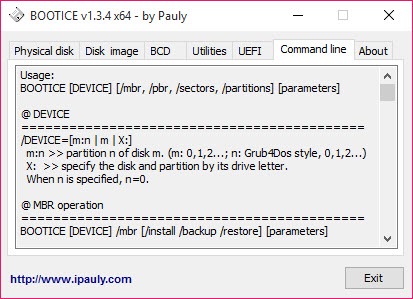
The GUI is dense and a bit ugly. Tabs across the top, a target disk selector that looks more like a debug readout than a control, and dialogs that throw acronyms at you with minimal explanation. It is not difficult once you know what each tab does, but the learning curve is real, and the help file is sparse.
Some Chinese strings still surface in a few dialog boxes depending on which build you grab. The application is fully usable in English, but every now and then you hit a label or a tooltip that did not get translated. Granted, this is the kind of utility where you read documentation elsewhere and use the GUI as a control panel, so the rough edges around localization matter less than they would in a product you live in all day.
Antivirus flags and the trust question
Because it reads and writes raw sectors and installs MBR code, Bootice trips heuristic antivirus engines fairly often. The behavior of stamping a Grub4DOS MBR onto a disk looks, statistically, a lot like a bootkit infecting a drive. Most flags are heuristic false positives, but you should grab it from a place you trust and verify the hash if you can find a reference. Running it from a sandbox the first time is also reasonable hygiene if you are uncertain.
Conclusion
Bootice is a specialist’s tool, and it does not pretend otherwise. If your work touches MBR repair, custom Grub4DOS USBs, BCD juggling across multiple Windows installs, or the occasional raw sector inspection, it covers ground that friendlier utilities deliberately avoid. If you just want to write an ISO to a stick and walk away, you are better served by a single-purpose builder.
The trade-off you accept is a dense interface, real risk if you mis-click, and the periodic antivirus theater that comes with any tool that writes to sector 0. For technicians, recovery workers, and people who maintain their own multiboot environments, it has the kind of focused capability that justifies keeping a copy around even on machines where it sits unused for months at a stretch.
Pros & Cons
- Edits MBR, PBR, BCD, partition tables, and raw sectors from a single small executable
- Built-in backup of MBR and PBR sectors before writing
- Supports many MBR/PBR styles including Grub4DOS, SYSLINUX, NT 5/6, Plop, USB-HDD+, USB-ZIP+
- Useful UEFI NVRAM editor for cleaning up orphan boot entries
- Disk image dump and restore for one-off clones
- No installation, runs portable from a USB stick
- GUI is dense and assumes you already understand boot sectors
- Sparse documentation, untranslated strings in a few dialogs
- Frequent heuristic flags from antivirus engines
- Easy to brick a drive if you click without thinking
- Limited partition management compared to dedicated partition managers
- No Secure Boot or TPM-aware UEFI handling
Frequently asked questions
EasyBCD focuses on Windows BCD entries and friendly multi-boot setup. Bootice goes lower, letting you install MBR and PBR code, edit raw sectors, modify partition tables, and tweak UEFI NVRAM directly. The two overlap on BCD editing but solve different problems.
Often, yes. If the issue is a damaged MBR or PBR, you can reinstall the appropriate boot code from the Process MBR or Process PBR tab without wiping the partition. If the partition table itself is corrupt, you may need to recreate it, which can mean data loss.
Yes. Bootice reads GPT partition tables, lets you inspect them, and includes a dedicated UEFI tab for NVRAM boot entries. It does not generate Secure Boot signed loaders, so its usefulness on strict Secure Boot machines is limited to inspection and cleanup.
Writing raw boot sectors looks structurally similar to bootkit malware. Heuristic engines flag the behavior, not a known signature. Verify the file source and hash, and run it from a sandbox the first time if you want extra reassurance.
Yes, this is one of its most common use cases. Pick the drive, open Process MBR, select Grub4DOS, install it, then optionally apply a Grub4DOS PBR to the active partition. Add grldr and menu.lst to the partition root and the stick will boot the menu.


