

BYOND

About BYOND
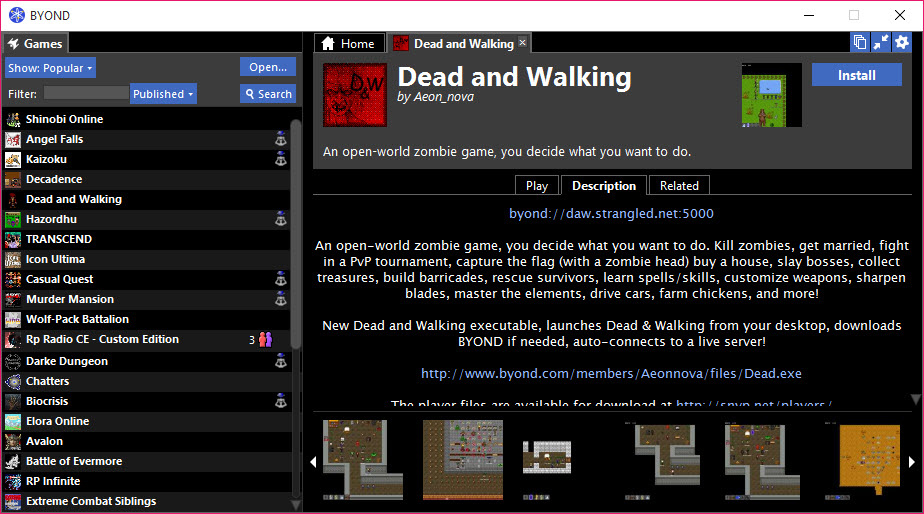
BYOND is a platform for making and playing online multiplayer games, and the two halves come in one installer. The player half is a client that connects to a hub listing hundreds of live game servers, joins one with a click and renders the game in a window, with a pager for friends and messages alongside.
The maker half is a complete toolkit, a code editor with its own language, a tile map editor, an icon editor for pixel art and a server program that hosts the finished game for anyone on the internet to join.
What makes it distinctive is that networking is not something you build. Every game written here is multiplayer by default. Define a player character, give it a map to walk on and a verb to say something, then compile, and the result already handles connections and chat for as many people as the server can hold.
BYOND is the engine behind Space Station 13 and its many descendants, and most people arrive either to play one of those or because they want to build something in the same mould.
The player side, and the hub
Dream Seeker is the BYOND client. Launch it, sign in with a key, which is the platform’s word for an account, and the hub shows games sorted by category and popularity, each with its list of live servers and player counts. Joining is a click, and the game’s assets stream down on first connection.
The pager sits beside it with a friends list and messaging, plus forum access, though most game communities have long since moved their chatter to a voice and text chat platform. Games render in a resizable window with a text pane, a map pane and whatever interface the maker designed, from a plain grid to an elaborate skin with browser-based panels.
The client is old in feel. It is a 32-bit program, its rendering is software-based with a directional sprite system, and it looks its age. Games built on it look their age too, tile-based and top-down almost without exception.
That is the aesthetic, and the communities around the big games are large enough not to mind.
Dream Maker and the DM language
Dream Maker is the BYOND editor. Projects are environments made of source files together with maps and icon files, and the language is DM, an object-oriented language with a C-style look and a tree of built-in types. Everything in a game descends from a few roots, areas and turfs for the world and objects and mobs for what lives in it, and a new thing is defined by extending a path such as /mob/monster/bear and overriding what differs. Memory is managed for you, typing is loose, and the compiler turns the source into a binary the server runs.
The design lets a beginner have a walking, talking multiplayer world in an afternoon, which is why so many people learned programming here. It also means performance is the language’s problem, and DM is slow by modern standards.
The server runs game logic on a single thread, so a busy world with thousands of objects updating every tick strains it, and the largest games lean on native libraries and clever scheduling to keep up. The built-in editor has no code completion to speak of, and serious projects are written in an external editor with a language plugin, using Dream Maker only to compile.
The map editor, the icon editor and the interface designer
The BYOND map editor places instances of your types on a grid of tiles, layer by layer, with multiple z-levels for floors of a building or decks of a ship. Objects placed on the map carry their own variable overrides, so one door can start locked and another open without separate types. Maps are text files under the hood and merge tolerably in version control, which matters for the large collaborative projects.
The icon editor produces DMI files, sprite sheets with named states and up to eight directions per state, plus animation frames and delays. It is adequate for editing and slow for drawing anything from scratch, and most artists draw in a dedicated pixel art editor and import.
The interface designer lays out the client window, with map and text output, an input line, info panels and buttons, and embedded browser controls that run HTML and JavaScript, which is how modern games on the platform get menus and status displays that look nothing like the stock window.
Hosting with Dream Daemon
Dream Daemon runs a compiled BYOND game as a server. Set the port, the visibility on the hub and the client build allowed, and players anywhere can join. It runs from a command line for unattended hosting and exposes a log, a profiler and a way to send commands into the running world. Hosting from a home connection works for small games, and the popular ones run on rented servers with wrapper tools that restart the daemon and pull updates from a repository.
A world can also be hosted straight from the client for testing, which is how a maker plays their own game in ten seconds after compiling. That loop, edit, compile, play with a friend who connects to your address, is the platform’s real strength, because nothing else makes a multiplayer test that quick.
Where it shows its age
The BYOND client and server are 32-bit and the server is single-threaded, so the ceiling on world complexity is lower than any current engine. Rendering is limited to 2D tiles and sprites with a handful of effects, and the map files, the icons and the interface layouts are proprietary formats that lock a project to the platform. The hub, the pager and the whole social layer are tied to one account system, and if that service goes, so do the games.
For anyone wanting a modern 2D engine with exported standalone builds, GDevelop and its peers produce games that run without a client. What they do not give you is a networked world with a lobby of players in an afternoon, and that trade is the entire reason this platform still has an audience.
Conclusion
BYOND suits two kinds of people. Players who want the games built on it, Space Station 13 above all, and beginners who want to make a multiplayer game without first learning networking. For the second group nothing else offers a shared world this quickly, and the language is forgiving enough that a teenager can ship something friends will actually join.
It is the wrong platform for anyone with modern performance or visual expectations, and its dependence on a single hub and 32-bit tools is a real risk for a long project. Come for the community and the instant multiplayer, accept the tile-based look and the ceiling on complexity, and it remains a remarkable place to learn.
Pros & Cons
- Multiplayer networking and chat built into every game, along with player accounts
- Language and editor simple enough for a first programming project
- Map and icon editors bundled with the compiler, plus an interface designer
- Hub connects players to live servers with one click
- Edit and compile, then test with a friend in seconds
- Browser controls allow modern-looking interfaces inside the client
- 32-bit client and single-threaded server limit world complexity
- 2D tile rendering only, with a dated look
- Built-in code editor lacks the tools serious projects need
- Proprietary formats tie projects to the platform
- Everything depends on one central account and hub service
Frequently asked questions
No. The client alone joins any game on the hub. The maker tools are there for anyone who wants to build, and they can be ignored.
DM, an object-oriented language with C-style syntax. Types extend paths such as /mob/player, and the compiler produces a binary that the server runs.
Yes. Dream Daemon hosts a compiled game on a port you choose, and it can be listed on the hub or kept private.
The server runs game logic on a single thread. Reduce the number of objects updating each tick, and large projects offload heavy work to native libraries.


