

WinMute
About WinMute
WinMute mutes the computer the moment you walk away from it and turns the sound back on when you return. Lock the screen and the audio stops. Let the screensaver start, let the display switch off, close a laptop’s lid, log off or switch user, and the same thing happens.
Unlock, open the lid or move the mouse and the volume comes back to exactly where it was. It sits in the tray, takes a few kilobytes on disk and asks for nothing once its two or three checkboxes are set, and it exists because music left playing in an empty office and a notification chiming through a locked screen are both avoidable.
The point is that the muting is tied to events rather than to a key. Plenty of tools mute on a hotkey, and the problem was never pressing the key but remembering to. WinMute watches for the moments that mean you have left, acts on its own, and undoes the act when the moment ends, which is a small idea done thoroughly.
Beyond the triggers it adds a quiet hours schedule, a hotkey for the times you do want a manual mute, control over which sound devices it manages, and a trigger for a Bluetooth headset disconnecting, which stops a podcast blaring from the laptop speakers when the headphones run flat.
The triggers, and what each one covers
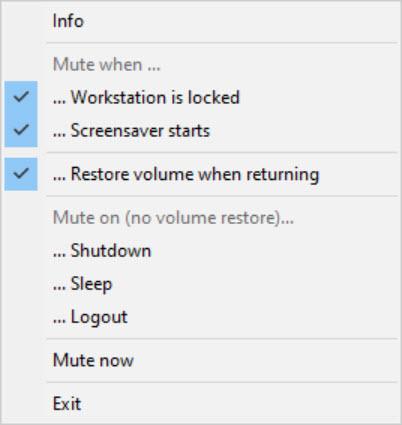
Each WinMute trigger is a checkbox in the tray menu. Workstation lock is the one most people want, since locking is the habit of anyone who shares an office. The screensaver trigger catches the people who never lock but do leave, and the display-off trigger catches the rest, since a screen that has gone dark on its power timer means nobody has touched the machine. Logging off and switching user mute so the next person does not inherit the last one’s music, and a laptop lid closing mutes before the machine sleeps.
The Bluetooth trigger is the newest and the one that answers a different problem, the headset that disconnects mid-stream and hands the audio to the speakers. With it on, the loss of the headset mutes the machine until you choose to unmute.
Together the triggers cover every ordinary way of leaving a desk, and each can be switched off for a machine where it would misfire, such as a media centre whose screensaver should not silence the film.
Restoring the volume, or not
By default WinMute remembers the volume at the moment it muted and restores it when the trigger ends, so the music resumes at the same level without a visit to the volume slider. An option turns the restore off, leaving the machine muted until you unmute it by hand, which suits a shared desk where the next thing played should start silent. Either way the choice applies across every trigger, so there is one behaviour to remember rather than one per event.
Muting works at the system level, on the sound devices rather than inside any program, so every application is covered at once and nothing has to be configured per program. Devices can be chosen individually, so a machine with speakers and a headset can mute the speakers alone and leave the headset playing, and the choice is remembered.
For switching which device plays rather than silencing one, SoundSwitch does that from a hotkey and the two tools sit together in the tray without conflict.
Quiet hours
Quiet hours mute the machine between two times of day, every day, and unmute at the end, which keeps a computer in a bedroom silent overnight whatever an update or a message decides to do at three in the morning.
The schedule runs independently of the triggers, and the two combine, so a machine locked during quiet hours stays muted when it is unlocked until the hours end. The schedule is the feature for the machine that is never locked but is always on.
The hotkey and startup
The WinMute hotkey toggles muting of every managed device from anywhere, for the moments when a call starts or a child falls asleep and the event triggers do not apply. It is configurable and off by default, and it is the only part of the program that asks for a key press. It toggles mute rather than level, so a volume pushed past the system’s ceiling with Sound Booster returns exactly as it was.
Startup with the system is a checkbox, and the program runs from a portable folder or an installer.
Where it stops
It mutes and unmutes, and nothing else. There is no per-application control, so a notification sound cannot be silenced while the music continues, and there is no fade, the sound simply stops.
Programs that reset the volume themselves on launch can override the restored level. The display-off trigger depends on the system reporting the event, which a few graphics drivers do oddly.
None of that is a flaw in a tool that intends to do one thing, and for routing or balancing individual programs, a per-application audio router is the different tool.
Conclusion
WinMute suits anyone who shares a space with other people and has ever left a desk with music playing, from open-plan offices to homes where a locked laptop keeps announcing messages. The event triggers cover every way of leaving, the restore puts the volume back, and the headset trigger alone saves a moment of embarrassment a week.
It does one thing and does not pretend otherwise, with no per-program control and no fade. Tick the lock and display-off triggers, set the quiet hours if the machine lives in a bedroom, and forget it is installed, which is the highest compliment a tray utility gets.
Pros & Cons
- Mutes on lock, screensaver, display off, log off, lid close and headset disconnect
- Restores the previous volume when the trigger ends, or stays muted by choice
- Works at the device level so every program is covered without configuration
- Quiet hours schedule and an optional global mute hotkey
- Per-device control for machines with speakers and a headset
- Tiny, open source and runs portable or installed
- No per-application muting
- No fade, the sound stops abruptly
- Programs that set their own volume on launch can override the restore
- Display-off trigger depends on the graphics driver reporting the event
Frequently asked questions
Yes, by default it remembers the level at the moment it muted and restores it when the trigger ends. An option keeps the machine muted until you unmute by hand.
Yes. Devices are chosen individually in the settings, so the speakers can be managed and the headset left alone, or the other way round.
With that trigger enabled, the machine mutes the moment the headset drops, so the audio does not jump to the speakers.
Yes. Quiet hours mute between two times of day and unmute at the end, independently of the lock and screensaver triggers.


