

Stunnel
About Stunnel
Stunnel wraps insecure network connections in TLS encryption without touching the programs on either end. If you have a service that sends data in plain text, an old mail server, a database connection between machines, a legacy application that was never built for encryption, this tool slips an encrypted layer underneath it. The application keeps talking the way it always has, and the traffic on the wire becomes unreadable to anyone listening.
That last point is the heart of why it exists. You do not have to rewrite the application, recompile it, or even reconfigure it much. Stunnel sits between the client and the server as a proxy, handling the entire encrypted handshake on the program’s behalf. The program thinks it is making an ordinary plain connection to a local port. In reality, that connection is being encrypted and forwarded across the network securely.
Think of it as bolting HTTPS-style protection onto things that never learned to speak it. For administrators stuck with software that cannot be changed but absolutely should not be sending data in the clear, that capability is invaluable.
Client mode and server mode
Stunnel revolves around two modes, and understanding them is the key to understanding everything else. In server mode, it sits in front of a service. It listens for incoming encrypted connections, decrypts them, and hands the plain traffic to the actual service running behind it. The outside world has to negotiate encryption to get in, but the service itself never has to know that happened.
In client mode it does the mirror image. An application on your machine connects to it in plain text on a local port, and it encrypts that traffic and forwards it to a remote secure endpoint. So a legacy client that has no idea what TLS is can still reach a modern encrypted server, because this tool does the encrypting in between.
The clever part is that you can run both ends. Put it in server mode on the machine hosting the service, and in client mode on each machine that connects, and suddenly two pieces of software that know nothing about encryption are communicating over a fully encrypted channel.
Neither one was modified. The encryption lives entirely in the layer between them.
How you actually set it up
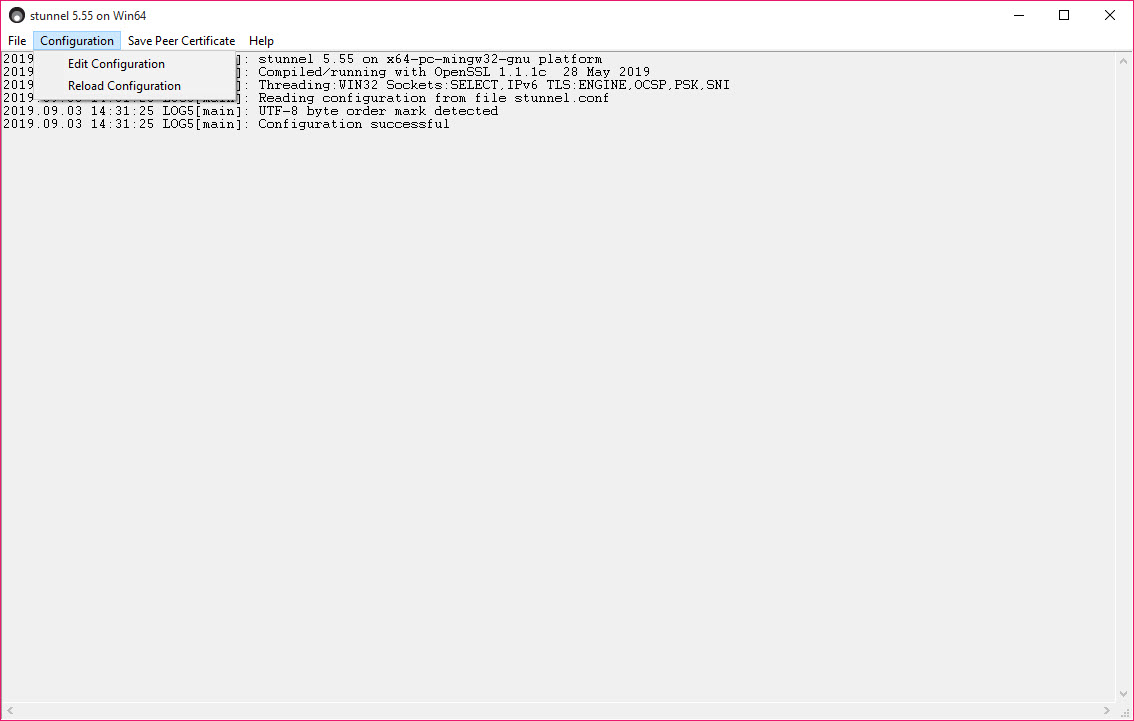
Configuration happens through a plain text file, and the structure is refreshingly readable once you see it. The file holds a few global settings and then one or more service blocks, each marked with a name in square brackets. Within a block you mainly define two things, the port to accept connections on and the address and port to forward them to. That accept-and-connect pair is the core of every tunnel you build.
Stunnel needs a certificate and a private key to do the encrypting, usually combined into a single file. Generating those is a standard task handled by common certificate tooling, and once the certificate is in place, the service is a matter of pointing the accept port at the connect destination.
For securing internal services, this is far less work than it sounds, and far less than deploying something heavier.
What people actually use it for
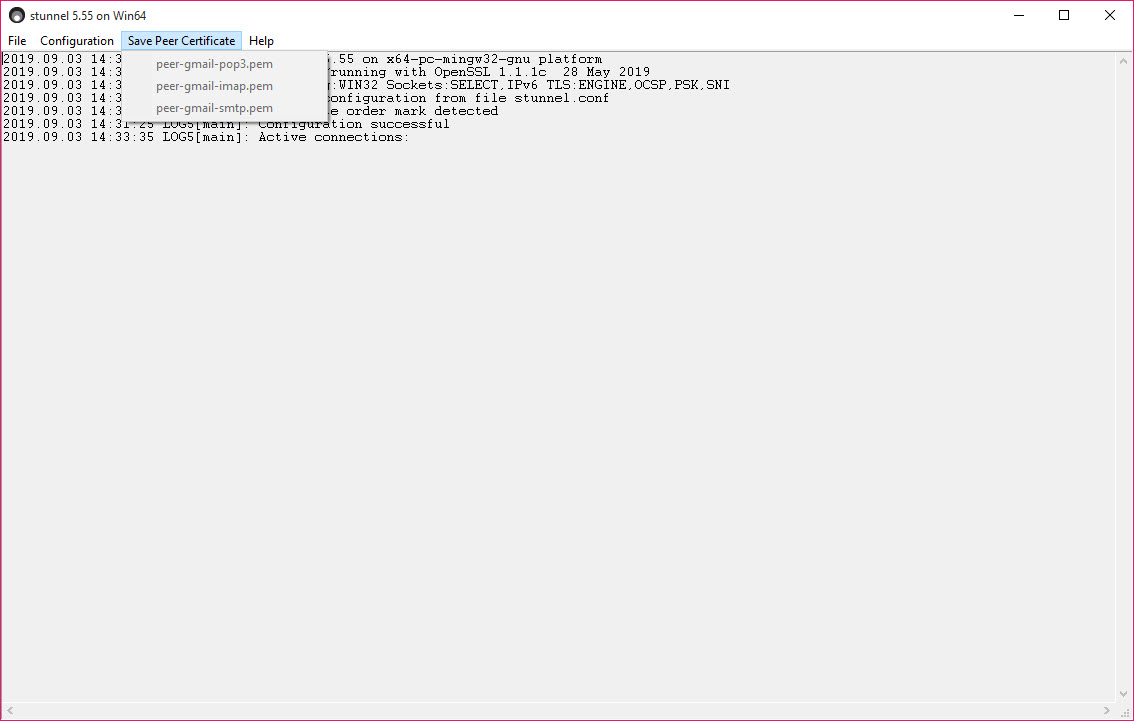
The Stunnel use cases are concrete and varied. Securing old mail protocols is a classic one, wrapping plain POP3, IMAP, or SMTP so that credentials and messages are not flying across the network unprotected. Encrypting a database or cache connection between two servers, a Redis link being a common example, is another, since those connections often default to plain text on the assumption they stay on a trusted network.
It also shines when you have a single application that needs protecting and a full VPN would be overkill. Rather than routing an entire machine’s traffic through a tunnel, you encrypt just the one service that matters. And because authentication can be built in with certificates, the server can be configured to accept connections only from clients holding a valid certificate, which doubles as an access-control mechanism on top of the encryption.
A more general-purpose secure channel, like the kind an SSH-tunneling tool such as Doffen SSH Tunnel provides, can cover some of the same ground, but for wrapping a specific service in TLS this is purpose-built.
What it is not
Be clear about the boundaries of Stunnel. This is a TLS wrapper, not a VPN and not a privacy tool for anonymous browsing. It does not hide your identity or route your whole connection somewhere else the way a tool like Shadowsocks or a broader option like Super Network Tunnel does. It secures specific connections you point it at, and that is the job it does well.
It is also TCP-only. It cannot wrap UDP-based protocols, which rules out certain applications and means you need a different approach for those. And it secures the transport, the data in motion, not the application’s own logic or its stored data, so it is one piece of a security setup rather than the whole thing.
The learning curve
There is no pretending this is a casual, click-and-go utility. It is an administrator’s tool, and it assumes a working understanding of ports, certificates, and how client-server connections fit together. The configuration file is logical, but you have to know what you are configuring. Setting up certificates correctly trips up newcomers more than anything else, and a misconfigured certificate or a port conflict will simply stop the tunnel from working.
The flip side is that the concepts, once learned, are widely reusable. Understanding the accept-and-connect model and the two modes carries over to a huge range of networking tasks. For the technical user it targets, the effort pays off quickly, and the tool becomes something you reach for again and again whenever a connection needs encrypting.
Conclusion
Stunnel is for administrators and developers who need to encrypt a connection that the software itself cannot encrypt. The legacy mail server, the cross-server database link, the old application that predates modern security, all of them can be wrapped in TLS without a single line of their code changing. Its two-mode design and simple configuration make that surprisingly approachable once the concepts click.
It is not a tool for casual users, and it is not trying to be a VPN or a privacy shield. It does one specialized job, adding encryption to plain connections, and it does it cleanly and reliably. For the technical audience that needs exactly that, it remains a dependable, lightweight answer to a problem that would otherwise require far more effort to solve.
Pros & Cons
- Adds TLS encryption to applications without modifying their code
- Client and server modes secure connections from either or both ends
- Simple accept-and-connect config blocks make each tunnel easy to define
- Certificate-based authentication can restrict access to approved clients
- Ideal for securing a single service where a full VPN would be excessive
- Works across a wide range of plain-text TCP protocols
- An administrator's tool with a real learning curve around certificates
- TCP only, so UDP-based protocols are not supported
- Not a VPN or anonymity tool, it only secures connections you define
- Misconfigured certificates or ports are a common stumbling block
Frequently asked questions
It adds TLS encryption to network services that send data in plain text, wrapping connections like old mail protocols or database links so they are encrypted on the wire, without changing the underlying application.
It acts as a proxy between the client and server. Your application connects to it in plain text on a local port, and it handles the encryption and forwarding, so the application never has to understand TLS itself.
Server mode accepts encrypted connections and forwards plain traffic to a local service. Client mode accepts plain traffic locally and forwards it encrypted to a remote endpoint. You can run both to encrypt a link end to end.
No. It only handles TCP-based connections. UDP-based protocols cannot be wrapped and need a different solution.
No. It is a TLS wrapper for specific connections, not a VPN or an anonymity tool. It encrypts the services you point it at rather than routing all of your traffic elsewhere.
Yes. It uses an X.509 certificate and private key to perform the encryption, typically combined into a single file. Certificates can also be used to authenticate and restrict which clients may connect.


