

ONLYOFFICE
About ONLYOFFICE
ONLYOFFICE is an office suite that opens documents, spreadsheets, presentations and PDFs as tabs in one window, the way a browser opens pages. A report, the spreadsheet it quotes and the slides built from both sit side by side, colour-coded along the tab bar, and switching between them is a click rather than a hunt through the taskbar. The editors underneath share one engine and one ribbon layout, so a chart behaves the same way in a document as in a spreadsheet, and the toolbar for a table does not change depending on which editor is open.
The engine was built around the Office Open XML formats from the start rather than translating into them, and that decision is the reason files travel well. A DOCX with tracked changes, footnotes, nested tables and a table of contents opens looking the way its author saw it and saves back without the formatting drift that other suites introduce. XLSX keeps its formulas, conditional formatting and pivot tables intact. PPTX keeps its animations and slide masters.
ONLYOFFICE also reads and writes the OpenDocument family, plus RTF, TXT, HTML, EPUB and Markdown, but the native comfort is with the formats most offices actually exchange. Around the three classic editors sit a PDF editor that rewrites text and rearranges pages, and a form creator that builds fillable forms and saves them as PDF.
Add plugins, a connector for any AI provider including local ones, and real-time collaboration through self-hosted platforms, and the suite covers far more ground than a word processor with a spreadsheet attached.
Tabs, the ribbon and the shared engine
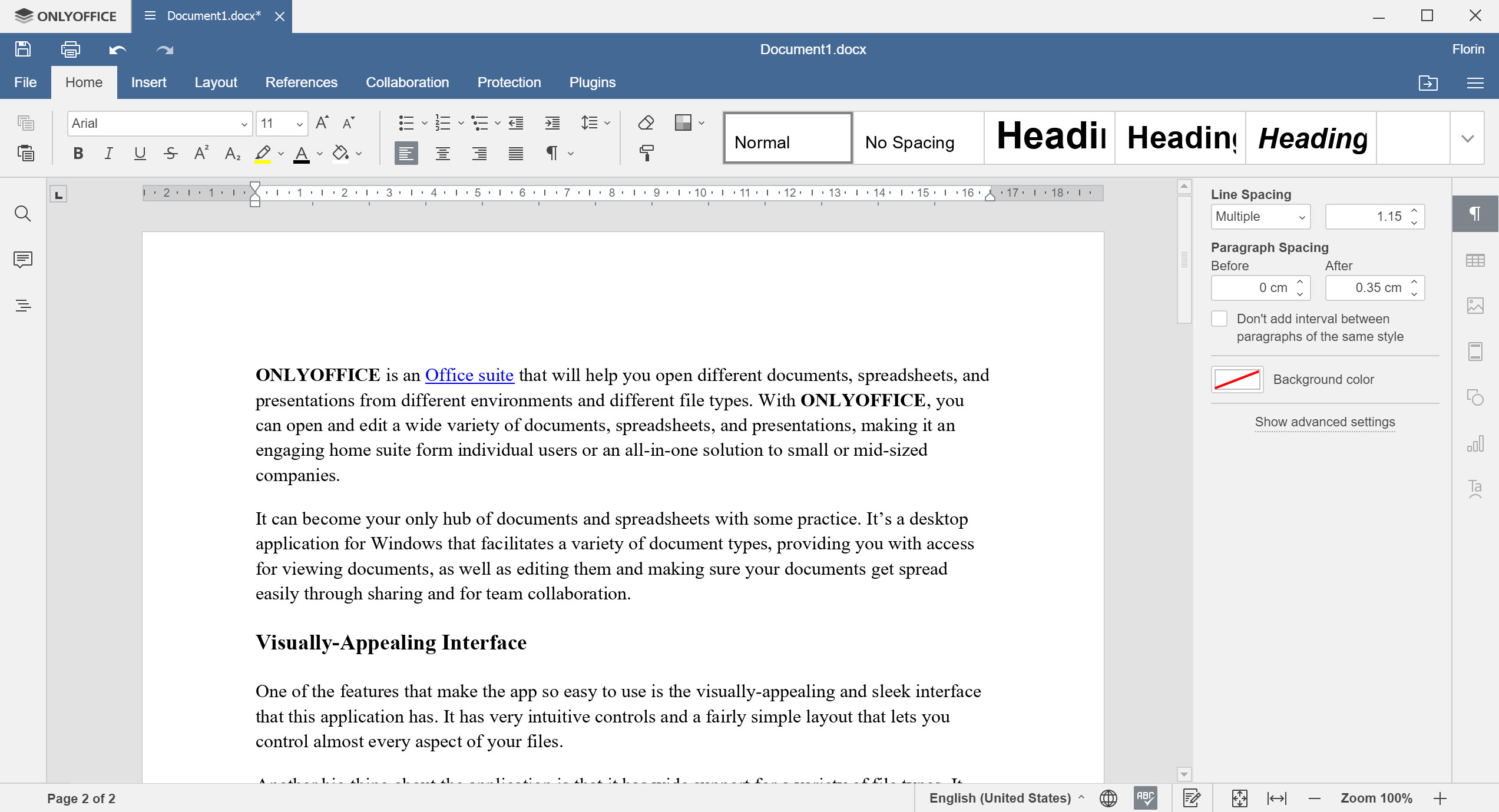
Every file opens as a tab in the same ONLYOFFICE window. Documents tint blue, spreadsheets green, presentations red and PDFs a fourth shade, so the tab bar reads at a glance. A start page lists recent files and folders, with pinning, and connects to local storage or a cloud account. The ribbon follows the layout most people already know, Home for formatting, Insert for objects, Layout for page setup, References, Collaboration, Protection, View and Plugins, and it is the same across every editor.
That consistency is the quiet advantage. Learn to insert and format a chart once and the knowledge applies everywhere, and the shape tools, image adjustments and hyperlink dialog are identical in the next tab over.
Each editor also runs its own spell checker, a navigation panel for headings, and find and replace with regular expressions, and macro recording in a JavaScript-based language shared across the suite.
Documents that survive the round trip
The ONLYOFFICE document editor handles long, structured work. Styles, multi-level lists, sections with different headers and page orientations, footnotes, endnotes, cross-references, captions, an updating table of contents, and bookmarks, with a bibliography through the references tab. Tables nest and merge, text wraps around images and shapes, and columns and text boxes behave. Track changes records edits per author with accept and reject per change or in bulk, and document comparison shows the differences between two versions as markup.
Compatibility is where it earns its reputation. A complex DOCX from another suite opens with its layout intact and returns without new artefacts, which is what a legal or academic user needs before trusting a tool.
Mail merge is available through a plugin, and the editor exports to PDF, PDF/A, EPUB for e-books, HTML and Markdown. Compared with LibreOffice, fidelity with DOCX is better and the feature set for typesetting and long-document tools is somewhat shallower.
Spreadsheets and presentations
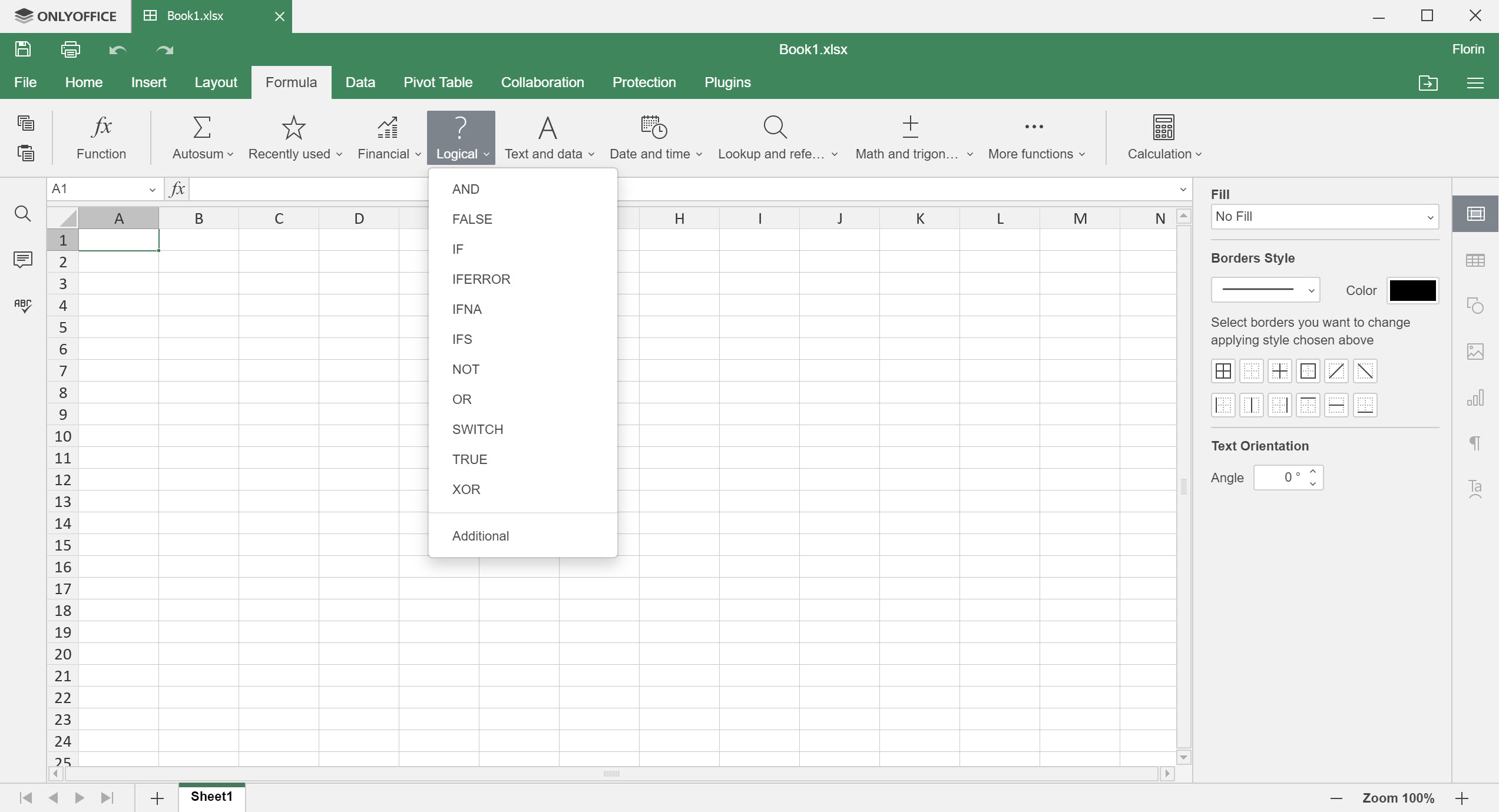
The ONLYOFFICE spreadsheet editor covers more than four hundred functions including the dynamic array set, named ranges, data validation, conditional formatting with rules and colour scales, pivot tables with slicers, sparklines, a full set of chart types and freeze panes. Sheet and workbook protection lock cells and structure. It opens XLSX files with pivot tables and complex formulas intact, and it handles CSV with encoding and delimiter choices on import. Macros record and replay in the shared scripting language, so existing VBA macros do not run.
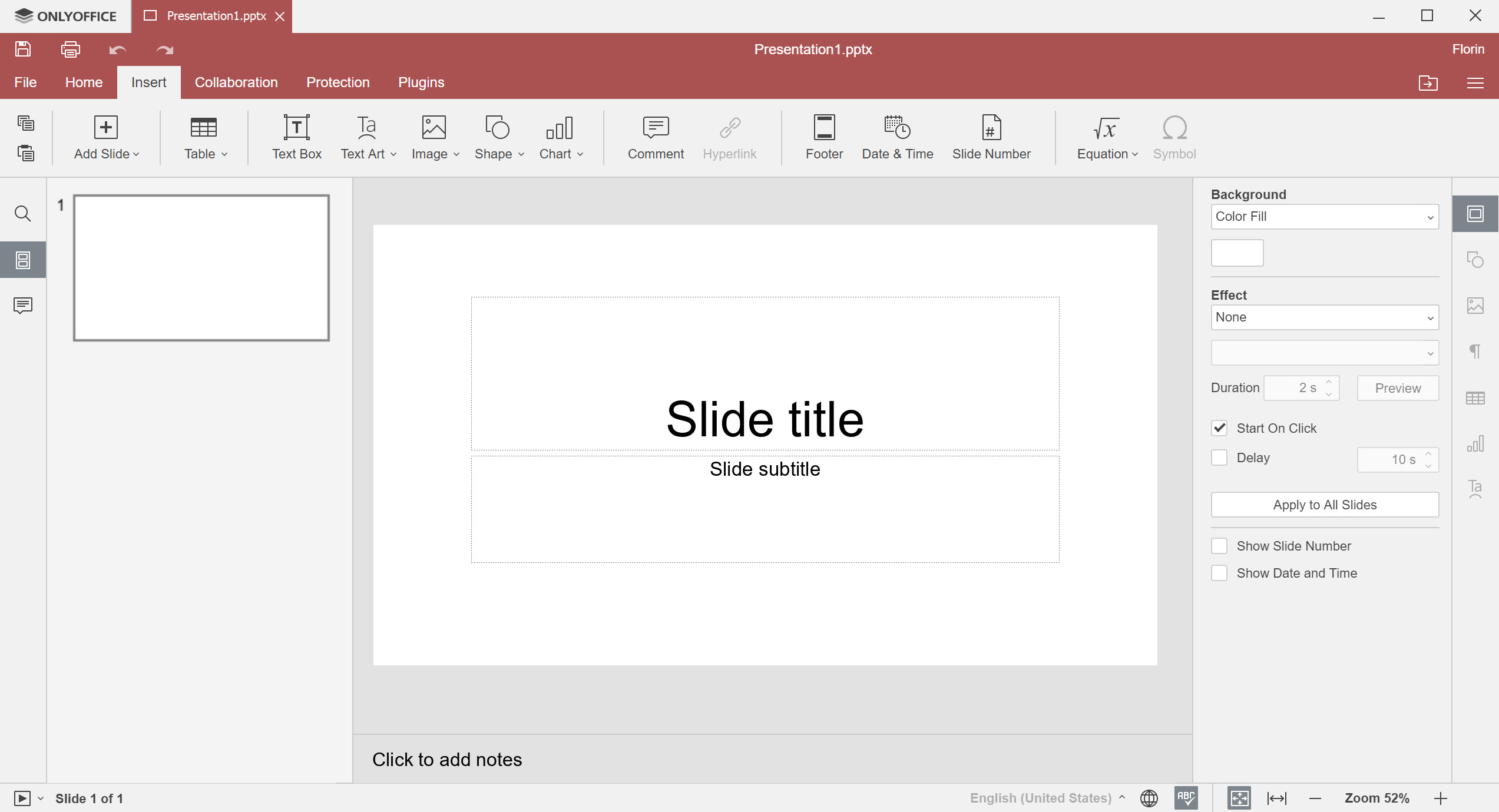
The presentation editor, no substitute for a page-layout tool in print work, has slide masters and layouts, transitions between slides and animations on objects with timing controls, a presenter view with notes and a timer, and the same shape and chart tools, image handling and table tools as the other editors.
Media embeds, and a YouTube plugin drops a video onto a slide. It is competent rather than remarkable, and it opens PPTX from the market leader faithfully, which is what most people need from it.
The PDF editor and fillable forms
Open a PDF in ONLYOFFICE and two modes are offered. Viewing and annotating gives the usual highlight and underline marks together with text comments, callouts and a freehand pen, and a mini toolbar appears on selection. Editing changes the PDF itself. Text in existing paragraphs can be rewritten, objects added or moved, pages inserted or removed, and several files merged into one.
A PDF can be converted into a DOCX for heavier editing and back again. This is a real PDF editor, not a viewer with a comment tool, and it sits closer to a dedicated PDF editor than to a viewer.
The form creator builds fillable documents from scratch or from an existing file, with text fields, comboboxes, dropdowns, checkboxes, radio buttons, image fields, date pickers, signature fields and role assignment for multi-party forms.
The result saves as a PDF form that fills in any viewer, or as the suite’s own form format for further editing. Forms co-edit with others through a connected cloud, and filled forms collect back through the same channel.
Plugins, AI providers and macros
The ONLYOFFICE plugin manager installs extensions from a catalogue with one click. Translation through several services, a thesaurus, a code highlighter, a photo editor, an OCR tool, a word counter, YouTube embedding, speech to text, bibliography managers for the two common reference tools, a mail merge tool, and dozens more. Plugins run inside the editors and act on the document, and the API is open, so a team can write its own in JavaScript for a repetitive task.
The AI connector accepts any provider, cloud services through their API keys or a model running locally, and exposes it in the editors for summarising, rewriting, translating, generating text and images, and analysing spreadsheets. The feature is off until a provider is configured, and a local model keeps documents on the machine.
Macros use the same JavaScript language across editors and can be recorded from actions or written, which is convenient for automation and a wall for anyone arriving with a library of macros in another language.
Collaboration, cloud storage and encryption
Connect ONLYOFFICE to a collaboration platform, the maker’s own or a self-hosted service such as Nextcloud, ownCloud or Seafile, or a learning platform such as Moodle, and documents stored there open in the same tabs with real-time co-editing. Several people type at once with coloured cursors, a fast mode that shows every keystroke or a strict mode that saves on demand, comments with threads and mentions, a built-in chat, version history and the ability to restore any earlier version. Cloud storage accounts including Dropbox and Box connect for plain file access without collaboration, and the desktop editors work fully offline with local files, syncing when a connection returns.
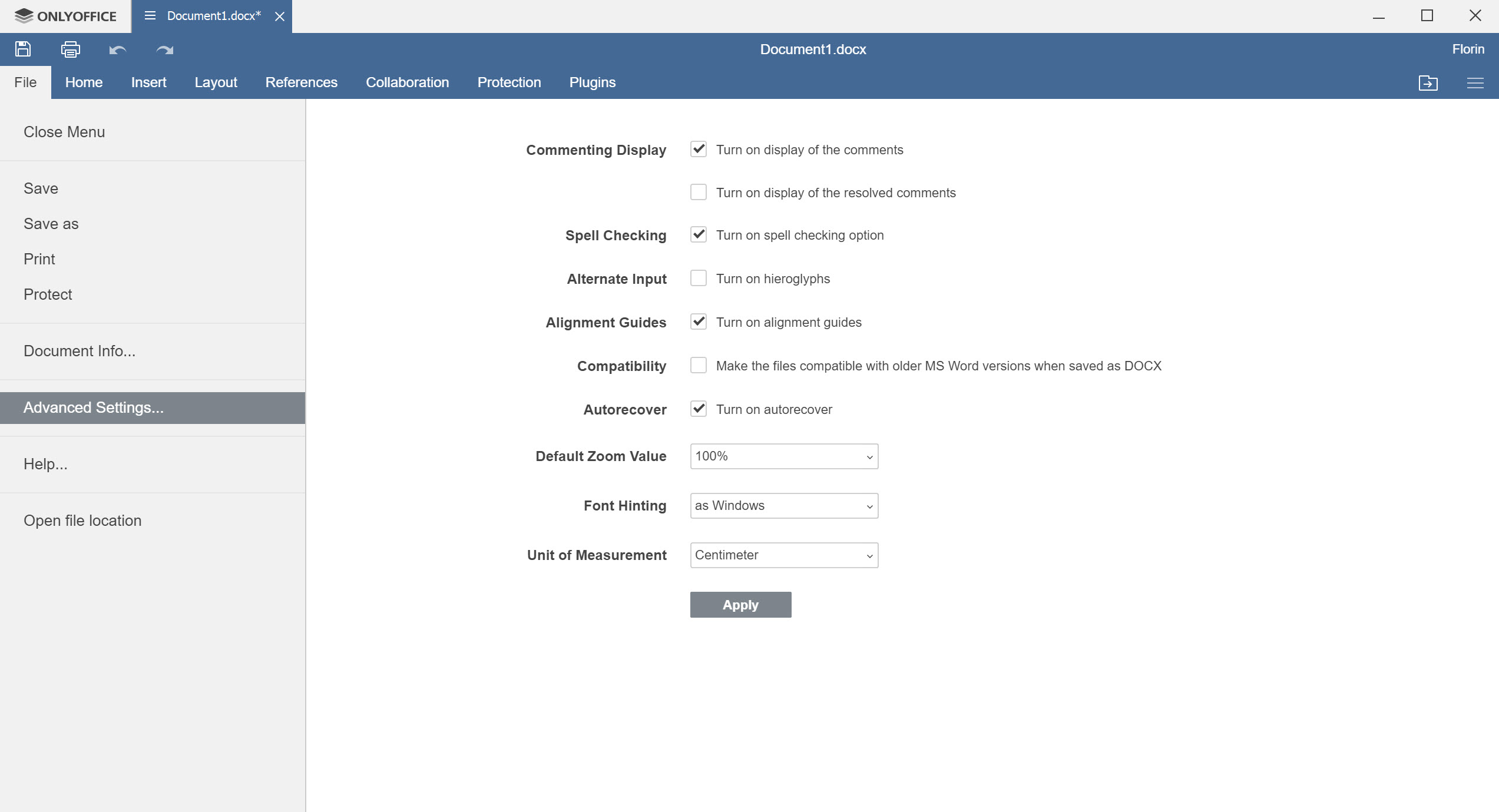
Documents can be password protected, and the Protection tab adds digital signatures, both visible signature lines and invisible ones that verify the file has not changed. End-to-end encryption through a private room is available when connected to the maker’s platform.
For a team already keeping files in a mainstream sync service, plain access arrives without moving anything, and collaboration waits for a platform.
Where it falls short
VBA macros do not run in ONLYOFFICE, which stops a spreadsheet-heavy office dead if its workbooks depend on them, and rewriting in JavaScript is real work. The spreadsheet lacks a few of the analysis add-ins power users expect, and very large workbooks with hundreds of thousands of rows are slower than in the market leader. Typesetting controls for long documents are thinner than LibreOffice offers.
The presentation editor is adequate rather than inspiring. Some plugins are maintained by their contributors rather than the suite, and their quality varies. The desktop editors are open source, but the collaboration features need a platform behind them, which is either a self-hosted service to run or a cloud account to hold.
Conclusion
ONLYOFFICE suits anyone who exchanges Office files with people on the market leader and needs them to arrive intact, and it suits teams who want real-time collaboration on a platform they control rather than on someone’s cloud. The tabbed window, the PDF editor and the form creator turn a suite into a document workshop, and the AI connector’s willingness to use a local model is unusual and welcome.
It is the wrong choice for a spreadsheet operation built on VBA, and for anyone typesetting a book who wants the deepest layout controls. Install it for the fidelity and the PDF tools, connect a platform when collaboration matters, and it will handle the daily traffic of documents without anyone on the other end noticing which suite they came from.
Pros & Cons
- Tabbed interface with all editors in one window and one consistent ribbon
- Native handling of DOCX, XLSX and PPTX with reliable round-trip fidelity
- Full PDF editor that rewrites text, merges files and rearranges pages
- Form creator with fields and roles, signature support, exported as fillable PDF
- Plugin catalogue and an AI connector that accepts local models
- Real-time co-editing through several self-hosted platforms
- VBA macros do not run and need rewriting in JavaScript
- Spreadsheet slows on very large workbooks
- Long-document typesetting is shallower than LibreOffice
- Collaboration requires a connected platform, self-hosted or cloud
- Plugin quality varies with contributors
Frequently asked questions
Yes. The engine is built on the Office Open XML formats, so complex documents with tracked changes, nested tables or pivot tables open with their layout intact and save back without drift.
Yes. The PDF editor rewrites text and moves objects, inserts or removes pages, merges files and annotates, and it converts PDF to DOCX and back.
No. VBA macros do not run. The suite uses a JavaScript-based macro language, so existing macros need rewriting.
Connect ONLYOFFICE to a collaboration platform, the maker's own or a self-hosted service such as Nextcloud, and documents there co-edit live with threaded comments, a built-in chat and version history.
Yes. The AI connector accepts any provider, including a model running locally, and stays off until one is configured.


