

Borderless Gaming
About Borderless Gaming
Borderless Gaming strips the window decorations off a game running in windowed mode and stretches it to cover the entire screen, producing the visual effect of fullscreen without actually using exclusive fullscreen. The point is to keep all the conveniences of windowed mode (instant Alt-Tab, working hotkeys for other apps, accessible second monitor) while losing the black border, the title bar, and the wasted screen real estate that windowed mode usually drags along.
The application targets a specific frustration. Older games and a surprising number of newer ones lack a built-in borderless windowed option. They give you exclusive fullscreen or a small window in the middle of your monitor, and nothing in between.
Borderless Gaming sits in the system tray, watches for game windows, and reshapes them on demand. It’s a single-purpose tool that does the one thing well rather than trying to be a full game launcher or system tweaker.
How the window manipulation actually works
The mechanism is simple in concept and slightly tricky in practice. Borderless Gaming uses Windows APIs to find a target window, remove its style flags (the title bar, the resize handles, the border), and resize it to the exact dimensions of your monitor. The game itself still thinks it’s running in a window. It just happens to be a window that covers every pixel of your display.
This matters because the underlying rendering mode stays windowed. Exclusive fullscreen gives the game direct control over the GPU and the display, which historically meant better performance and faster Alt-Tab transitions. Borderless windowed routes everything through the Desktop Window Manager, which adds a small amount of input lag and can cap your refresh rate behavior depending on your GPU drivers.
The trade-off most people are after is exactly this: a few milliseconds of latency in exchange for not having the screen go black every time a Discord notification arrives.
The application doesn’t modify the game files, doesn’t hook into the rendering pipeline, and doesn’t inject anything into the process. It just talks to the window manager. That’s why it works on almost anything that runs in a window.
Favorites list and automatic processing
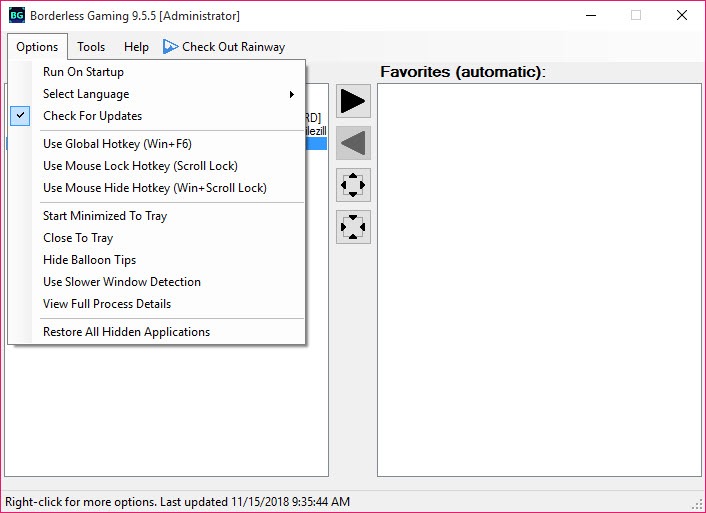
The favorites system is where the workflow lives. You add a game to the favorites list once, and from then on Borderless Gaming automatically detects when that game launches and applies the borderless treatment without any intervention. Launch the game, the window snaps into place, done.
You can configure the favorites with per-game settings. Some games need their window repositioned to a specific X/Y coordinate. Some need a manual size override (useful if the game runs at a non-native internal resolution and you want it centered with black bars on the sides rather than stretched). Some need a delay before processing because they create a temporary loading window first and you don’t want the tool to grab the wrong one.
The right-click menu on a game window in the running processes list lets you set all of this on the fly. Add to favorites, set window position, set size, set delay, hide the mouse cursor, force the window always on top, mute when minimized.
Multi-monitor handling
This is where the application earns most of its keep for users with multiple displays. Native fullscreen on a multi-monitor setup is famously annoying. You move the mouse to the edge of the game window and it slides off onto the second monitor, which usually minimizes the game. You try to keep a browser or Discord visible on the secondary display and the fullscreen game refuses to cooperate.
Borderless windowed mode solves this without any compromise. The cursor moves freely between monitors. You can watch a video on one screen while playing on the other. Streaming software captures the window cleanly. None of these things work reliably with exclusive fullscreen.
Borderless Gaming lets you pick which monitor to use for borderless mode per game, which is the killer feature on a multi-display setup. You can pin a game to your primary 1440p display while leaving a 1080p secondary monitor free for chat and reference material.
Tools like Custom Resolution Utility pair well with this when you want to add specific resolutions for older titles, and pairing it with DxWnd covers a lot of legacy games that won’t even launch in windowed mode without help.
Compatibility quirks and games it doesn’t handle well
Not everything plays nice. Games that use exclusive fullscreen by hard requirement (some older DirectX 9 titles, certain DRM-wrapped releases, anything using GameGuard or other aggressive anti-cheat that inspects window properties) either ignore the resizing entirely or get angry about it. Online competitive games with anti-cheat sometimes flag window manipulation tools, so checking the anti-cheat policy of a multiplayer title before using this is worth a minute.
Some games also resist the window-grab because they recreate their window on every resolution change, leaving Borderless Gaming chasing a moving target. The fix is usually setting the in-game resolution to match your desktop resolution first, then letting the tool do its work. Other games run at a strange internal resolution and stretching them looks distorted, which is where the manual position-and-size options come in.
The other quirk worth knowing about is performance. Borderless mode through the Desktop Window Manager can cap variable refresh rate behavior on G-Sync and FreeSync monitors in older driver configurations.
Modern Nvidia and AMD drivers handle this better than they used to, but if you’re chasing absolute lowest latency in a competitive shooter, exclusive fullscreen is still measurably faster. The gap is small. For most single-player and cooperative titles, it’s invisible.
Conclusion
Borderless Gaming solves one specific problem well: turning windowed games into screen-filling ones without losing the benefits of windowed mode. The target audience is clear. Users with multiple monitors, streamers who need clean window capture, anyone who Alt-Tabs frequently during gameplay, and players of older titles that lack a modern borderless option built in.
It’s less suited to competitive shooters where every millisecond of input lag counts, or to users whose game library is mostly modern AAA titles that already ship with a borderless windowed toggle in their video settings. For everything in between, the favorites list and per-game configuration turn a recurring annoyance into a set-and-forget background utility.
Pros & Cons
- Removes title bar and borders from windowed games to fill the entire screen
- Favorites list automatically processes games on launch without manual intervention
- Per-game position, size, and timing options handle quirky titles
- Multi-monitor support with per-game monitor selection works far better than exclusive fullscreen
- Lightweight tray application with minimal system footprint
- No file modification, no injection, no permanent changes to game installations
- Adds small input lag compared to exclusive fullscreen, noticeable in competitive shooters
- Some anti-cheat systems flag window manipulation, risking false positives in online games
- Games with aggressive DRM or hard-coded fullscreen rendering may ignore the treatment entirely
- Variable refresh rate behavior can be inconsistent depending on GPU driver version
- Interface is functional but visually dated and not always intuitive on first use
Frequently asked questions
It takes a game running in windowed mode and removes the window's title bar and borders, then stretches the window to cover the full screen. The result looks like fullscreen but keeps the conveniences of windowed mode.
It depends on what you value. Borderless wins for multi-monitor use, instant Alt-Tab, and overlay compatibility. Exclusive fullscreen wins for absolute lowest input lag and consistent variable refresh rate behavior. Most users prefer borderless except in competitive online play.
A small amount, yes. Borderless mode routes the game through the Desktop Window Manager, which adds a few milliseconds of latency compared to exclusive fullscreen. It's noticeable in twitch shooters and largely invisible in everything else.
Sometimes. Some anti-cheat systems flag any tool that manipulates game windows, so it's worth checking the game's anti-cheat policy before using the application on competitive multiplayer titles.
Add the game to the favorites list. Once a title is in favorites, the tool detects when it launches and applies borderless mode without further input.
No. The game has to support windowed mode at some level for this to work. For older titles that only run in exclusive fullscreen, a different approach (window-mode injection tools) is needed.
Yes, and this is where it shines. You can select which monitor to use per game, the cursor moves freely between displays, and secondary screens remain accessible for chat or reference material while playing.


