

ADATA SSD ToolBox
About ADATA SSD ToolBox
Every solid state drive maker ships a utility, and they all do roughly the same five things. ADATA SSD ToolBox is the one for drives carrying that brand, laid out as a navigation list down the left with drive information, a diagnostic scan, utilities, optimisation settings and system details.
Two of those five panes are useful, one is dangerous if misread, one contains advice that has aged badly, and one is filler. Sorting out which is which is the point here, because the interface presents them all with equal confidence.
What the information pane actually shows
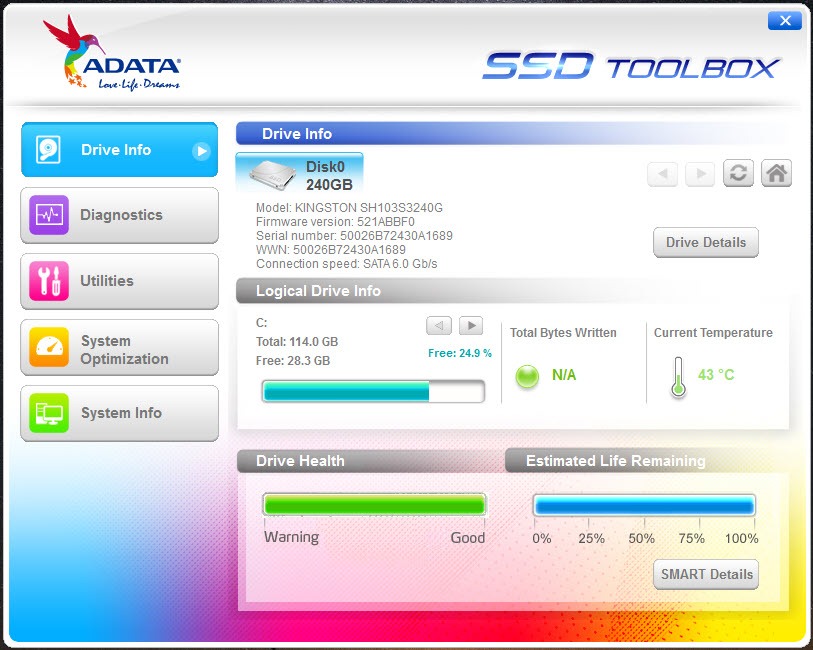
The first screen is the one you will open most. It reports drive health as a word, the current temperature, remaining lifespan, the model and firmware revision, the serial number, capacity, plus total bytes written since the drive was new. A button reveals the full attribute table behind those summaries.
Total bytes written is the figure that matters and the one people ignore. Flash storage wears by being written to, so that number against the drive’s rated endurance tells you where it is in its life far more honestly than a green word saying Good. A drive reporting healthy while approaching its write rating is not reassuring, it is a warning.
Multiple drives are selectable from a dropdown at the top, so a machine with several can be checked without closing anything. For the attribute detail across every drive in the machine regardless of who made it, CrystalDiskInfo remains the better window, and it shows the trend rather than a snapshot.
Two scans, and what the second one writes
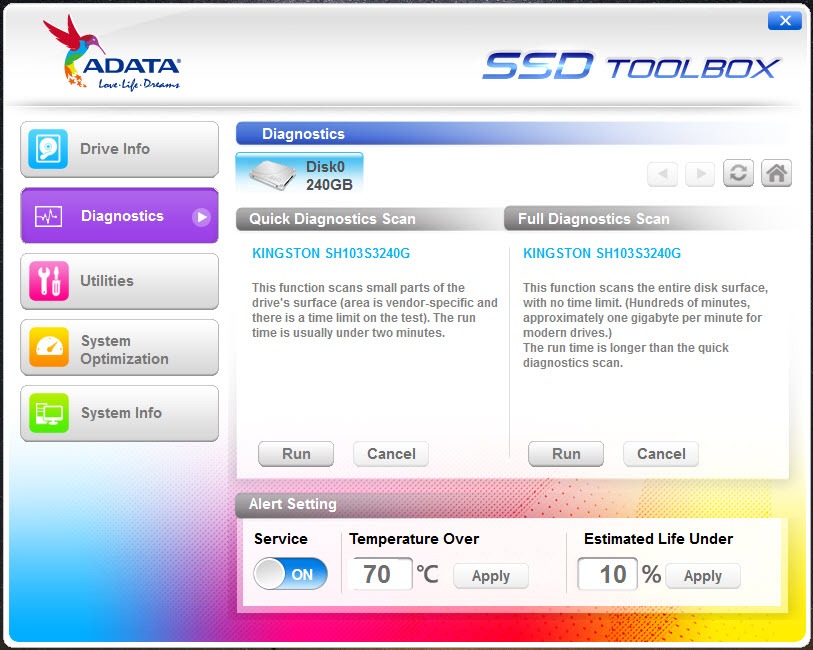
The quick scan in ADATA SSD ToolBox runs a basic test across the drive’s free space and finishes in a couple of minutes. The full scan reads all used space and then writes across all free space, with no time limit on how long it takes.
That write pass deserves attention. On a mechanical disk a surface test takes nothing but time. On flash it consumes endurance, because every write against free space is written to cells that have a finite number of them left. Running a full scan monthly on a drive you are worried about is a way of using up the thing you were trying to preserve.
Use the quick scan routinely and the full scan when you actually suspect a fault. If the question is performance rather than integrity, a scan will not answer it and AS SSD Benchmark will.
Secure erase, and the maker’s own warnings
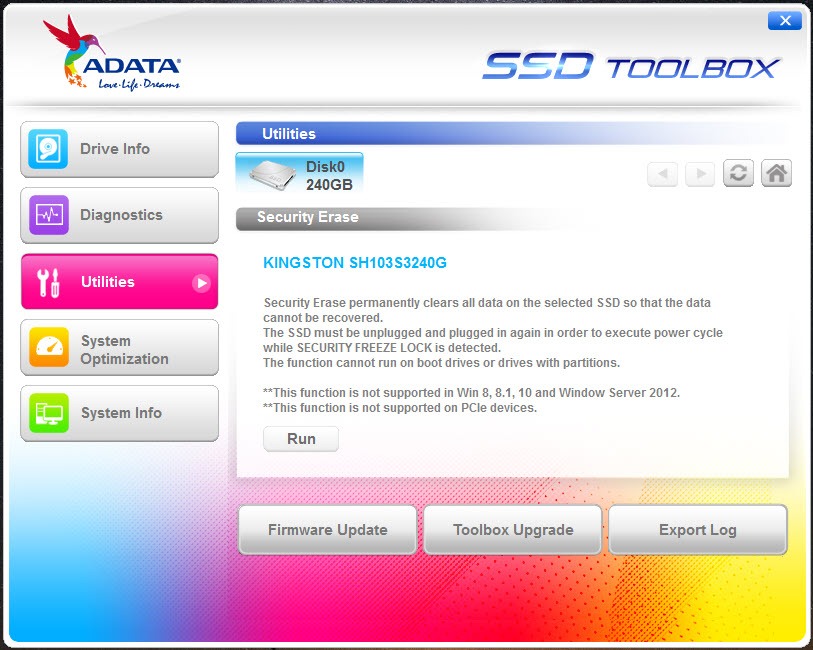
The ADATA SSD ToolBox utilities pane holds a secure erase that returns the drive to its factory state, deleting everything. What makes it interesting is the list of cautions the documentation itself attaches to it.
Remove every partition before running it. Do not disconnect the drive while it works, because interrupting the operation leaves the drive security-locked rather than merely unfinished. Understand that the process reduces the drive’s lifespan. And use the function only when necessary.
That last instruction, from the people who wrote the tool, is worth taking at face value. Secure erase exists for passing a drive on or resetting one that has degraded into poor performance, not as routine maintenance. When the goal is removing particular files rather than resetting a whole drive, a shredder that overwrites individual files is the proportionate tool.
The optimisation pane needs a sceptical eye
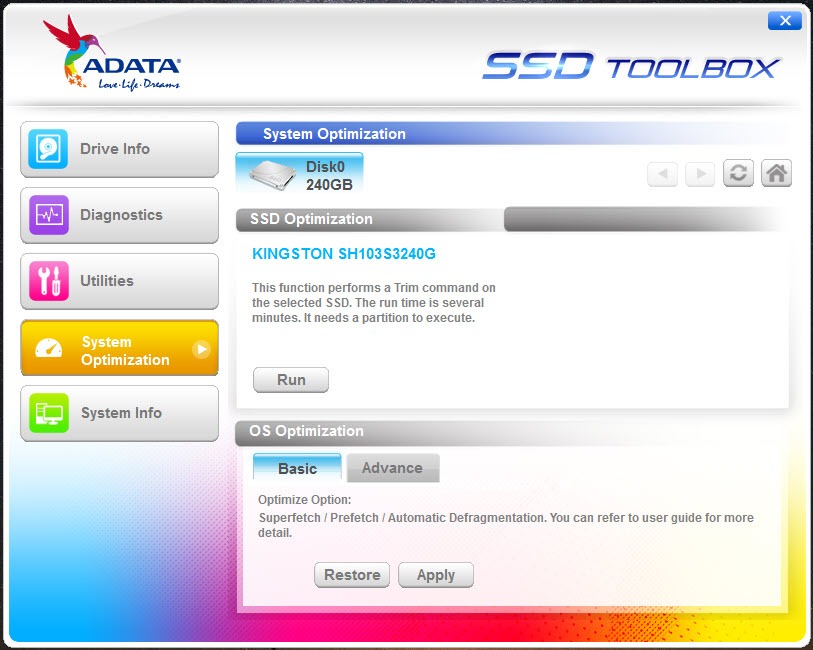
Two functions live here and they deserve different treatment. The drive-side option issues the trim command across free space, telling the drive which blocks are no longer in use. That is harmless and largely redundant, since the system already does it on a schedule.
The system-side option is the one to leave alone. Its advanced mode changes hibernation behaviour, file system memory usage, the large system cache setting, the pre-loading and caching services, and whether system files are held in memory. Every item on that list comes from a checklist written for flash drives that were small and fragile, and most of that guidance has since been withdrawn by the people who gave it.
Modern drives are large enough that the space saved is irrelevant, and durable enough that the writes avoided do not matter. Meanwhile the services being switched off do improve how the machine feels. ADATA SSD ToolBox presents this as optimisation, and on current hardware it is closer to the opposite.
Where it stops
The utilities depend on two things being true. The drive has to be one of the maker’s own, and the specific model has to support the operation, so a function greyed out is usually the drive rather than the software. The informational panes are more generous and will report on other drives attached to the machine.
Detection has one documented failure to know about. If hot-plug support is switched off in the machine’s firmware setup, the drive may not appear at all, which looks like an incompatibility and is a setting somewhere else entirely.
A log export exists for support conversations, and a system information pane reports processor and board details, which any tool that reads a drive can also show.
Owners of other brands need the matching utility rather than this one. Samsung Magician covers one large family with the same arrangement of health, firmware and erase functions behind a brand check.
The dashboard for another maker’s drives covers a second family the same way.
Conclusion
ADATA SSD ToolBox is worth having installed if you own drives from this maker, mostly for two screens. The information pane gives you total bytes written and the attribute table, which together tell you honestly how much life a drive has left, and the firmware updater keeps that drive current without hunting for anything.
Treat the rest with care. The full scan writes to your free space, secure erase carries warnings the makers themselves emphasise, and the advanced optimisation settings apply advice that stopped being correct several drive generations ago. Use it as a monitor and an updater, keep a general health tool alongside it for the numbers over time, and leave the optimisation tab closed.
Pros & Cons
- Total bytes written is reported directly, which is the figure that indicates real wear
- Full attribute table is one button away rather than hidden entirely
- Quick scan finishes in a couple of minutes and touches only free space
- Multiple drives are selectable from a single dropdown
- Secure erase returns a drive to factory condition when passing it on
- Firmware updates and log export are handled from the same window
- The full scan writes across free space, which consumes endurance on flash
- Advanced system optimisation applies guidance that has since been withdrawn
- Health is reported as a word rather than a figure you can track over time
- Utilities are gated by both brand and model, so functions silently grey out
- Secure erase can leave a drive security-locked if it is interrupted
- The system information pane adds nothing another tool cannot show
Frequently asked questions
The informational panes generally will, reporting health and attributes on whatever is attached. The utilities are the restricted part, since secure erase and firmware updates require the drive to be one of the maker's own and the model to support them.
Yes. It reads all used space and writes across all free space, which is why it should be reserved for occasions when you suspect a real fault. Repeating it routinely consumes the endurance you are trying to protect.
It deletes everything and restores factory defaults. The documentation adds that partitions must be removed first, that interrupting it leaves the drive security-locked, and that the operation itself reduces the drive's lifespan.
Probably not. Those settings switch off caching and pre-loading behaviour on advice written for much smaller and less durable drives, and on current hardware the machine usually feels worse afterwards rather than better.
Check whether hot-plug support is disabled in the machine's firmware setup, which is the documented cause of a drive being invisible to it. Failing that, the drive may simply be from a maker whose products it does not enumerate.


Not good, couldn’t detect its own Adata SSD (NMME PCIe SSD)