

RocketDock


 (14 votes, average: 3.79 out of 5)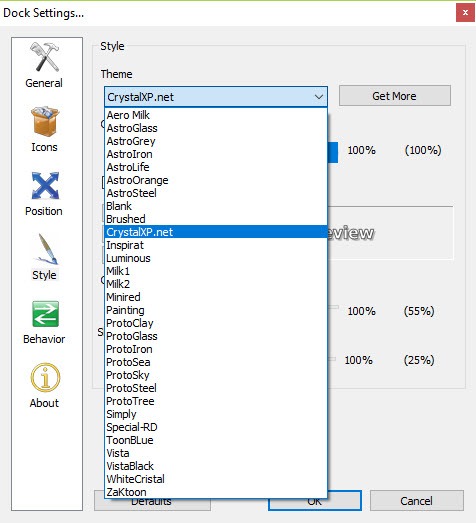
About RocketDock
A row of icons along one screen edge, hidden until the pointer approaches, magnifying under the cursor as you slide across them. That is RocketDock, and the description has not needed updating in a long time because neither has the program. Drag an application, a file or a folder onto it and you get a shortcut. Move the mouse away and the whole thing disappears.
The appeal is that it separates launching from window management. The system taskbar tries to do both and ends up crowded. A dock holds only the things you chose to put there, sits wherever you want it, and vanishes when you are not using it.
It shares the field with ObjectDock and a handful of others, and it has outlasted most of them by being free and undemanding, and endlessly reskinnable. The catch, which this review will come back to, is that outlasting is not the same as keeping up.
What actually gets stored when you drop something on
This trips people up, so it comes first. RocketDock does not copy anything. Each icon is a pointer to the original file or folder, much like a quick launch entry, and the dock stores no duplicate. Delete or move the original and you are left with an icon that does nothing.
The other half of that design is that dock items are not files themselves. You cannot drag one back onto the desktop or into a folder, because there is nothing there to drag.
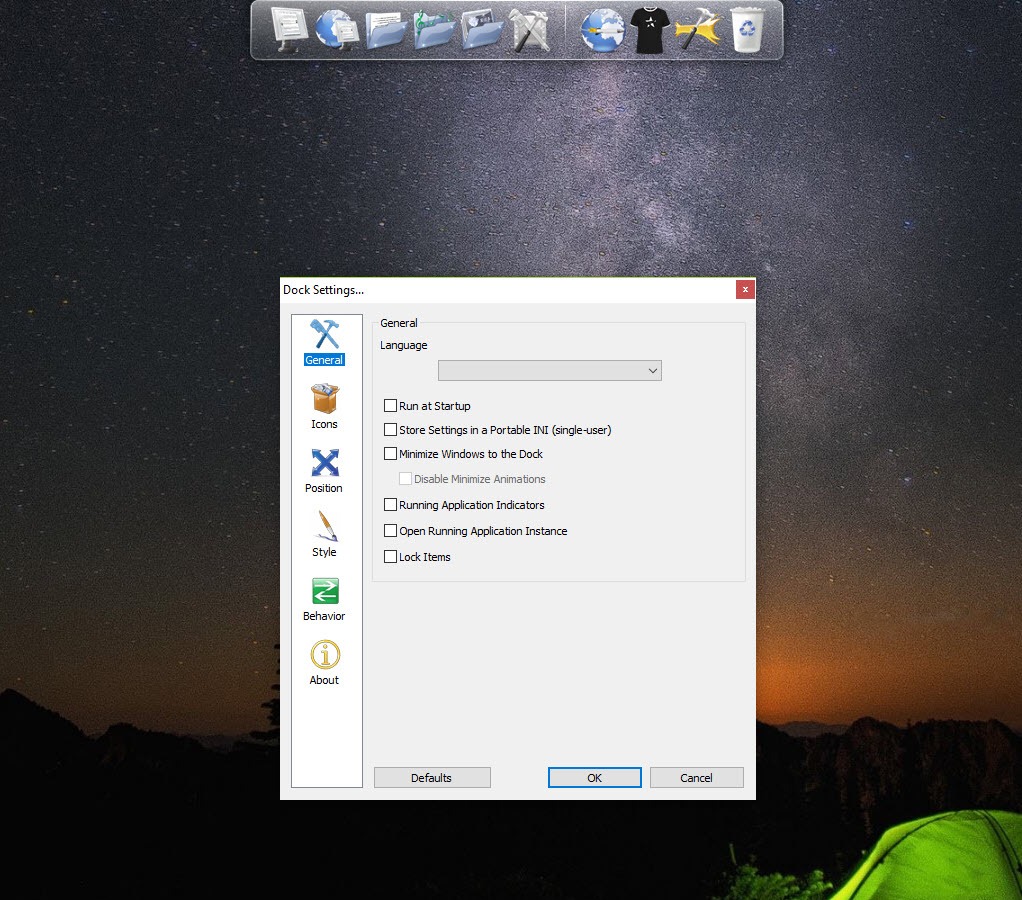
A Lock Items setting prevents accidental deletion or reordering, and holding Control while dragging overrides the lock when you actually mean it.
The zoom, and the settings nobody reads
Hover magnification is the signature, and it is more adjustable than most people discover. Maximum zoom size is configurable, and beyond the default bulging curve there is a plateau mode that flattens the peak so several icons enlarge together rather than one ballooning above its neighbours.
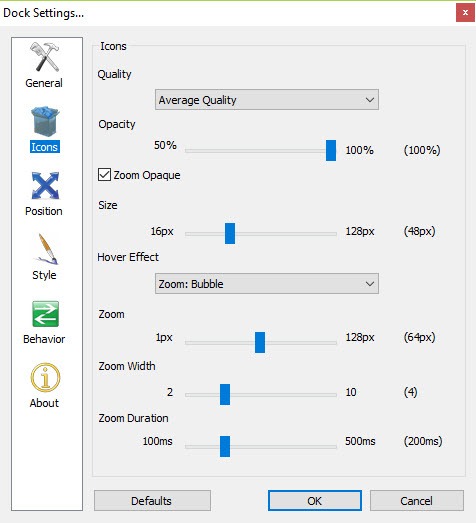
Underneath that sit the details. A rendering quality setting controls how icons are drawn while zooming, opacity can be lowered so the dock ghosts into the wallpaper, and a zoom-opaque option brings icons back to full solidity as they enlarge. Initial item size is separate from zoom size. Edge offset accepts negative values, letting you push the dock partly off screen so only the top of each icon shows until you hover.
Placement is equally granular. The dock attaches to any screen edge on any display, hides entirely until the pointer reaches that edge, and layering options decide whether it floats above open windows or sits beneath them.
Minimising windows into the dock
RocketDock can also take over from the taskbar. Open windows minimise into the dock as icons, running applications get a small indicator beside them, previews appear for open windows, and there is a setting to skip the minimise animation if the movement irritates you. A related option focuses an application’s existing window instead of starting a second copy, which is the behaviour you want from a launcher and rarely get.
This is the weakest half of the program though. The minimise and preview behaviour was built against an older window compositor, and on a current desktop it ranges from fine to visibly confused depending on the application.
If reshaping how the actual taskbar behaves is the goal, ExplorerPatcher works with the real thing rather than around it.
Docklets and the enormous skin pool
Docklets are the plugin format, and the bundled ones cover a clock, a recycle bin that changes icon when it has contents, plus volume and simple monitoring modules, and separators for grouping. It also loads docklets written for a rival dock, which widens the pool considerably.
Skins are the bigger story. RocketDock reads the skin formats of several older dock projects as well as its own, so a vast body of community artwork loads without conversion. Whether you want something that disappears into the wallpaper or a glossy shelf that dominates the screen, it has already been made.
If the shape itself is what you want to change, a radial dock that fans icons around the cursor takes a different approach entirely.
Living with a program that stopped being updated
Development ended, and the consequences are specific rather than vague. There is no per-monitor scaling awareness, so on a high-density display icons look soft and the dock sizes itself oddly, which is the single biggest reason people abandon it. Packaged applications from the system’s own store are not understood either, so those shortcuts need coaxing or do not work.
What still works is everything local and everything visual. Settings live in a plain configuration file beside the program, so a setup can be copied to another machine wholesale. If you are already replacing shell components, Open-Shell sits alongside it comfortably and the two together produce a desktop that behaves the way you decided rather than the way it shipped.
And it is worth asking whether a dock is what you actually need. If the goal is reaching a program in under a second, a keyboard launcher you type into beats any amount of mouse travel, and it does not care about display scaling at all.
Conclusion
RocketDock suits anyone who wants a launcher that looks how they want and asks almost nothing of the machine. On a standard-density display it still does its job cleanly, the customisation depth is out of proportion to the size of the program, and the pointer-based approach means uninstalling it leaves no mess behind.
Where it falls down is on modern hardware. A high-density screen makes it look tired in a way no setting fixes, the taskbar features belong to a desktop that no longer exists, and nothing will improve because nobody is working on it. Install it for the launching and the appearance, leave the window management to the system, and RocketDock remains a pleasant thing to have on a desktop rather than a piece of software you depend on.
Pros & Cons
- Icons are pointers rather than copies, so the dock adds nothing to disk and nothing to maintain
- Zoom is adjustable in shape as well as size, including a flat plateau curve
- Negative edge offset can tuck the dock partly off screen for a minimal footprint
- Auto-hide plus layering options let it coexist with maximised windows
- Loads docklets and skins built for other dock projects, so the customisation pool is huge
- Configuration sits in a plain file that can be copied between machines
- Focusing an existing window instead of launching a duplicate is a setting, not a guess
- No per-monitor scaling awareness, so icons soften badly on high-density displays
- Minimise-to-dock and window previews were built for an older compositor and behave unevenly
- Packaged applications from the system store are not properly understood
- Deleting an original file leaves a dead icon with no warning
- Dock entries cannot be dragged back out, since they are not files
- Development has ended, so none of the above is going to be fixed
Frequently asked questions
No. Each entry is a pointer to the original, so nothing is duplicated and nothing is backed up. Move or delete the original and the icon stops working, which is why you should never treat the dock as storage.
Because it has no per-monitor scaling awareness. The system scales the dock rather than the program drawing at native density, and the result softens. Raising the icon size setting helps a little and does not solve it.
Partly. It handles minimised windows, running indicators and previews, but that side of it was designed for an older desktop and is the least dependable part now. Most people keep the taskbar and use the dock purely for launching.
Many will. It reads the skin formats of several older dock projects alongside its own, which is why the available artwork is so plentiful compared with newer alternatives.
Yes. Settings are held in a plain configuration file next to the program, so copying that across carries your icons and sizes along with the appearance settings.


