

Bitcoin Core
About Bitcoin Core
Every wallet app shows you a balance. Almost all of them are taking someone else’s word for it, querying a server that promises the numbers are right. Bitcoin Core is the exception and the original. It downloads the entire blockchain, checks every transaction ever made against the network’s rules on your own hardware, and answers questions about your money from your own verified copy. Nobody’s word is taken for anything, which is the whole point of the exercise.
That makes this software two things in one. It’s a full node, meaning your machine becomes an independent, rule-enforcing participant in the network. And it’s a wallet, one aimed less at convenience than at people who want maximum control over exactly how their transactions are built and broadcast.
Be clear about what it isn’t before installing. There’s no exchange inside, no buying or selling, no support for any other cryptocurrency, and no hand-holding. A trading terminal like Qt Bitcoin Trader covers a completely different job.
What running a full node buys you
When a light wallet asks a remote server about your balance, that server learns which addresses interest you, and you trust its answers. A full node removes both problems at once. Your wallet queries your own database, so no third party learns anything about your addresses, and every rule (signatures, amounts, supply schedule) has been verified by your own machine rather than promised by someone else’s.
There’s a civic angle too. Each independent node makes the network harder to fool and more resilient, so people run Bitcoin Core on spare machines purely to strengthen the system, wallet unused.
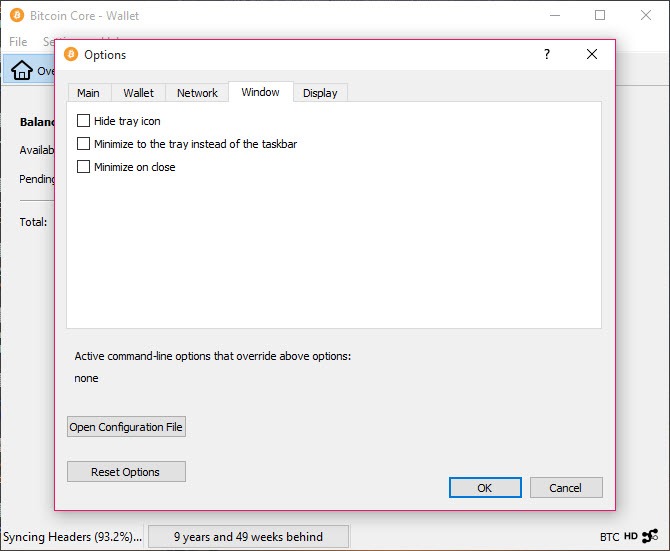
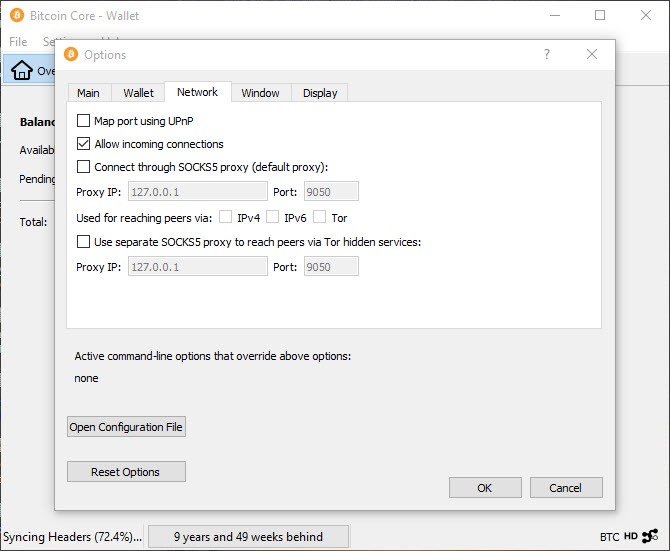
Built-in Tor support pushes the privacy further by hiding even your node’s network location from peers.
The initial sync, in honest numbers
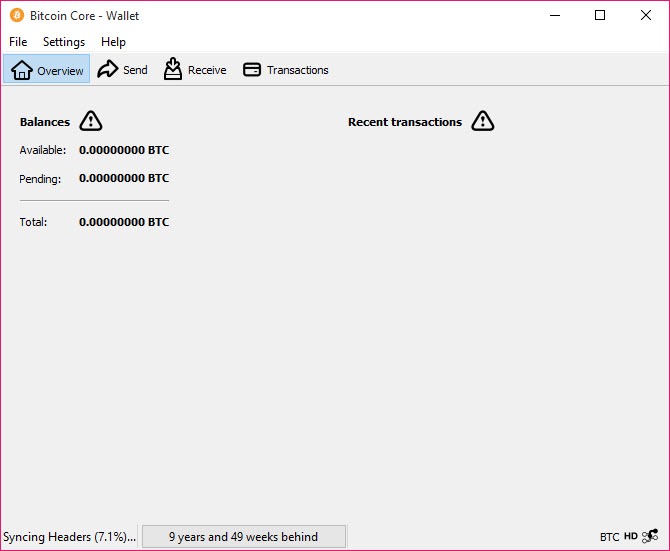
Now the part that filters out the casual. The blockchain has grown north of half a terabyte, and the first synchronization downloads and verifies all of it, block by block, from the very first one. On a machine with a fast SSD and good bandwidth, expect the better part of a day or more. On an old laptop with a spinning disk, expect days, plural. The application is polite about running in the background and resumes cleanly after a shutdown, but there’s no shortcut through the verification itself, because the verification is the product.
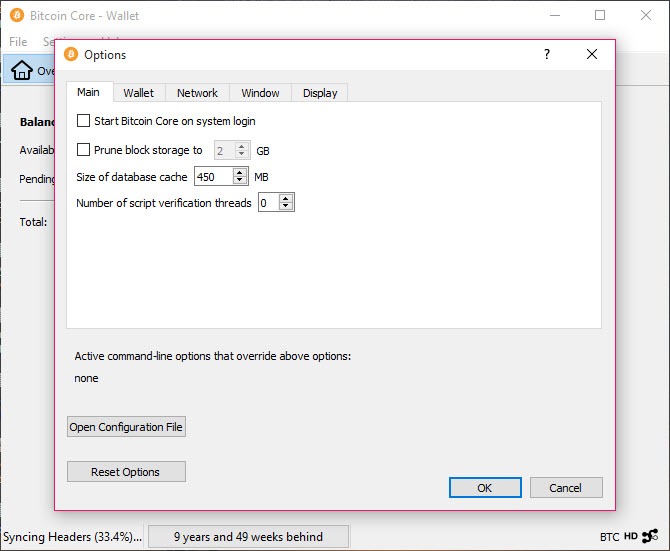
Pruning softens the storage blow considerably. With a pruned configuration, blocks are verified and then discarded, keeping disk usage down to a few gigabytes while your node still checks everything and your wallet still works.
You give up serving historical blocks to other nodes and a couple of rescan conveniences, a fair trade for most people on constrained hardware. Bandwidth deserves a thought as well, since a node uploads to peers indefinitely, so a metered connection will want the built-in upload limits configured on day one.
A wallet built for careful people
The wallet side rewards attention to detail. Coin control lets you choose exactly which pieces of your balance fund a payment, something privacy-conscious users rely on to avoid linking their financial history together. Fees are fully manual when you want them to be, and replace-by-fee can bump a transaction that’s stuck in a congested period. Multisignature setups and watch-only wallets are both supported, so you can track cold-storage funds without their keys ever touching an online machine.
Hardware wallet workflows run through partially signed transactions, the PSBT standard, where Bitcoin Core builds the transaction, an offline device signs it, and the node broadcasts the result. Wallet files can be encrypted with a passphrase, and backing up that wallet file somewhere protected (an encrypted container made with VeraCrypt is a reasonable home) is the step nobody should skip.
None of this is beginner-friendly, and it doesn’t pretend to be. Someone who wants a five-minute setup with a friendly interface is better served by Electrum, which delivers most of the wallet features without the blockchain download by trusting servers instead. That trade, convenience against independence, is exactly the line between the two programs.
Plain looks, deep plumbing
The interface is functional and gray, closer to a database tool than a consumer app. Send, receive, transaction list, a console, and settings. The console matters more than it looks, because the full RPC interface lives behind it, the same one the bitcoin-cli command-line tool exposes. Developers and tinkerers script the node, query any block or transaction, and build services on top of it, which is why so many tools in the wider ecosystem quietly run on top of this program.
The honest downsides are the ones already implied. Storage and sync demands rule out weak machines unless pruning is used. The wallet’s power assumes you know why you’d want coin control in the first place.
And there is no customer support desk, only documentation and community knowledge, which suits the self-reliant and frustrates everyone else.
Conclusion
Bitcoin Core is for the person who takes the phrase “don’t trust, verify” literally. Long-term holders who want their own copy of the truth, privacy-minded users tired of leaking addresses to strangers’ servers, developers building on the RPC interface, and volunteers strengthening the network from a spare machine all qualify. For them, nothing else fully substitutes.
Everyone else should be honest about the costs. The disk, the sync time, and the learning curve buy independence, not convenience. If you mainly want to send and receive with minimal fuss, a light wallet gets you there in minutes, and this node will still be here when your standards change.
Pros & Cons
- Fully independent verification of every rule, with no trusted third party
- Wallet queries stay on your machine, revealing nothing to outside servers
- Coin control, manual fees, replace-by-fee, multisig, and watch-only wallets
- PSBT support integrates hardware wallets into a clean offline signing flow
- Pruning mode cuts storage from hundreds of gigabytes to a few
- Built-in Tor support and a full RPC interface for scripting
- Initial sync takes from many hours to days depending on hardware
- Full archive demands over half a terabyte of disk and constant bandwidth
- No exchange features and no support for other cryptocurrencies
- Interface and concepts assume real technical comfort
Frequently asked questions
A full archival node currently needs well over half a terabyte, and the figure grows continuously. Pruned mode verifies everything but keeps only recent data, running comfortably in a few gigabytes.
Anywhere from most of a day on fast hardware with a quick connection to several days on older machines. The node verifies every historical block itself, and that work can't be skipped.
Yes, through partially signed transactions. The node prepares the transaction, the hardware device signs it offline, and the node broadcasts the signed result, so keys never touch the online machine.
No. It handles bitcoin only, by design, and nothing else will ever appear in it. Multi-asset needs point you toward entirely different software.
Yes, enabling pruning discards old block data while keeping validation intact. Going back from pruned to full archive, however, means downloading the chain again.


