

simplewall
About simplewall
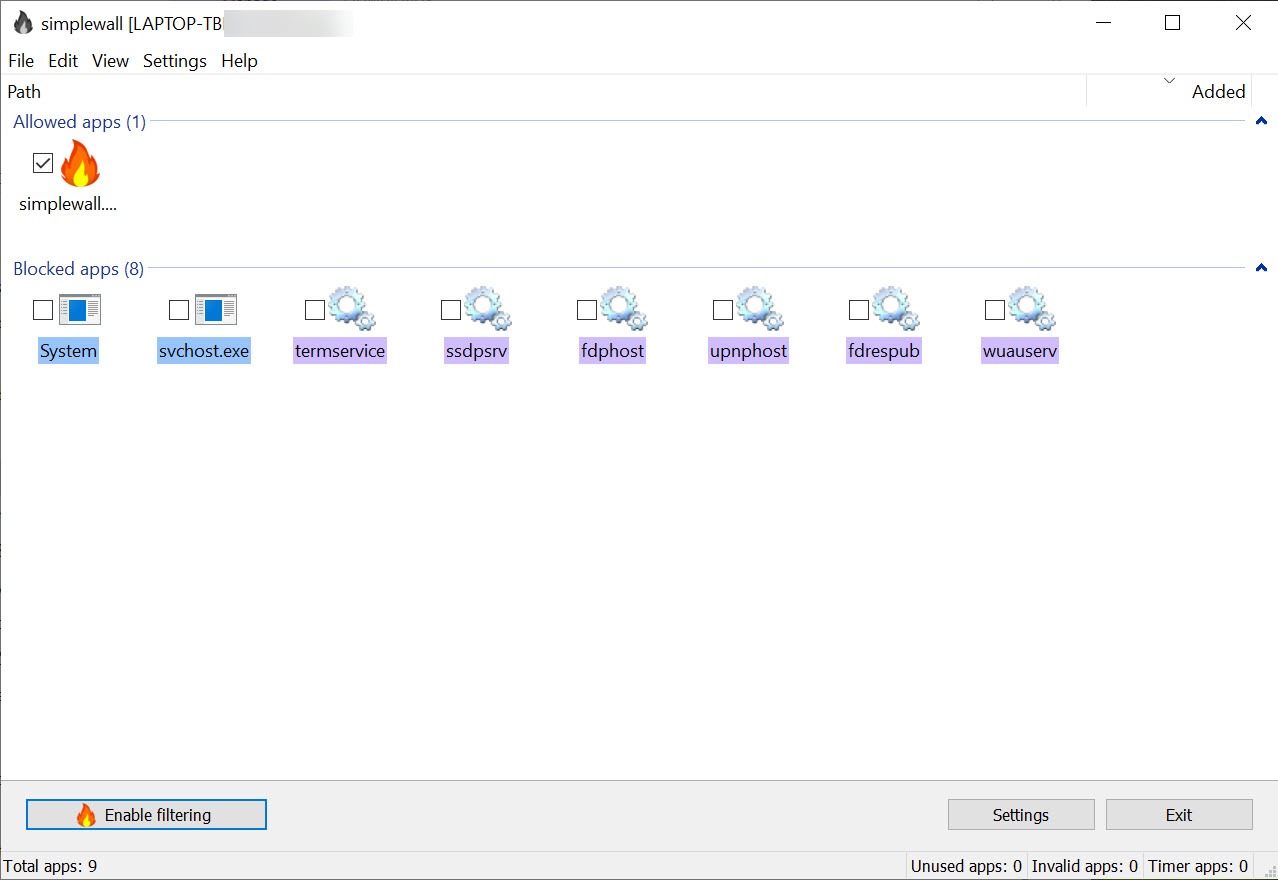
simplewall is the lightweight Windows firewall that sits on top of the operating system’s own Windows Filtering Platform and turns it into something genuinely usable. Where the built-in Windows Defender Firewall is functional but buried behind layers of legacy UI, simplewall exposes per-application connection control through a clean interface that fits on a single screen, with notifications when new applications try to reach the network and a clear log of what got blocked.
The application is open-source, free, runs as a single executable with optional installation, and does not install kernel drivers or replace the built-in firewall stack.
What makes the application particularly interesting is the architecture choice. Many third-party Windows firewalls (Comodo, ZoneAlarm, classic Outpost) install their own kernel drivers, hook into the network stack at a low level, and effectively replace the built-in firewall mechanisms. simplewall does the opposite.
It programs Windows Filtering Platform rules through the documented API the operating system already provides, which means no driver conflicts, no boot-time stability concerns, and no parallel firewall stack to fight with the official one. The trade-off is that it only does what WFP supports, which turns out to be most of what users actually want.
How WFP-based firewalls actually work
The Windows Filtering Platform is the kernel-level component the operating system itself uses for network filtering. Both the built-in firewall and the routing decisions happen through WFP layers, and Microsoft exposes the APIs to third-party applications that want to program rules at the same layers. simplewall is essentially a user-friendly configuration tool for WFP rules, applying allow and block decisions per-process based on a managed rule set.
The practical implication is significant. Because the rules live inside the OS firewall layer, they survive uninstalling or stopping the application. simplewall can be set to keep its rules active even when the application is closed, leaving the firewall protection in place without any process running. This is the opposite of how traditional firewall suites work, where stopping the service typically disables protection.
The same architecture is used by TinyWall and Fort Firewall, which are the two most direct alternatives. All three share the WFP foundation but differ significantly in UI philosophy, default behavior, and feature emphasis.
For users who specifically want a more comprehensive security suite with antivirus and firewall combined, Comodo Internet Security takes the traditional kernel-driver approach with a much heavier installation.
Notification mode and the per-app workflow
The default workflow is notification-based. When an application tries to make a network connection that does not match an existing rule, simplewall intercepts the attempt and shows a popup asking what to do. The popup includes the application name, the full path to the executable, the destination IP, the port, and any additional context the system can extract. You choose Allow, Block, Allow Once, or Block Once, and the decision either becomes a permanent rule or applies only to that connection attempt.
The notifications stay visible until acted upon, which is a deliberate choice. Some users find this disruptive. Others appreciate that the application does not auto-decide and leave them wondering what happened. There is a quiet mode that converts unhandled connections to silent blocks instead of prompts, useful once the rule set has settled into a known state.
Building a rule set takes a few days of normal use. The first session is busy with notifications as every installed application tries to connect to its various servers. By the third or fourth day the prompts taper off because most legitimate applications have been configured.
From there the firewall mostly stays quiet, prompting only when a new application is installed or an existing one tries to reach a new destination.
Block lists and the telemetry question
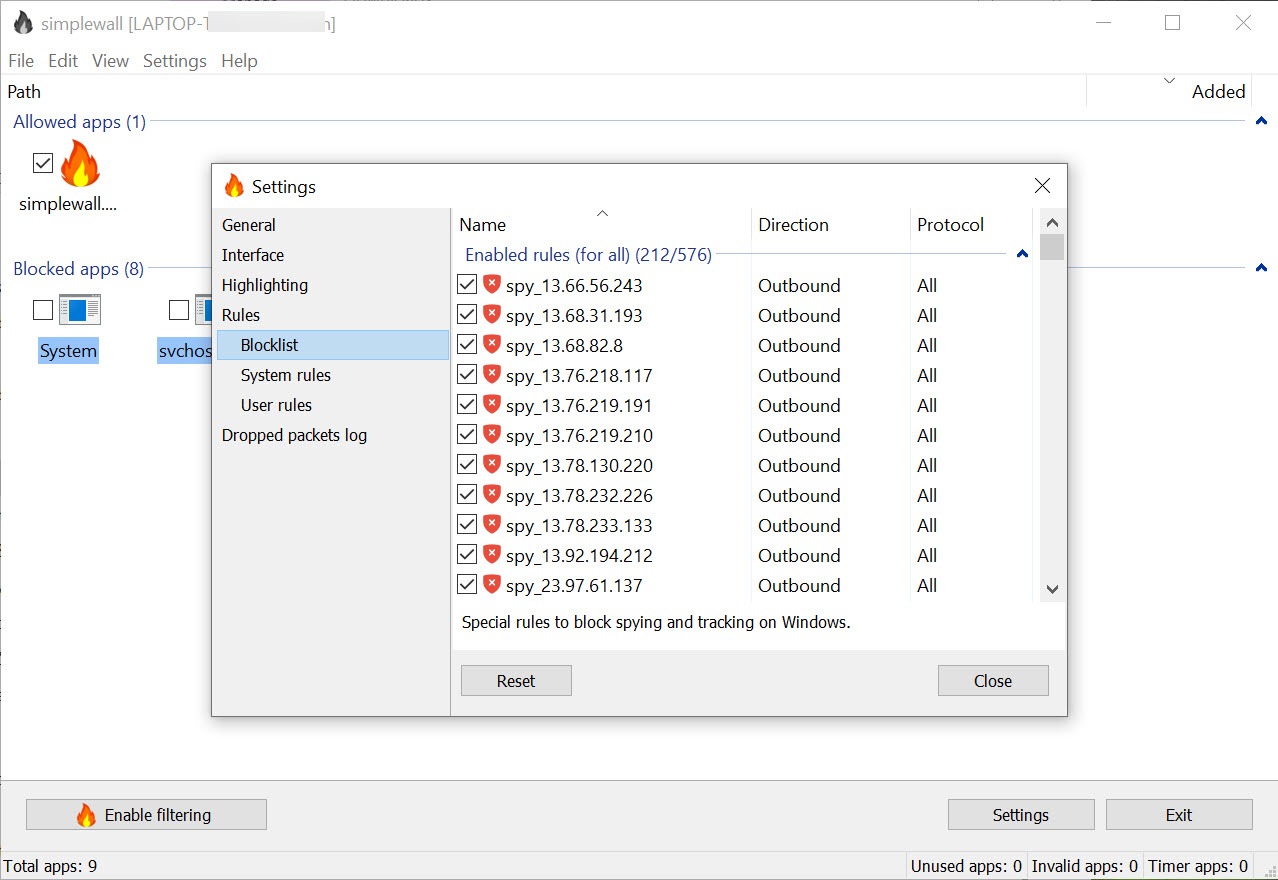
A feature that distinguishes simplewall from minimalist competitors is its support for block lists. These are downloadable lists of known telemetry endpoints, advertising networks, tracking domains, and Microsoft services that some users prefer to silence. The application can subscribe to community-maintained lists and block all matching destinations automatically.
The most popular use is Windows telemetry blocking. Microsoft’s diagnostic data collection generates a constant background traffic that some users prefer to disable. The block lists target the specific endpoints involved, allowing simplewall to silence telemetry without breaking application functionality. The same lists can target advertising networks, social media trackers, or specific software phone-home behaviors.
This is genuinely useful but worth being thoughtful about. Aggressive block list use can break functionality in ways that are hard to diagnose later. Windows updates, certain Edge browser features, and some Microsoft Store applications depend on telemetry endpoints to function correctly.
The application logs every block, so when something stops working, the logs usually identify which blocked connection is responsible. For deeper network traffic analysis when troubleshooting block list interactions, Wireshark provides the packet-level visibility that simplewall‘s logs do not include.
Profile system and rule management
Rules in simplewall are organized into profiles. The Apps profile holds per-application rules built from notifications and manual additions. System Rules hold protocol-level decisions (block all IPv6, allow only specific ports, restrict ICMP). Network Rules handle subnet and IP-range decisions. Packages handles the modern Windows store applications which behave differently from traditional executables.
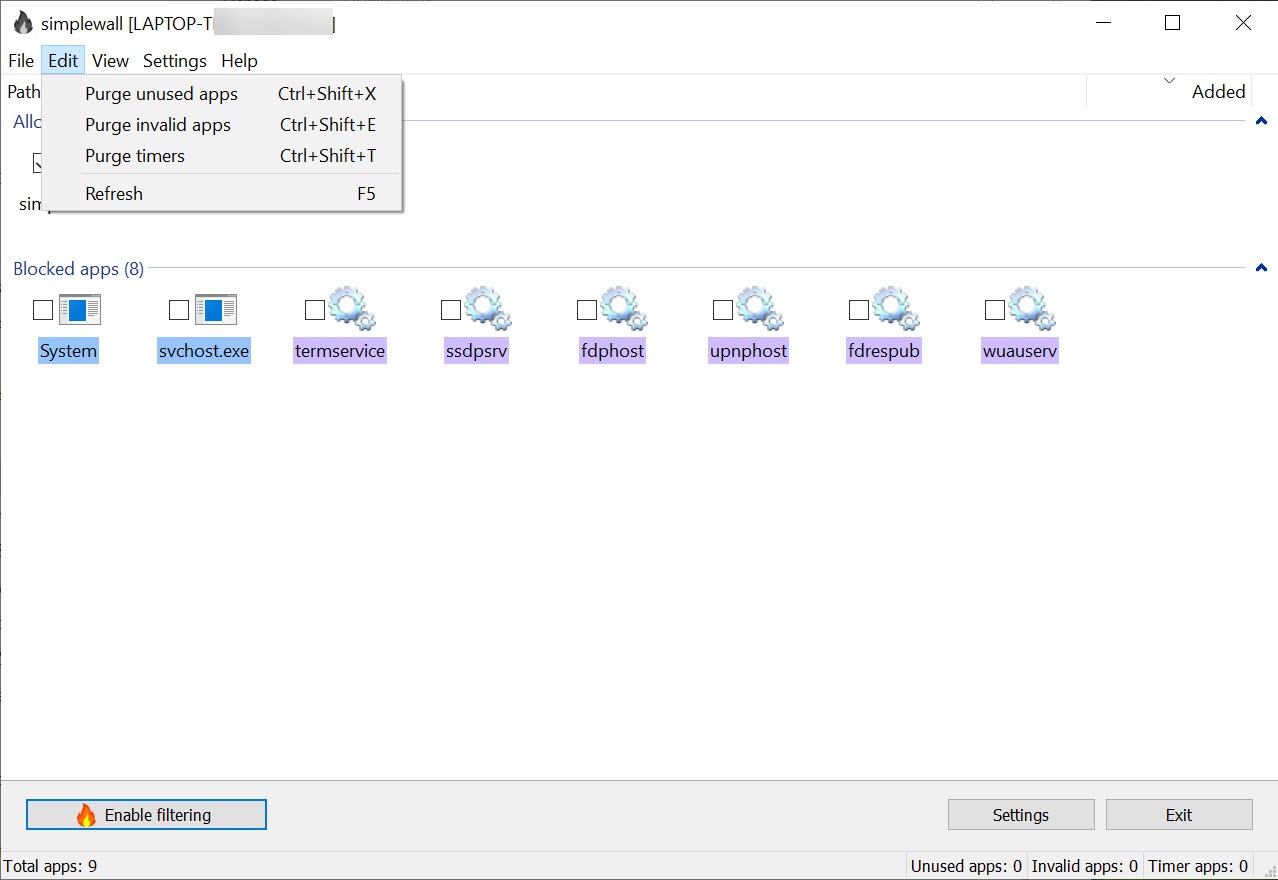
Each rule can have its own enable/disable state, allowing temporary exceptions without losing the configuration. The application also supports rule import and export through XML files, which means you can build a rule set on one machine and transfer it to others. This is useful for managing multiple PCs or for backing up a configuration before experiments.
A specific behavior worth knowing about is the time-limited rules. You can set a rule to allow a connection for a defined period (one hour, one day) after which the rule expires automatically. This is useful for one-time downloads or temporary access that should not become permanent.
Power users of network analysis tools like GlassWire use the time-limited approach to grant temporary access during active monitoring sessions.
Comparison to TinyWall and Fort Firewall
The three WFP-based firewalls cover similar ground with different design philosophies, and the comparison comes up constantly in forums. simplewall sits between TinyWall’s extreme minimalism and Fort Firewall’s more feature-rich approach.
TinyWall is the most minimal of the three. It does not show notifications by default, instead relying on an autolearn mode that grants access to whitelisted applications. The interface is more sparse, the rule management is simpler, and the application emphasizes silent operation. Users who want a firewall that essentially configures itself and stays out of the way often prefer this approach.
Fort Firewall is more feature-rich, with rate limiting, traffic statistics, and more detailed rule definitions. The interface is denser, the configuration depth is greater, and the application targets users who want more visibility into network traffic alongside the firewall rules.
simplewall balances between these two. The notification workflow is more present than TinyWall’s silent autolearn, but the feature set is more focused than Fort Firewall’s broader scope. For users who want to see what their PC is doing on the network and make decisions about it, simplewall offers the right level of visibility without becoming a full traffic monitoring tool.
For users who specifically want to block individual applications without thinking about WFP rules at all, Firewall App Blocker is the simplest possible interface over the same Windows firewall functionality.
Logging and the audit trail
Every blocked connection (and optionally every allowed connection) writes to the application log. The log shows timestamp, source process, destination IP, port, protocol, and the rule that triggered the decision. This is genuinely useful for troubleshooting and for understanding what happens on your machine over time.
Common uses include identifying applications that try to reach unexpected destinations, finding which blocked connection broke a specific feature, and understanding background traffic patterns. The log is searchable and filterable, with export options to CSV for users who want to analyze patterns in spreadsheet tools.
A specific use case is finding misbehaving software. An application that quietly tries to reach hundreds of domains per session shows up clearly in the log. Some users discover that supposedly offline tools have aggressive telemetry behavior that the log makes visible. The information is not always actionable but it changes how you think about what is installed.
The portable mode and single-executable architecture
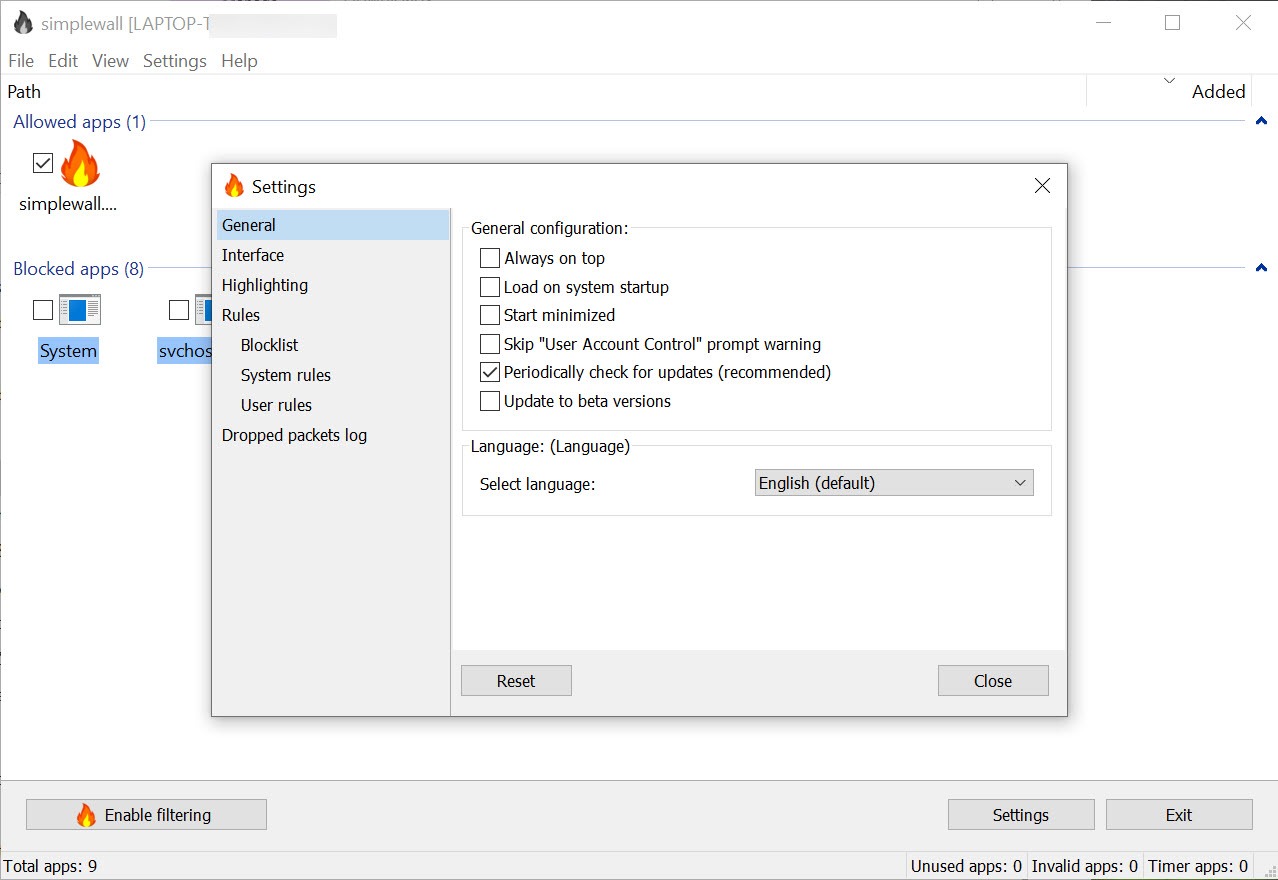
simplewall can run as a portable application, with all configuration stored in a single file alongside the executable rather than in the system registry. This is useful for several scenarios. Running from a USB drive without installation, keeping multiple configurations on the same system, or experimenting with rules without committing to system-wide changes.
The portable mode is also useful for system imaging scenarios. The rule configuration travels with the executable, so deploying a known-good firewall configuration to multiple machines is as simple as copying the folder. The same approach works for backup, where a single file captures the entire firewall state.
The application itself is small. The download is a few megabytes, the installation footprint is minimal, and memory usage during operation is light. This is the opposite of how traditional security suites size up, and the difference becomes noticeable on systems where every megabyte of background memory matters. Compared to the heavier monitoring approach of full traffic analyzers, simplewall focuses on rule enforcement rather than visualization.
Real limitations
The application does what WFP supports, and WFP has limits. It cannot inspect packet contents (deep packet inspection requires kernel driver access that traditional firewall suites use). It cannot block connections based on process behavior or heuristic threat detection. It does not include antivirus, intrusion detection, or any of the broader security capabilities that suites like Comodo bundle. Users who want those capabilities need to pair simplewall with separate tools.
The user interface is functional but unpolished. It has improved over the years but the visual style retains a utilitarian quality that polished commercial firewalls do not have. Configuration depth is solid but discovering all the settings requires reading the documentation rather than clicking through menus intuitively.
There is also a learning curve to using the firewall well. Understanding when to allow versus block, building a useful rule set, and managing the notification interruptions while the rule set settles all take time. New users sometimes block essential Windows services and break network functionality, requiring rollback or whitelist additions.
The application provides default rules for common Windows services, but the defaults are conservative and some legitimate background services still trigger prompts.
Conclusion
simplewall is the right choice for Windows users who want meaningful per-application firewall control without installing a heavyweight security suite. The WFP-based architecture is fundamentally sound, the notification workflow gives users actual visibility into what their machine does on the network, and the block list support handles the common privacy concerns about Windows telemetry and advertising trackers. For users willing to spend a few days building a rule set, the application produces a quieter and more controlled network behavior than any default Windows configuration provides.
The application is not the right choice for users who want a turnkey security suite with antivirus, intrusion detection, and deep packet inspection bundled together. The WFP architecture has clear limits and simplewall does not pretend to exceed them. For its specific niche, however, the combination of openness, low resource use, and genuine user control makes it one of the more respected firewall alternatives available outside the commercial security industry.
Pros & Cons
- WFP-based architecture coexists with the built-in Windows firewall without driver conflicts
- Per-application notifications let you build a rule set based on actual usage rather than guesswork
- Block lists handle Windows telemetry, advertising, and tracking endpoints in bulk
- Rules persist when the application is closed, keeping protection active without a running process
- Portable mode allows running from USB or maintaining multiple configurations on one system
- Open source with active development on GitHub, including community contributions
- Cannot perform deep packet inspection or heuristic threat detection like traditional firewall suites
- Initial notification burst during the first days of use is disruptive while the rule set settles
- Aggressive block list use can break Windows features in ways that are hard to diagnose
- Interface design is functional rather than polished compared to commercial alternatives
- No antivirus or broader security suite features, requiring pairing with separate security tools
- Learning curve for users who have not configured a per-application firewall before
Frequently asked questions
The application provides a clean per-application interface, notifications for new connection attempts, block list support for telemetry and tracking endpoints, and a usable log of what gets blocked. The built-in firewall has the underlying capability but exposes it through a much more cumbersome interface.
No. The application programs rules through the Windows Filtering Platform that the built-in firewall also uses, so the two coexist. simplewall essentially provides a better interface to the same underlying filtering capability.
All three are WFP-based firewalls with different design philosophies. TinyWall emphasizes silent autolearn operation, Fort Firewall provides more detailed traffic statistics, and simplewall balances between with a notification-based per-application workflow.
Yes, through its block list feature. Community-maintained lists target the specific endpoints Microsoft uses for diagnostic data collection. Subscribe to a telemetry-blocking list and the application silences those connections automatically.
Yes, when configured to persist rules. The rules live inside the Windows Filtering Platform and remain active without requiring the simplewall process to be running. Closing the application does not weaken the firewall.
Yes, with the standard caveat about firewalls in general. Aggressive blocking can break specific applications, and learning what to allow takes a few days of normal use. The application logs every block, so troubleshooting broken features is straightforward.
Yes. The application does not include antivirus features and does not conflict with separate AV software. Many users pair it with their preferred antivirus or anti-malware tool for layered protection. What happens when I uninstall simplewall? The application can be configured to either keep its rules active in Windows Filtering Platform after uninstall or remove them entirely. The default removes the rules during uninstall, restoring the system to the pre-simplewall firewall state.


Small and great, thanks.
The best firewall for Windows! Free, open source, simple to use, and very effective. It is much better than the rest! Too bad it doesn’t exist for Linux.